I don't know when exactly Africa became a hot destination for evangelical concern. It might have been Bruce Prayer of Jabez Wilkinson's 2002 move to Johannesburg and later Swaziland to start Dream for Africa, a ministry to orphans. Or perhaps it was Bono's December 2002 seven-states-in-seven-days Heart of America tour, when he visited venerable evangelical institutions like Willow Creek and Wheaton College, scolding them for ignoring the HIV/AIDS pandemic. Or maybe it was Rick Warren's 2005 foray into Rwanda to promote his PEACE Plan and create a purpose-driven country.
Surely a constellation of circumstances raised Africa's profile. But it didn't hurt that celebrities whom evangelicals trusted leveraged their considerable influence. Lost in the media hype that celebrities create was one "celebrity" and one famous church taking a different approach: Bill Hybels and his Willow Creek Community Church in suburban Chicago.
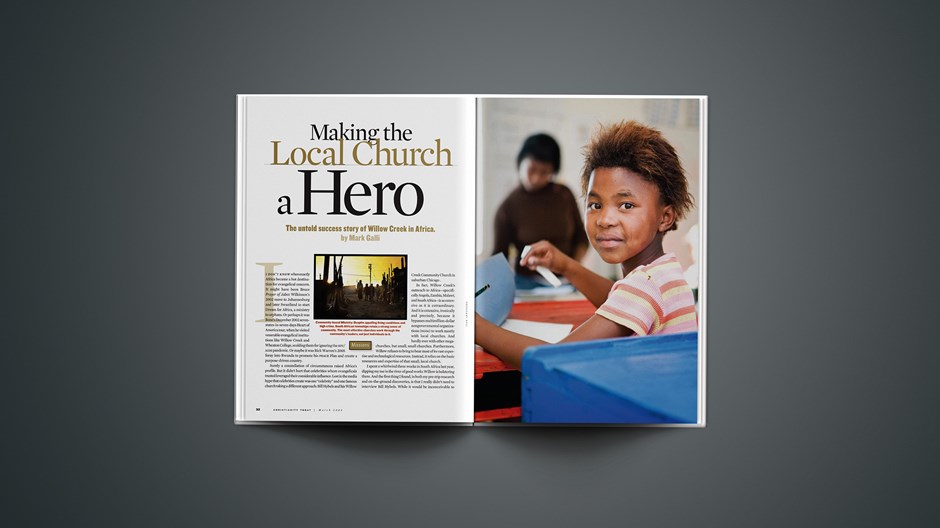
In fact, Willow Creek's outreach to Africa—specifically Angola, Zambia, Malawi, and South Africa—is as extensive as it is extraordinary. And it is extensive, ironically and precisely, because it bypasses multimillion-dollar nongovernmental organizations (NGOs) to work mostly with local churches. And hardly ever with other megachurches, but small, small churches. Furthermore, Willow refuses to bring to bear most of its vast expertise and technological resources. Instead, it relies on the basic resources and expertise of that small, local church.
I spent a whirlwind three weeks in South Africa last year, dipping my toe in the river of good works Willow is bolstering there. And the first thing I found, in both my pre-trip research and on-the-ground discoveries, is that I really didn't need to interview Bill Hybels. While it would be inconceivable to do a story about Saddleback Church's work in Africa without talking to head pastor Rick Warren, it is unnecessary to talk with the senior pastor of Willow. In fact, when talking with Willow-supported ministries in Africa, the church very quickly fades into the background.
While Willow's contribution to these ministries is vital, the megachurch's role is nearly invisible. Willow is not the first or only church to practice a church-to-church ministry model. It does its homework and monitors "metrics of success" like the best of them. But how it partners with local churches, and its insistence on staying in the background, is a model that can be replicated by many more churches.
In the early 1990s, when it came to overseas ministry, Willow worked closely with several larger NGOs. But in the late '90s, it began to rethink its philosophy. "We said that if we believe the local church is the hope of the world, which is the mantra of Willow," says Warren Beach, director of Willow's Global Connections ministry, "then why would we not be more focused on building relationships with our brothers and sisters who are in the foxholes on the frontlines fighting against global poverty and AIDS and reclaiming their communities for Christ?"
So Willow started looking for overseas churches who were "practitioners"—those "already in the game," as Beach puts it. He quotes 2 Chronicles 16:9: "For the eyes of the Lord range throughout the earth to strengthen those whose hearts are fully committed to him."
"That was our prayer," he says. "To find where God was working in local churches, and come alongside and provide some resources appropriately without creating dependency."
Willow began looking for churches that were reaching out, regardless of whether Willow would support them or not. "They are not waiting for the West to come in with resources," says Beach. "They are looking inside and saying: What has God given our community to address? Do we have a teacher who can do a preschool or a mentoring class after school? Do we have an entrepreneur who can talk to the youth about business skills? Those are the folks that set our hearts aflutter."
Willow began doing this in the Dominican Republic, then in Costa Rica.
In 2004, Lynne Hybels came back from a trip to Africa overwhelmed by the staggering needs that the HIV/AIDS pandemic left in its wake. "Why aren't we doing anything there?" she asked Willow's leadership. "If we're going to be the church, how could we face God someday without having addressed HIV/AIDS and what's happening in sub-Saharan Africa?"
And so began Willow's work in Africa. Well, except for the fact that it is not Willow's work. It's the work of Africans, and "our sweet spot is the local church," as Beach puts it. In particular, Willow looks for churches with "good leadership," says Beach, "hopefully black leadership, in tough situations, congregations that are mobilized to some degree around HIV/AIDS and the social realities there, with a little bit of a track record of effectiveness."
It wasn't long before Willow found enough such ministries that it could spend over $2 million a year in Africa.
Article continues below
Africans Already in the Game
Willow could jump-start this new emphasis because it already had connections in South Africa. The Willow Creek Association holds leadership conferences that currently attract some 5,000 South Africans each year. It was only natural to turn to this network to find churches that were "already in the game."
"We like to work with people first before providing any form of funding," says Willow Creek Association's Southern Africa head, Gerry Couchman. "We get to know the person, we get to know his integrity. We've seen what they are trying to do on their own with very limited resources."
In the last four years, the association has found 28 projects to come alongside. I visited three. Or was it six?
In Cape Town, for example, Lerato's Hope is the nonprofit arm of Pinelands Baptist Church. It partners with existing grassroots organizations that care for, treat, and support poor families affected by AIDS in the townships of Gugulethu, Nyanga, Crossroads, and Philippi.
These areas are home to half a million people, whose salient statistics include the following: The average household earns less than $8 a day; unemployment stands at 60 percent; there are 409 Christian places of worship but 819 liquor outlets; more than 30 percent of all deaths are AIDS-related; and over 50 percent of the population lives in shacks.
Lerato's Hope is named after a young girl. Eight years ago, she was an 18-month-old baby who had been brought to a children's home called Beautiful Gate. Some of Pineland Baptist's families had been running a Sunday school there, and had been taking the residents on outings and forming relationships with the children. But this child, Lerato, was not doing well. She was too weak to talk or walk because she was dying of AIDS.
This was before the days of the widespread use of antiretrovirals (ARVS) in Africa, so no one had much hope for Lerato. When one of the church families began visiting Lerato regularly as she lay in a hospital bed, the doctors told the family not to trouble themselves, that she was going to die. The family refused to accept that: "And if she is going to die," they said, "she's going to die being held and loved."
They continued a loving bedside vigil—and miraculously, Lerato began to recover. Today she is a strong 10-year-old. Her story not only electrified the church but the local community as well. And Lerato's Hope was born.
Lerato, of course, was but the proverbial tip of the iceberg of South Africa's immense needs, which are so great and desperate that no one in South Africa imagines they can do it alone. So people form partnerships. And the partnerships form partnerships. (It's all very confusing when you are trying to sort things out as a journalist.) Willow is just one of Lerato's partners. Lerato in turn partners with other organizations to reach out to the townships in its area. Hence my confusion about whether I was visiting three or six projects.
Article continues below
For example, Lerato partners with Izandla Zethemba. To get to this project, we drive down Klipfontein Road, moving within a few kilometers from a wealthy area—one of the richest in the country, with clean, well-paved roads, sparkling, upscale shopping centers, and prestigious private schools—into severely impoverished areas. We pull into a pot-holed parking lot and drive up to a green building, with no landscaping and windows and doors covered with bars.
We step into a large room that shows signs of children having recently been there, with art on the walls and craft projects in process. Apparently the children are off at school, explain a young man and woman, Xolile and Unathi, students who have taken a year off from university to work at Izandla.
Izandla is a nonprofit started by Khanyisa Community Church that works with 40 orphaned and vulnerable children and over 80 families from the local community. It gives out food parcels and offers HIV prevention programs and support groups.
If it sounds like Izandla is doing a lot, it is. Yet there is so much more need. That leaves Xolile frustrated some days: "When you go to visit and then you find out there's so much need, you just wish that you could take their suffering away."
Unathi identifies with him: "Sometimes you deal with a situation where you find a kid needs more help than you can do anything about. I feel helpless because I don't know what to do, because the situation is hard enough to handle by myself."
But they are in the game, according to Lerato executive director Rowan Haarhoff: "To find people in these communities who will give as much time and effort as these two—it's very difficult," he says. "But these two are taking a year of their life, no salary. It's huge."
We drive down Klipfontein Road a few more kilometers. The shopping centers at the beginning have turned into row upon row of shacks made of any material that can be thrown together—plywood, corrugated tin, concrete blocks. We turn into a deeply rutted dirt road and enter a settlement built on a rubbish heap. We bounce along slowly through the community, called Barcelona, among its 2,000 shacks. The smell of the community—the familiar scent of rotting garbage—seeps into the car even though the windows are rolled up.
Article continues below
In the middle of Barcelona, we come to a newly constructed cement building. It's the headquarters of Ubuntu. We meet Cobi De Bonte, a Dutch woman who manages the project, and Mama Beauty, a black South African who acts as the "community mother."
Ubuntu ministers to children affected by deep poverty and HIV/AIDS. There's a breakfast club for children (without which they would go to school hungry). Forty to fifty children are fed—every morning. Ubuntu also makes possible a drama club, a gospel choir, a soccer club, and a youth group—all organized by members of the community. If it weren't for such activities, kids would be wandering aimlessly in the community, subject to both neglect and abuse.
Most of all, Ubuntu supplies a "safety mother." Mama Beauty lives in the community so she can be available when sudden needs arise, such as during the previous night, when she gave shelter to a mother and three children who had been kicked out of their shack by the boyfriend/husband. Other times she becomes a caregiver for a mother who has to go to the hospital or look for a job.
De Bonte says, "This is a township, and a township is chaos. One day you have a job. The next day you're sick. The third you are gone to another township. We are living in the middle of chaos."
"Basically these two are the cornerstone of this organization," Haarhoff says. "If they disappear, the organization disappears. It's that simple."
Two more people in the game.
A half-hour later we are at Beautiful Gate. The environment has taken a definite step up, as we're now in a community of modest houses and businesses. Beautiful Gate is surrounded by a security fence, and once inside, the scene is remarkable. Any North American would breathe a sigh of relief in this modern building—clean, well-lit, large, with the air of efficiency. Obviously a well-funded ministry.
And one, like the others I've seen, that is biblically driven. In this case, the name originates with a passage in Acts 3, where a man crippled since birth lies at the temple gate called Beautiful. When he asks Peter and John for money, Peter replies, "Silver or gold I do not have, but what I have I give you. In the name of Jesus Christ of Nazareth, walk."
Beautiful Gate's particular ministry is putting families back together. "We believe that the best place for each child is within a family," says its website, "and that the best way to support families is to enable their community to provide support."
Article continues below
The ministry estimates that out of a population of about 230,000 in its immediate area, some 63,000 people are HIV-positive. The ravages of the disease include thousands of children abandoned by parents who are unable or unwilling to look after them. Beautiful Gate takes in these children and gives them a temporary home while trying to reunite them with their parents or extended families.
Director Vaughan Stannard says that from the children's point of view, their situation is not about the effects of a lethal disease, as bad as that might be. "The majority of children here are not concerned about HIV," says Stannard. "The majority of children here are concerned about the fact that they don't have a mommy or daddy."
Since reuniting families doesn't happen overnight, the ministry offers a variety of services to care for children, everything from after-school programs to food distribution to medical care. For the children who live there for a few weeks or months, Lerato's Hope has some 20 volunteers who take the children on picnics, boat rides, and other excursions.
One morning's visit revealed three of Pinelands Baptist Church's ministries, supported through its Lerato's Hope extension. With a modest $45,000 budget, Lerato's Hope employs a few staff to oversee more than 50 volunteers. Together, they touch hundreds of vulnerable lives each year.
With a track record like that, it's no wonder Willow comes alongside—in this case, paying for a van to transport people and food parcels, subsidizing salaries and food distribution, and so forth.
Testing, Testing
Lerato is heavily committed to grassroots organizations. Other projects focus on other needs.
On my visit, I met with pastor John Maloma of Seeker's Tower Ministries in Vereeniging, an industrial city just south of Johannesburg. When I pull up in front of the storefront entrance in my rental car, Maloma, a business-executive-turned-pastor, greets me. Though the street is practically deserted, he tells me to drive around back so I can park the car in a well-protected lot.
He shows me his worship center, a large multipurpose room with rows of chairs. The church has grown from five members to over 400, and includes a plentiful collection of Africans from Nigeria, Zambia, Zimbabwe, and Congo. All hope to work in South Africa's relatively prosperous economy. They also come because the church openly talks about HIV and works with people who have tested positive for the antibodies.
Article continues below
In fact, the church is on a mission to find more such people. Seeker's Tower offers free testing for HIV, as well as counseling for those who discover they test positive. The church was testing between 40 and 60 a month at the time Willow heard about its work. When Seeker's Tower described how many more people it could test if it had a mobile unit, Willow didn't blink. It helped the church buy a new trailer. In the first full month of mobile testing, the number jumped to over 300 tests administered.
Another ministry with another emphasis is Table View Assembly of God and its SALT ("Sharing Abundant Life Together") ministry. What this Cape Town NGO does—distribute food to hungry people in the townships—may not seem extraordinary, until you realize that with upwards of 40 percent unemployment, there's not a lot of money for people to buy food. Malnutrition is rampant. And buying food for the hungry is not a government priority. If local churches and other community organizations didn't collect and distribute food, people simply would not eat. As my trip evolved, it became clearer to me why every church I visited in South Africa had a food ministry. Not a once-a-year collection at Christmas, and not a once-a-month donation to a food closet, but daily donations. People bring food in, and church volunteers take food to the townships every day of the year.
Table View is one of those churches. When I visited the church, it had just filled a fellowship hall with food and emptied it again at a time when riots had left many foreigners homeless and hungry. Aside from that crisis, SALT day to day collects and distributes food for township families.
Willow was interested in this project not primarily because of hunger, though, but because, as it turns out, food distribution is vital in the fight against HIV/AIDS.
Pauline De Klerk, the project director of SALT, explained to me the irony of the government's policy toward HIV/AIDS. It's very generous about supplying ARVS to people, but it doesn't support township clinics by giving them food. But, "if patients are not eating properly, you may as well not even give them ARVS because it doesn't work," says De Klerk. "This food distribution is vital."
De Klerk, a small woman with a face exuding calm concern, is so committed to this ministry that she acts as its full-time director at no salary, even though she directs salaried staff. That's the type of commitment and effectiveness that gives Willow goose bumps. When Willow first saw the project, SALT was distributing 30 bags a month. Willow's first contribution allowed the NGO to up that to nearly 300.
Article continues below
"Our hope is that the local church will be seen as the hero, not Willow or any other NGO," says Beach at Willow. "It's the local church."
Indeed. The people I met and the churches I visited in South Africa are the heroes. That's partly because they (not North Americans) are also "the experts," the people on the ground who know directly what the problems are. They are also part of believing communities that have people in them who sacrificially rise to the challenges God places before them. Willow, like many other North American churches doing church-to-church mission, knows all this. It's the reason Willow tries to support the local work, and then just gets out of the way.
















 While we pray for peace, we need moral clarity about this war.
 A Christian reconciliation group in Israel and Palestine warned that war would come. Now the war threatens their relevance.españolالعربيةFrançaisрусскийУкраїнська
 The government plans to close its porous border with Myanmar to boost security, separating ethnic groups that straddle the boundary.






