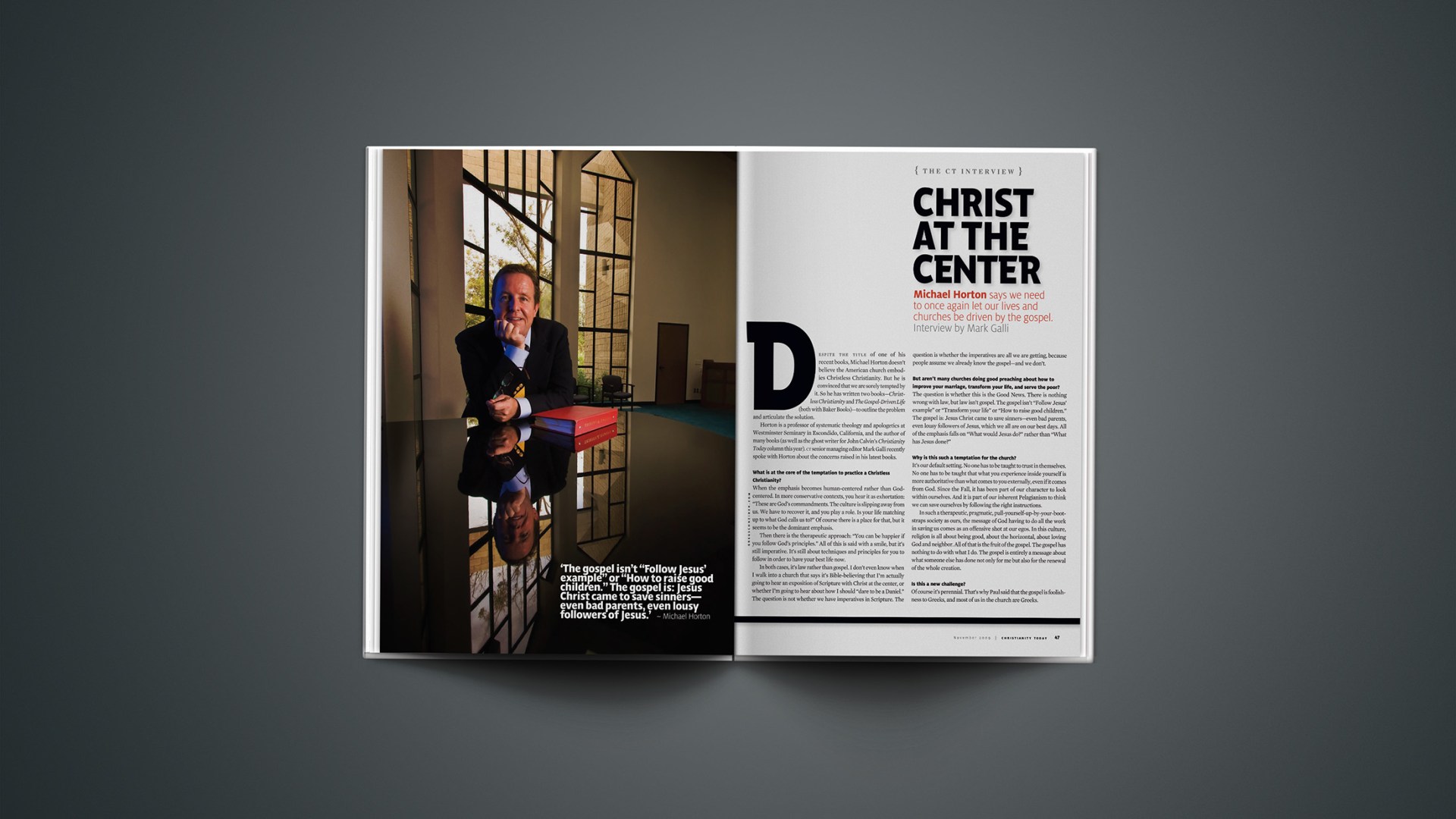

Michael Horton says we need to once again let our lives and churches be driven by the gospel. Interview by Mark Galli Despite the title of one of his recent books, Michael Horton doesn’t believe the American church embodies Christless Christianity. But he is convinced that we are sorely tempted by it. So he has written two books—Christless Christianity and The Gospel-Driven Life (both with Baker Books)—to outline the problem and articulate the solution.
Horton is a professor of systematic theology and apologetics at Westminster Seminary in Escondido, California, and the author of many books (as well as the ghost writer for John Calvin’s Christianity Today column this year). CT senior managing editor Mark Galli recently spoke with Horton about the concerns raised in his latest books.
What is at the core of the temptation to practice a Christless Christianity?
When the emphasis becomes human-centered rather than God-centered. In more conservative contexts, you hear it as exhortation: “These are God’s commandments. The culture is slipping away from us. We have to recover it, and you play a role. Is your life matching up to what God calls us to?” Of course there is a place for that, but it seems to be the dominant emphasis.
Then there is the therapeutic approach: “You can be happier if you follow God’s principles.” All of this is said with a smile, but it’s still imperative. It’s still about techniques and principles for you to follow in order to have your best life now.
In both cases, it’s law rather than gospel. I don’t even know when I walk into a church that says it’s Bible-believing that I’m actually going to hear an exposition of Scripture with Christ at the center, or whether I’m going to hear about how I should “dare to be a Daniel.” The question is not whether we have imperatives in Scripture. The question is whether the imperatives are all we are getting, because people assume we already know the gospel—and we don’t.
But aren’t many churches doing good preaching about how to improve your marriage, transform your life, and serve the poor?
The question is whether this is the Good News. There is nothing wrong with law, but law isn’t gospel. The gospel isn’t “Follow Jesus’ example” or “Transform your life” or “How to raise good children.” The gospel is: Jesus Christ came to save sinners—even bad parents, even lousy followers of Jesus, which we all are on our best days. All of the emphasis falls on “What would Jesus do?” rather than “What has Jesus done?”
Why is this such a temptation for the church?
It’s our default setting. No one has to be taught to trust in themselves. No one has to be taught that what you experience inside yourself is more authoritative than what comes to you externally, even if it comes from God. Since the Fall, it has been part of our character to look within ourselves. And it is part of our inherent Pelagianism to think we can save ourselves by following the right instructions.
In such a therapeutic, pragmatic, pull-yourself-up-by-your-bootstraps society as ours, the message of God having to do all the work in saving us comes as an offensive shot at our egos. In this culture, religion is all about being good, about the horizontal, about loving God and neighbor. All of that is the fruit of the gospel. The gospel has nothing to do with what I do. The gospel is entirely a message about what someone else has done not only for me but also for the renewal of the whole creation.
Is this a new challenge?
Of course it’s perennial. That’s why Paul said that the gospel is foolishness to Greeks, and most of us in the church are Greeks. But today we have a new situation. We are facing a bewildering diversity of opposition to Christianity that is increasingly explicit—at the same time that not only people in the pews but also pastors and theologians seem the least capable of articulating the Christian faith, much less of offering persuasive arguments for it.
A recent issue of Newsweek featured an article, “We Are All Hindus Now,” by Lisa Miller. She acknowledges that, of course, most Americans aren’t practicing Hindus. But she appeals to various surveys to show that most Christians, including many evangelicals, embrace more Hindu tenets than Christian ones.
Two examples: First, the resurrection of the body. Miller points out that most Americans assume that at death, the soul, which they think of as the real part of a person, is finally released from its bodily prison to float off somewhere or to be reincarnated. Second, she refers more generally to the widespread belief that all paths lead to God or the divine, another major Hindu tenet but of course opposed to Christianity’s central claim that Jesus is the only Mediator and Savior.
What specifically do you mean by “a gospel-driven life”?
Because I live in San Diego, I think of a sailboat decked out with all of the latest equipment that tells you where you are and where you need to be. It plots your course, but it’s a sailboat, so you need wind in your sails. You start out, and it’s a beautiful day with wind in your sails. You’re out in the middle of the ocean when the wind dies down. You’re just sitting there dead calm. And your radio tells you that a hurricane is approaching. But all of your sophisticated equipment will not be able to get you to safety. What you need is wind in your sails.
A lot of Christians, especially people who have had dramatic conversion experiences, go sailing out of the harbor with wind in their sails. They are so confident in Christ and what he has done for their salvation, and that gospel wind is in their sails. Yet after two years, they have heard just one imperative after another. They have lots of course plotting, lots of books on how to do this and that. They’ve read every manual on spiritual disciplines. They have heard their pastor tell them they need to pray more, to read the Bible more, to evangelize more. Now they are dead in the water. There’s no wind in the sails.
Paul calls the gospel “the power of God unto salvation,” and I don’t think he meant the power of God just unto conversion. The gospel remains the power of God unto salvation until we are glorified. Calvin once said we need the gospel preached to us every week, and the Lord’s Supper to ratify that promise, because we are partly unbelievers until we die.
‘Paul calls the gospel “the power of God unto salvation,” and I don’t think he meant the power of God just unto conversion.
In The Gospel-Driven Life you use news as a metaphor. Why?
I stole it from the apostles! Their dominant metaphor for the gospel message is “good news.” The content is that God has done all the saving, no thanks to us. Someone asked Martin Luther what we contribute to salvation, and he said, “Sin and resistance!”
The gospel is not even my conversion experience. If somebody asks me what the gospel is, I’m not going to talk about me; I’m going to talk about Christ. All of the testimonies we find from the apostles’ lips are not testimonies about what happened in their hearts. They are testimonies about what happened in history when God saved his people from their sins. That’s the gospel. Although the gospel makes all sorts of things happen inside of me and gives me the fruit of the Spirit, the gospel itself is always an external word that comes to me announcing that someone else in history has accomplished my salvation for me.
Someone comes with instructions and says, “Here’s what your life could be like if you do x, y, or z.” Good news is, “Let me tell you what has happened!” The gospel is not good instructions, not a good idea, and not good advice. The gospel is an announcement of what God has done for us in Jesus Christ.
You also say it’s not “a personal relationship with God” or “making Jesus your Lord and Savior.” What do you mean?
I realize that those are deeply held, personal convictions among many evangelicals. But everyone has a personal relationship with God. You start with Genesis and work your way to the Book of Revelation—everyone has a relationship with God. In Romans 1-3, Paul says Gentiles have a relationship with God, even when they are engaging in idolatry. The question is whether the relationship is with a father, who has justified and adopted his heirs, or with a judge.
The phrase “making Jesus Lord and Savior” does not appear anywhere in Scripture (any more than does “personal relationship”). It assumes we are the ones who make God something. It is hard to imagine a Jew saying he made God his liberator and Lord in the Exodus. No. God made the Israelites the recipients of his saving and lordly work. So we don’t make God anything; it is he who makes us his people. The Good News is not that Jesus has made it possible for you to make him Lord and Savior. The Good News is that he has actually saved and liberated you, and that he is your Savior.
Another popular way of conceiving the Christian life is to describe it as simply “following Jesus,” but you have concerns.
It’s an explicit confusion of the law and the gospel. People talk about living the gospel and quote the line from Francis of Assisi (at least it’s attributed to him), “Preach the gospel at all times, and if necessary use words.” Well, Paul says that faith comes from hearing the word of Christ (Rom. 10:17). He says that salvation comes by hearing words, good words. And it’s great news for me and for the people I’m witnessing to that my life isn’t the gospel.
When we set things up in terms of following Jesus’ example rather than looking to Jesus first and foremost as Savior, we set ourselves up as the gospel and preach ourselves rather than Christ. We also set ourselves up for a fall, when we fail to live up to the commands of Christ that we profess.
Wouldn’t it be better to tell them, “Look, don’t believe in Christ because I’m a marvelous person with wonderful experiences and morality. Look at Christ, because you and I both are so sinful and so prone to evil that we need a Savior.” Unbelievers should see our testimony to Christ primarily when we are in church confessing our sin and confessing our faith in Jesus Christ.
Yes, our lives are a fragrant aroma that brings attraction to or repulsion from the gospel. But our transforming work is not the gospel. The gospel is Jesus Christ’s objective work in history.
Given your identification with Reformed theology, some might wonder if you’re just preaching to Arminians.
Well, William Willimon, an Arminian and United Methodist bishop, wrote the foreword to Christless Christianity. One point I wanted to make in both books is that this is not about Calvinism versus Arminianism. As a Calvinist, I might think that focusing on Christ makes sense within a Reformed paradigm. But my argument is that this creeping fog of moralistic therapeutic deism is as obvious in Reformed churches today as it is in Methodist churches.
None of us has clean hands here. This is not restricted to any one tradition.
Some theologians argue that classical Protestantism—with its concern for the individual’s relationship with God—leads to individualism and to a withdrawing from the world, because it becomes about me getting my soul saved for heaven.
It’s exactly the opposite. I go into great detail about this in The Gospel-Driven Life. The Word creates community. All the Reformers said that if you read the Bible by yourself in a corner, there’s no telling how many spirits you’ll be filled with. That just means, as Luther said, that every man will go to hell in his own way. An external word takes the form of a corporate event. It is preached. It’s not us determining for ourselves over in a corner what we believe and how we’ll live. It’s the obsession with the spiritual disciplines that’s actually very individualistic.
I’ve been in emerging church services where you have one person going up to take Communion, another person going up to watch a video, and another person going up to have a conversation. Talk about individualism.
No, the corporate event is highlighted when God says, “Assemble before me, all of you people. I am going to make you one people in Christ. I’m going to draw all of you into my Son by my Spirit, and make you united not only to Christ but also to each other.”
Baptism is not only a sacrament of our union with Christ; it is also a sacrament of our communion as the body of Christ. Paul upbraided the Corinthians for their individualism by appealing to the practice of the Lord’s Supper and by saying we are all one body because we eat of one loaf. The word-and-sacrament ministry [of Reformation Protestantism] is precisely what we need in order to uproot the narcissism and individualism that pervade our culture.
So what is the first step in living a gospel-driven life?
Become a recipient again. Mary and Martha, the two sisters and disciples of Jesus, had different relationships with Jesus. Martha busied herself with many tasks, and she was getting mad at Mary for making her do all the work. Mary was sitting at Jesus’ feet, learning from him. Jesus rebuked Martha for criticizing her sister and said Mary had chosen the better part.
First and foremost, disciples are recipients of Jesus Christ’s teaching. His teachings are really teachings concerning his person and his work. He has accomplished our salvation. He has accomplished our redemption. So first, allow the gospel to soak in again.
Then allow the imperatives that arise out of that to be our reasonable service. Instead of trying to live the victorious Christian life, instead of trying to get into God’s favor by following tips and formulas, let’s receive the gospel and then follow the commands of God’s law when it comes to directives. Then our sailboat is perfectly equipped. Now we have the wind in our sails—the gospel—and we also have God’s own wisdom to guide us in that gospel-driven life.
Go to ChristianBibleStudies.com for “The Gospel Defined,” a Bible study based on this article.
Copyright © 2009 Christianity Today. Click for reprint information.
Related Elsewhere:
Michael Horton’s Christless Christianity and The Gospel-Driven Life are available at ChristianBook.com and other book retailers. He authored People and Place: A Covenant Ecclesiology, which won first place in the theology category for Christianity Today‘s 2009 book awards.
Horton also wrote How the Kingdom Comes and My Top 5 Books on Calvin for Christianity Today.