The study of religion is too important to be left in the hands of believers.
So claims David A. Hollinger, a professor of American history at the University of California at Berkeley, in his response to religion emerging as the hottest topic of study among members of the American Historical Association (AHA).
Perhaps surprisingly, leading evangelical scholars voiced general agreement with his basic premise.
"The practice of history is best served by many historians working from all their separate angles," said Rick Kennedy, president of the Conference on Faith and History (CFH) and a professor of history at Point Loma Nazarene University in San Diego. "What is good about the new surge in religious history is that something that was neglected is now gaining its rightful place."
Barry Hankins, resident scholar at the Institute for Studies of Religion at Baylor University in Waco, Texas, said he shared Hollinger's sentiments, "as long as the understanding of faith is not left only to unbelievers."
"The trick for insiders is to think critically about their own tradition, while the trick for outsiders is to try to develop a feel or affinity for the group he or she is studying," said Hankins.
In an annual survey of AHA members, 7.7 percent of respondents selected religion as one of three areas of interest. That topped the 7.5 percent who chose cultural history, ranked number one for 15 years.
Maxie B. Burch, author of The Evangelical Historians, points out that self-identified believers such as George Marsden, Nathan Hatch, and Mark Noll have helped propel wider academic interest in religious history with their outstanding scholarship.
"Particularly within the larger academic, intellectual world, these guys have helped to legitimize the study of religious history," said Burch, an associate pastor at North Phoenix Baptist Church in Arizona.
Hollinger clarified on his blog that he doesn't regard religious belief as a barrier to successful scholarship. "But this religious demography of scholarship does narrow the inventory of perspectives brought to the field," he wrote.
Like other evangelicals interviewed, Douglas A. Sweeney, a professor of church history at Trinity Evangelical Divinity School in Deerfield, Illinois, said the field benefits from having more perspectives, but voiced concern that most historians do not take theology seriously.
"These scholars don't have to be evangelicals," said Sweeney, director of the Carl F. H. Henry Center for Theological Understanding. "Sadly, evangelical schools offer less support for first-rate scholarship than do secular schools. And evangelical historians are often harder on their own people than they are on religious people from other traditions.
"So, having more evangelical standouts will not necessarily help the cause either of scholarship or of evangelicalism. But having more serious scholars committed to telling the truth … could well help the cause of our scholarship and our evangelical movement."
In the AHA survey report, Jon Butler, a professor of history at Yale University, suggested that scholarly interest in religion has grown because "historians realize that the world is aflame with faith, yet our traditional ways of dealing with modern history especially can't explain how or why."
To Paul Michelson, a professor of history at Huntington University in Indiana and the secretary of CFH, such an acknowledgment by a secular scholar by itself speaks volumes.
"It is promising that the misleading dichotomy between sacred and secular spheres is losing some of its recent force in academia," Michelson said. "It is also the case that the assumption that religion is falling by the wayside in modern society has proven false, which means religion appears to be a more viable study than two decades ago."















 While we pray for peace, we need moral clarity about this war.
 As my doubts about his teachings grew, so did a secret fascination with Jesus.
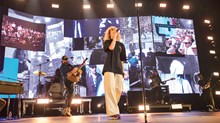 How groups like Hillsong learned to let go of the literal in favor of creative collaboration.españolPortuguês






