Evangelical vs. Mainline Politics

Download a PDF of this article here
Copyright © 2010 Christianity Today. Click for reprint information.
Related Elsewhere:
The Henry Institute's report is not yet available online.
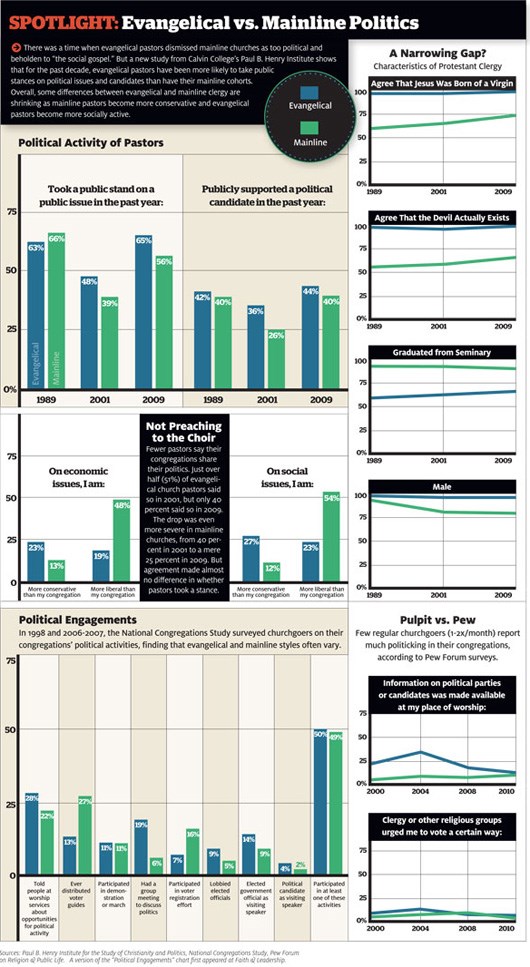
A version of the "Political Engagements" chart first appeared at Faith & Leadership's Call & Response blog. Elsewhere on that blog, Mark Chaves of the National Congregations Study looked at the political issues demonstrated, marched, or lobbied on and Americans' attitudes toward religious leaders' political involvement.
The Pew Research Center for the People and the Press has more data on political activity at churches. The Pew Forum on Religion & Public Life has newer data on religious aspects of the 2010 election.
CT previously spotlighted what Americans think Obama's religion is, the future(s) of missions, health-care reform, Africa, American Idol, Haiti, Robert Park, persecution, Supreme Court and crosses, international religious liberty advocates, and church violence.

A Fractured and Beautiful Faith
Streaming This Weekend, May 24, 2013

(on articles open to the public, you must at least register for a free account).


Comments
Displaying 13 of 17 comments
See all comments
Douglas E. Lass
I have one question on the liberal and conservative politics dealing with liberal and conservative Christianity. WHY? It seems both sides of the Christian faith are saying that if you don't vote for this particular candidate, not only are you a traitor to your country, you are going straight to Hell! And why are so many people following their pastor's opinion or that of a nationally known televangelist? Don't they have a mind of their own? I think that the individual in the pew should look at what the candidate has done or wants to do when they get into office in January. And by that I mean go ask for information from each candidate as to where they stand and what they will try to do when elected. Personally, I haven't voted for a Democrat or Republican in 20 years as Neither party can be trusted with what they are elected to do as soon as they get into office they forget about the voters at home and try to get sweet deals from lobbyists and other Washington Ilk
Dan H
"...if a society were to try to take on a Christian appearance, following the teachings of Jesus, it would appear to be a very liberal and progressive society." You've got to be pulling my leg! I'm sure Jesus would have been a big supporter of the homosexual agenda, abortion, assisted suicide, and big govt. lobbying taxes on whomever it wants. If you believe Jesus would have supported those liberal, progressive causes, I've got some cheap swamp land in FL I would like to sell you. And neither would he support the stupid wars we are mired down in. And neither would he wrap Himself in Old Glory and say "My country right or wrong." And the incredible Wall Street greed? Please! Or the inane and comically absurd contemporary mega churches with their variety shows they try to pass off as worship or the small churches that try to pull off the same nonsense as the big churches - but w/o the talent. (I know, "Tell us what you really think, Dan H!" Too much coffee this morning, I guess.)
grateful believer
Sinclair Lewis was not a believer; his books show that he was very confused about what Christianity really is. So I consider the source, and his comment is not meaningful to me. This new study says, "Evangelical pastors have been more likely to take public stances 'and candidates' (what does that mean?) than their mainline cohorts." I'm curious: Does this mean that Martin Luther King, Jesse Jackson, and Al Sharpton, et al, are considered to be evangelicals? I have not known of any pastors who have taken more public stances than they -- they've preached purely political messages from many church pulpits, they've taken their message to the streets, they have not hesitated to stir up controversy when it suited their cause. I have often wondered why this seems to be totally acceptable, while evangelicals (is this code for 'white pastors'?) are criticized and condemned if they speak out on issues which affect believers. I'm not against black pastors; just wonder why the difference?