 |
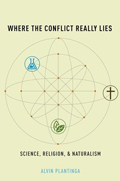
Where the Conflict Really Lies: Science, Religion, and Naturalism by Alvin Plantinga Oxford University Press, December 2011 376 pp., $27.95 |
Alvin Plantinga is among the preeminent philosophers of his generation. After a long career, chiefly at Calvin College and the University of Notre Dame (where he is emeritus John A. O’Brien Professor of Philosophy), Plantinga has formally retired, but he hasn’t been idle. In his new book, Where the Conflict Really Lies: Science, Religion, and Naturalism (Oxford University Press), he sheds light on a subject that is often obscured by posturing and superficial polemics. John Wilson, editor of Books & Culture, spoke with Plantinga about the underlying harmony between scientific and religious accounts of reality.
Most of your book is taken up with the proposition that there’s superficial conflict but deep concord between theistic religion and science.
In certain areas, the right word would be alleged conflict. For example, I argue that there’s no real conflict between evolutionary theory—that is, the scientific theory of evolution apart from any naturalistic spin—and what C. S. Lewis called “mere Christianity.” There’s no real conflict, even though conflict has been alleged by people on the Right as well as on the Left. Richard Dawkins, Daniel Dennett, and a host of others claim that there is outright conflict between evolutionary theory and belief in such a person as God, who has created and designed the living world. At the other end, there are Christian thinkers, too—like Phillip Johnson—who think there is irreconcilable conflict between the scientific theory of evolution and Christian belief.
But I don’t think there is. What current scientific evolutionary theory says is that the living world has come to be via a certain process of natural selection operating on some form of genetic variation. And it’s clear that God could have made the living world that way if he wanted to. What Christianity tells us, what theistic religion generally tells us, is that God has created the world and created human beings in his image. He could have done that through a variety of means. And that point goes all the way back to the 19th century. Some of the Princeton theologians—Charles Hodge, for example—said exactly that shortly after Darwin’s theory of evolution appeared. It’s not a new thought at all.
That being the case, why does so much of the public debate focus on this alleged conflict?
There may be several reasons. One reason, I think, is that so many of the “experts” declare that there is a fundamental conflict. Another is the deep and pervasive confusion that exists between what you might call “guided evolution” and “unguided evolution.” The theory of evolution doesn’t say that the whole process is guided by God. Of course it doesn’t say that. But it also doesn’t say that it isn’t. Being a scientific theory, it doesn’t make any statements on that point. In the same way, physics doesn’t say that Newton’s laws are established by God, but it also doesn’t say they aren’t. It doesn’t address that question.
Now some people seem to think that if science doesn’t say something happened, what it’s really saying is that that thing didn’t happen. So if science doesn’t say that God is guiding the process of evolution, then science is really saying that God is not guiding the process. But that’s ridiculous. Science doesn’t say anything about it one way or the other.
A lot of people—like Dennett, for example—add naturalism onto the scientific theory of evolution, and from that they deduce that the process is unguided and that there isn’t any such person as God who’s created the living world. But they’re just adding that on. It’s not part of the scientific theory.
So they’re really shuttling back and forth between science and philosophy, and presenting the philosophizing as if it were science.
Yes, I think that’s the right way to put it. And it’s worth noting that evolutionary theory is ordinarily presented to students as entailing philosophical naturalism. I recently saw a list of biology textbooks at the college level, all of which said exactly that. They just took it that the theory entails unguided evolution.
In the last, much briefer section of the book, you discuss whether there is a fundamental incompatibility between naturalism and the theory of evolution.
I think that’s an extremely interesting and important point, though to argue for it properly is quite complicated; it’s hard to do in a brief compass. The basic idea, which is far from being original, is that if you are a naturalist and think that we have come to be by evolutionary processes, then you will think that the main purpose of our cognitive processes, our mental faculties, is survival and reproductive fitness, not the production of true belief. Evolution doesn’t give a rip about whether your beliefs are true. It only cares whether or not your actions are adaptive, whether they contribute to your fitness. From the point of view of evolution together with naturalism, you wouldn’t expect that our faculties would be really adjusted to truth or aimed at truth. They would just be aimed at fitness.
But if this is true, if our minds are aimed at mere survival, not at truth, then it’s not probable that our minds should be reliable—that is, produce an appropriate preponderance of true over false beliefs; and if that is so, then one who believes both naturalism and evolution should reject the thought that our minds are reliable. But that’s a crippling position to be in. Nietzsche is among the people who have suggested this problem. Some contemporary philosophers—Thomas Nagel, for example—have voiced the same worry, and so did Darwin himself.
Copyright © 2011 Christianity Today. Click for reprint information.
Related Elsewhere:
Where the Conflict Really Lies is available from Barnes and Noble and other retailers.
Previous Christianity Today coverage of the debate between science and religion includes:
The Search for the Historical Adam | The center of the evolution debate has shifted from asking whether we came from earlier animals to whether we could have come from one man and one woman. (June 3, 2011)
Sin in the Double Helix | Reports linking moral behavior to genetic traits actually prove Scripture’s claims, not undermine them. (March 17, 2011)
Adamant on Adam | Resignation of prominent scholar Bruce Waltke underscores tension over evolution. (May 25, 2010)
CT also has more music, movies, books, and other media reviews.