Our daughter was born at 5:22 P.M. on a Friday afternoon. For two hours, we reveled in the sweetness of new life—her pouty lips and soft skin, her deep blue eyes, her full head of black hair. Then a nurse called my husband out of the room. When Peter returned, it took me a moment to see that his eyes were brimming. "The doctors think Penny has Down syndrome," he told me. And the world began to break into pieces.
A few hours later, a woman was giving birth in the adjoining room. "She's perfect! She's perfect!" they exclaimed, as another baby girl was born.
In those early hours, I came face to face with my unspoken assumptions about my child. I had thought Penny would be just like me—a little girl who walked early and taught herself to read, who won academic awards in high school and got in early at Princeton. Peter, who was a high-school teacher and a varsity athlete, had shared many of those assumptions, expecting to see his competitive spirit in his new daughter.
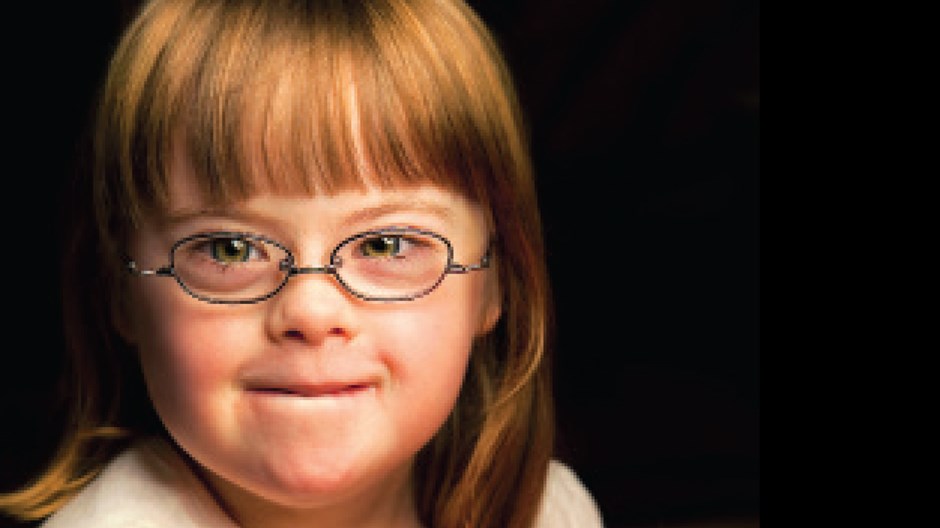
Despite our Christian faith, we had sub-Christian expectations about our children's appearance, education, and abilities. I would never have stated it so bluntly, but in truth I wanted and even thought I deserved a "perfect" child. God gave me a child with an extra fold of skin around her eyes and floppy limbs and intellectual limitations. I didn't know what to do.
Doctors consider Down syndrome a birth defect. Other words to describe it include abnormality and disability. According to the doctors, Penny would have trouble learning. She would probably need glasses and possibly hearing aids. She would never be even five feet tall. She would have trouble communicating. I quickly learned that many doctors and parents alike believe children like Penny should never be born. The American College of Obstetricians and Gynecologists recommends that every pregnant woman receive prenatal screening for Down syndrome. Of the women who screen for Down syndrome and receive a prenatal diagnosis via chorionic villus sampling or amniocentesis, 90 percent choose to terminate their pregnancies. From the moment she was conceived, our daughter fell short of our medical and cultural standards of worth.
After Penny was born, I thought I needed to abandon the hope of perfection altogether. Sin will always render me and my children imperfect. But I still wasn't sure how to think of her, how to have hopes and dreams for her once those initial expectations were stripped away.
When Penny was five months old, I was playing with her in our living room. By that point, I no longer saw her in terms of what she couldn't do. My heart skipped a beat when she turned her head at the sound of my voice. I had felt wonder as her eyelashes grew long and dark, when she smiled and cooed, when she nestled against my chest for comfort. That day, as I massaged her pudgy legs and wiped strands of dark hair from her eyes, I remembered a verse from Matthew 5: "Be perfect, as your heavenly Father is perfect."
Jesus was vulnerable, needy, dependent, and limited, but I wasn't able to see him that way until Penny illuminated it for me.
I looked it up in my Greek New Testament. The Greek word that was translated perfect is teleioi, which comes from the word telos, meaning "complete," "whole," "full-grown," or "mature." In other words, this perfection has to do with becoming a certain type of person. It has to do with becoming the complete, whole, mature, full version of ourselves.
A few verses earlier, Jesus offers his description of blessed humanity. A quick glance at the Beatitudes makes clear that being fully human—being "perfectly" human—is not about physique, intelligence, or abilities. It is about meekness, sorrow, and longing for God. Being fully human implies understanding ourselves as creatures. As ones who are not God but rather formed by God, cared for by God, in need of God. Or, to put it differently, a major aspect of recognizing my humanity meant recognizing that I am vulnerable, needy, dependent, and limited.
Just like my daughter.
These aren't words that naturally resonate with our usual idea of perfection, but they align with the Beatitudes. They are also in tune with other passages, such as Jesus' description of those who will participate in the great wedding feast, a symbol of the kingdom of heaven: the outcast, the disabled, the poor, the needy. In other words, those utterly dependent on God's gracious provision. This idea of perfection also lines up with Paul's conception of the body of Christ, that we each have gifts to offer the church, which assumes we each have limitations. We are dependent on one another.
And even Jesus, who was and is the perfect human, had limitations. He needed sleep. He needed to eat. He needed friends to pray for him. He was vulnerable to suffering and even death.
Henri Nouwen, among others, has helped me understand the connection between vulnerable humanity and Jesus. Nouwen, a longtime professor at Yale University, spent his final years living among people with intellectual and physical disabilities in a L'Arche community in Canada. In Adam: God's Beloved, his book about the man with whom he spent the most time, Nouwen writes, "I am not saying that Adam was a second Jesus. But I am saying that because of the vulnerability of Jesus, we can see Adam's extremely vulnerable life as a life of utmost spiritual significance." Jesus was vulnerable, needy, dependent, and limited, but I wasn't able to see him that way until Penny came into my life.
Article continues below
Five years ago, the hopeful and joyous words from the hospital room next door—"She's perfect! She's perfect!"—haunted me. Now they seem prophetic. Penny was not the "perfect baby" that I expected, but she was exactly the baby I needed. I look at her now, giggling with her little sister, complaining that her brother isn't sharing his toys, sitting in my lap and whispering that she's afraid she'll be lonely when she goes to kindergarten. I don't see much that's different from other children.
Penny is both created in God's image and fallen from grace—like everyone else. By giving me a new understanding of God's view of perfection, Penny has offered us a way to participate more fully in the body of Christ as we become more and more human and more whole.
A Christian Response to Overpopulation | We can continue to affirm life while acknowledging that unrestricted population growth can put women and children at risk. (May 25, 2011)
Be Fruitful and Multiply? | Observers weigh in on whether Christians have a special responsibility to have children. (July 26, 2010)
How Many Kids Should We Have? | To answer the question, Christian couples need more than a few select Bible verses. (Her.meneutics, June 19, 2010)
A Real Christian Education | My daughter Penny reveals that academic success is not always connected to test scores. (October 26, 2011)
Coming Home After Hurricane Irene | The place where our family played, worked, and fell in love for nearly 100 years was destroyed. So it's not "just a house." (September 21, 2011)
How Do I Explain Easter to My Children? | The reality of a human raised from the dead is hard enough for adults to understand, much less kids. But here are some approaches I've taken. (April 20, 2011)
Have something to add about this? See something we missed? Share your feedback here.















 While we pray for peace, we need moral clarity about this war.
 A Christian reconciliation group in Israel and Palestine warned that war would come. Now the war threatens their relevance.españolالعربيةFrançaisрусскийУкраїнська
 The rage of the mob is a poor substitute for real community.






