The summer before Katey Tryon's senior year of high school, she got pregnant. Recently split from her boyfriend, she was sad and vulnerable when she hooked up with her older brother's friend. They had sex once. Six weeks later, she was tired and her period was late.
"It was terrifying," Tryon said. "I'm from a small town in Oregon. My parents are pillars in the community. I was born and raised here, fourth generation. So my sin was very apparent." Tryon's parents, both believers, rallied around her. Abortion was out of the question. Two days before high school graduation, Tryon gave birth to a girl and gave her up for adoption.
Tryon enrolled in a Christian college in Portland, determined to turn her life around, but still felt vulnerable. "I started dating a guy who embraced me for what I had just gone through, who understood that I didn't want to have sex until I got married," she said.
But they started sleeping together, and one night the condom didn't work. Over spring break, at an intercollegiate softball tournament, Tryon found out she was pregnant again. Her daughter was nine months old. "My world came crashing down tenfold from the first time," she said.
Abortion was never a serious option, she said, although "trust me, it went through my mind. I recognize why other women go there. You want to get away from your situation. We want to cover up our mistakes and have them all go away."
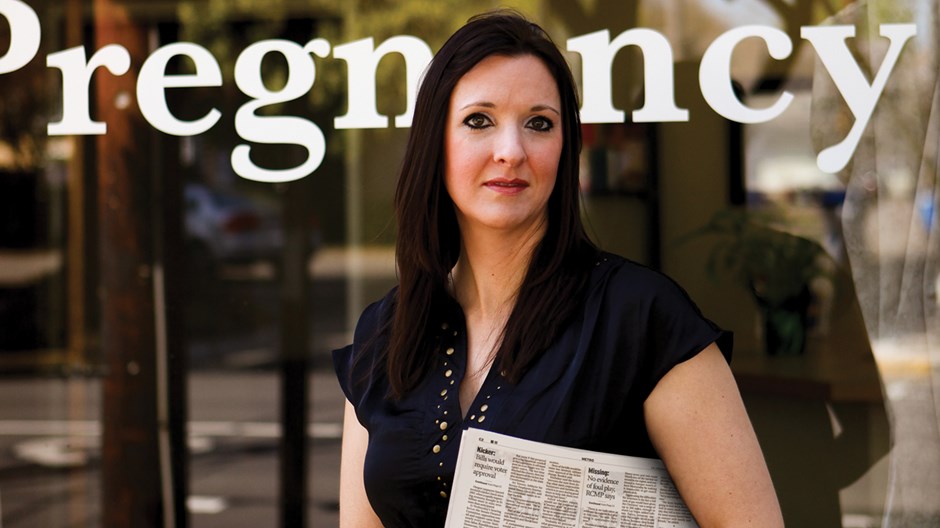
Tryon found support at a local pregnancy center, which sparked in her a fresh sense of purpose. She gave birth to a boy and gave him up for adoption. She went back to college, double majoring in social work and sociology. Eventually she became the development director at Lane Pregnancy Support Center in Eugene, Oregon.
In April, Tryon testified before the Oregon State Legislature about how a pregnancy center changed her life for the better. A Senate committee was considering a bill to force pregnancy centers to publicly post on doors, in waiting areas, and in brochures that they are not abortion providers. If centers did not post these notices in five days, they could be fined up to $1,000, up to $5,000 if not posted in two weeks.
This is one of many new legislative initiatives on abortion, but the majority of them are working in the other direction.
Flood of Legislation
The Oregon bill is one of 576 measures related to abortion that have been introduced so far in 2011 in 48 states, according to Elizabeth Nash, public policy associate for the pro-choice Guttmacher Institute.
Like the Oregon bill, many of them will never pass committee. Yet by early April, 142 abortion-related provisions had passed at least one chamber of a state legislature, compared with 67 in 2009. More than half of the 142 bills (57 percent) introduced this year seek to restrict abortion access, compared with 38 percent in 2010.
About 40 new anti-abortion laws were on the books by mid-April. They include:
expanding the waiting period requirement in South Dakota from 24 hours to 72 hours, and requiring women to visit a crisis pregnancy center in the interim.
requiring a physician who performs an abortion in South Dakota to provide counseling on all risk factors related to abortion.
allowing any hospital employee in Utah to refuse to "participate in any way" in an abortion.
making it a felony in Arizona to perform or provide money for abortions sought because of a baby's race or sex.
prohibiting insurance plans that participate in the state insurance exchange from including abortion coverage in Virginia, Arizona, Idaho, Louisiana, Mississippi, Missouri, and Tennessee.
prohibiting the abortion of a fetus capable of feeling pain in Nebraska, Kansas, Idaho, and Oklahoma. The organization National Right to Life has drafted a model bill for pro-life lawmakers to use.
Republican victories in the 2010 mid-term elections account for much of the legislative surge. Republicans won control of the House of Representatives and made gains in the Senate. But their success at the state level was more significant. They took 29 governorships and 680 seats in state legislatures, according to the National Conference of State Legislatures.
It's the largest gain in modern history. The previous record was held by Democrats in the post-Watergate 1974 election, in which they picked up 628 seats. Republicans now control the governor's office and both legislative chambers of 21 states, according to the National Conference of State Legislatures.
"The November elections brought huge change in the state houses," said Charmaine Yoest, president of Americans United for Life. "But we've been tilling this ground for a while."
The forward momentum began, Yoest said, when the Supreme Court upheld the federal ban on partial-birth abortion in 2007.
Article continues below
'My life and the life of my unborn baby were forever changed the minute I called for help.'—Katey Tyron, a director at Lane Pregnancy Support Center
"They chipped away at the absolute right to abortion," Yoest said. "The Supreme Court said that states do have the right to limit abortion. That was a seismic shift." Pro-life advocates began to see how far they could get with restrictions, such as parental notification and informed consent laws, she said.
The legislation has been snowballing since the Republican sweep: "Just in the first three months of this year, we've provided testimony on 17 life-related legislative matters," she said. In previous years, the average number of testimonies provided was two or three for the entire year.
Public Opinion Changes
Restricting abortion through new state laws seems to be highly effective in reducing abortion rates.
"We see that the number of abortions has gone down by 22 percent between 1990 and 2005," said Michael New, political science professor at the University of Alabama. "An important reason is the restrictions that more and more states are passing."
New examined the effects of three laws on abortion rates. Opting not to fund abortions through Medicaid was most significant, dropping state abortion rates by about 9 percent, he said.
"That's a strong consistent finding," he said, pointing to a Guttmacher report that 20 of 24 peer-reviewed studies found that public funding restrictions reduced the number of abortions. The second is informed-consent laws, which require abortion providers to inform a woman about the potential risks to her health, fetal development, and available assistance before an abortion is performed. Those laws were connected with in-state abortion reductions of 5 to 7 percent, he said.
New also analyzed parental involvement laws, which require minors to either tell or get permission from their parents before having an abortion. While these laws don't have a large impact on the overall abortion rate, they correlate with a 15 percent decline in in-state abortions obtained by minors.
Recent pro-life legislation is changing gears, pushing for laws that give women the opportunity to view an ultrasound before an abortion or banning abortion after the fetus can feel pain. Fetal-pain laws have been a big goal of National Right to Life. Director of state legislation Mary Spaulding Balch told Christianity Today, "The Pain-Capable Unborn Child Protection Act very clearly talks about the humanity of the unborn child." So far, abortion supporters have not initiated court challenges to the new fetal-pain laws.
Article continues below
The effect on the abortion rate from pain-related or ultrasound laws may not be dramatic, New said. Requiring ultrasounds can be tricky because abortion providers have to self-enforce, and relatively few abortions are performed after the second trimester, when the fetus begins to feel pain, he said.
But those laws are still important, New said. "You have to make progress incrementally. We have made more progress than we think. We've convinced a lot of people that abortion is wrong. Most doctors and hospitals want nothing to do with it."
Indeed, public opinion now lines up against abortion for the first time since Gallup began asking the question in 1995. In 2010, 47 percent of Americans called themselves pro-life, while 45 percent identified as pro-choice.
The pro-life advantage held through three surveys, prompting Gallup to label it a "real change in public opinion," one that's showing itself at the polls.
Last year's health care debate put abortion back on the national stage, and President Obama had to issue an executive order strengthening the limits on abortion to get the health care reform bill passed.
In addition, the House of Representatives passed a bill this spring that would defund Planned Parenthood, the largest abortion provider in the country. The bill failed in the Senate, but the victory in the House was historic, Yoest said.
'We see that the number of abortions has gone down by 22 percent between 1990 and 2005. An important reason is the restrictions more and more states are passing.'—Michael New, political science professor at the University of Alabama
"I absolutely think this is a swelling tide, regardless of what happens in this particular skirmish. There is very much a future in terms of bringing more and more attention to the massive federal subsidy of the abortion industry."
Counteroffensive
All this leaves the pro-choice movement "definitely defensive," said Nash of the Guttmacher Institute. "We need to make the case for why these services are important."
The public questioning of Planned Parenthood is "a major shift," said Melinda Delahoyde, president of Care Net, a network of more than 1,000 pregnancy centers.
Care Net's pregnancy centers are among the targets of the pro-choice counteroffensive. New York City's new disclosure law is "the most difficult thing we're facing," she said. The law, like the one Tryon testified against in Oregon, requires all pregnancy centers to post in waiting rooms and in all literature whether they offer or make referrals for abortions, contraception, and prenatal care. The American Center for Law and Justice is challenging the constitutionality of the law in federal court.
Article continues below
In January, a federal judge struck down a similar disclosure law in Baltimore, calling it an unconstitutional violation of free speech and "viewpoint-based discrimination."
"It puts onerous regulations on pregnancy centers," Delahoyde said. "It opens centers up to costly lawsuits—a right to action by aggrieved persons. There are very harsh restrictions put up all over against pregnancy centers, and we know their goal is to shut us down."
But most of the bills targeting pregnancy centers fail to pass. Two bills in Virginia—one that proposed to limit the revenue pregnancy centers receive from license plates, the other to require disclosure that abortions are not offered at the centers—were withdrawn in March. A resolution praising the work of pregnancy centers was passed instead. Another disclosure bill in Washington made it out of committee but failed in the House of Representatives.
When pro-choice groups can't get bills passed at the state level, they look for local municipalities where they can get propositions passed, Delahoyde said.
Care Net prepares their centers for the legislation, she said. "We send our public relations and legal people on the road. We provide a united front at the state house, and that's very effective."
Alliance Defense Fund also provides legal help through hundreds of attorneys connected to local pregnancy centers, she said.
"We train extensively," Delahoyde said. "We are pressing forward. Look, there are so many encouraging signs. The pro-choice brand is eroding."
Pendulum Swings
When Tryon gave birth to her second baby in December 1992, she was part of a trend. U.S. teen pregnancy rates had swelled to their all-time high—almost 12 percent of teenage girls—in 1990, according to the Centers for Disease Control and Prevention (CDC).
Abortion rates peaked at the same time, with 1.4 million abortions performed in 1990, according to the CDC. Public support of abortion was also high, with 56 percent of Americans labeling themselves pro-choice, according to Gallup. Just 33 percent self-identified as pro-life.
Article continues below
Some 20 years after Tryon was a pregnant teenager, the pendulum is swinging the other way. She is now an articulate leader at a pregnancy center, wife of a worship pastor, and mother of three school-age children.
"As a teenager, finding myself in an unplanned pregnancy was scary at best. Thankfully, I turned to a pregnancy resource center that provided not only free and confidential services to me, but treated me in a fair and professional manner, provided me life-giving options when I needed them most, and eased my fears," she testified before an Oregon Senate committee.
"My life and the life of my unborn baby were forever changed the minute I called on them for help. After being educated about all of my options, I chose an adoption plan that not only gave my baby a hope and a future, but it also gave it to me.
"It is devastating to think that the vital services I received so many years ago could be torn from those that so desperately need them today. I urge you to vote 'No' on this bill."
That bill in Oregon never came to a vote. But neither did another bill calling for a ban on abortions after 19 weeks.
Sarah Eekhoff Zylstra is a journalist based in the Chicago area.
Abortion Case: Womb vs. Egg | Ethical issues abound in case of British Columbia couple who wanted surrogate mom to terminate pregnancy after baby was found to have Down Syndrome. (October 15, 2010)
CT covers more political developments on the politics blog.
Have something to add about this? See something we missed? Share your feedback here.

















 While we pray for peace, we need moral clarity about this war.
 A Christian reconciliation group in Israel and Palestine warned that war would come. Now the war threatens their relevance.españolالعربيةFrançaisрусскийУкраїнська
 Beyoncé’s right. Whether listening to Cowboy Carter or reading theology, diversity is a good thing.






