A wide range of voices claims that a crisis of biblical interpretation is taking place. But contrary to many pundits, the crisis does not simply involve a decline in the Bible's authority. Even when the Bible is turned to as the authority, it's not necessarily interpreted Christianly.
Consider, for example, a recent Christian bestseller that offers a "Bible diet." The book claims to enable better concentration, improve appearance, increase energy, and reverse the process of "accelerated aging." To want to improve your appearance and energy level, do you have to be interested in knowing God or Jesus? Of course not. There is nothing intrinsically Christian about the advice.
Similar trends appear in Christian books that promise biblical solutions for success in finances, relationships, and family. These books can help Christians see implications of their faith for various aspects of life, but they often communicate that the Bible is the authoritative answer book to felt needs and problems. This message centers on the individual and his or her preferences, and does not interpret the Bible in a way that calls felt needs into question or looks beyond them.
It's not just well-meaning writers but also many biblical scholars who fail to approach the Bible as Christian Scripture. Some approach it only as ancient history, using it as a piece of evidence in answering archeological or sociological questions about the ancient world. Other scholars try to reconstruct the thought of a book or author. A scholar can write an in-depth essay about Paul's theology without ever considering that God could be addressing the scholar's own time through Paul's ancient texts.
Even those who try to connect the historical-critical context of a passage to today's world can inadvertently suggest that most of the world's Christians cannot truly understand God's Word because they are not scholars. After returning from a semester of teaching church leaders in Ethiopia, I heard a well-known biblical scholar argue that "historical reconstruction" behind and within the biblical text is the central way to avoid idolatrous and unfaithful biblical interpretation. I left the lecture wondering: Where does that leave Ethiopia, a country with millions of Christians and a growing church, yet with very few who could historically reconstruct the Bible?
Partly due to the inadequacies of popular and scholarly readings of the Bible, an increasing number of scholars have been advocating a "theological interpretation of Scripture." They encourage us to read the Bible as God's instrument of self-revelation and saving fellowship. This school of interpretation includes a wide range of practices, but all of them move us toward knowing the triune God and being formed as Christ's disciples through Scripture.
When examining how we interpret Scripture, we should pay attention to our functional theology of Scripture: how our use of Scripture reflects particular beliefs about what the Bible is. There are two common approaches to using Scripture today.
Some readers start with a detailed blueprint of what the Bible says, then read individual passages of Scripture as if they were the concrete building blocks to fit into the blueprint. They translate each passage into a set of propositions or principles that fit the established details of the blueprint. This approach assumes that we already know the larger meaning of Scripture; our system of theology gives us the meaning. Thus, the task of interpreting Scripture becomes a matter of discovering where in our theological system a particular passage fits.
Others prefer a smorgasbord approach. Imagine a huge cafeteria loaded with food of many kinds for many tastes; you are at the cafeteria with the members of a small-group Bible study. Can you imagine what some of the other members of the group would choose to eat? I suspect that there might even be patterns based on age, gender, ethnicity, or socioeconomic status, but each person chooses which foods to feast on based on his or her appetite. In the smorgasbord approach to Scripture, the Bible becomes the answer book for our felt needs and personal perspectives.
With both the blueprint and smorgasbord approaches, we end up using Scripture for our own purposes. We are in control. The Bible may be viewed as authoritative, but it provides either confirmation of our preconceived ideas or divine advice for felt needs.
Blueprint readers rightly sense that one cannot read the Bible without bringing some understanding to the table; we each come with some theological assumptions about the Bible when we open its pages. Smorgasbord readers rightly believe that the Bible is a book through which God addresses us; it's not just a book of ancient history or doctrine or worldview. A theological reading of Scripture makes use of both of these assumptions, yet in a deeper and fuller way.
Instead of providing a detailed blueprint, a theological reading brings a map for a journey. Our map does not give all the answers about a particular text. Instead, our reading sends us on a journey in which God in Scripture encounters us again and again, both with comforting signs of his presence and surprises that confound us, yet may open new vistas. Reading Scripture is not about solving puzzles but discerning a mystery. Through Scripture, we encounter no less than the mysterious triune God himself.
Article continues below
Early Christians also taught that Christians should—indeed, must—approach Scripture with a basic theological map in hand. By the second century, Irenaeus spoke of the "rule of faith" as a way to understand the basic Christian story with which orthodox Christians (versus Gnostics) should approach the Bible. This "rule of faith" was not the creation of detached scholars, but an account of the gospel and Christian identity rooted in baptism: one reads Scripture as a follower of Jesus, baptized in the name of the Father, the Son, and the Holy Spirit. Thus, early baptismal creeds—statements of faith—had a Trinitarian character (e.g., the Apostles' Creed) that provided the basic content of the "rule of faith."
Why is this necessary? The Bible is a large book, and even careful readers can interpret it in a variety of ways. But not all of these ways are Christian ways of reading Scripture. For example, one can read the Bible in a way that sees the God of Israel as a judging God, as the antithesis of the God of Jesus, who is supposedly only a gracious (not judging) God. But this is not a Christian reading of the Old or New Testaments. In the early centuries of Christianity, the rule of faith helped make sure that Christians held together the Old Testament with the New—that the God of creation and covenant is also the God revealed to us in Jesus Christ.
Our reading sends us on a journey in which God in Scripture encounters us again and again, both with comforting signs of his presence and surprises that confound us.
The Trinitarian rule of faith has been a critical element of Bible reading from the early church through the Middle Ages and the Protestant Reformation. The Reformers emphasized that Scripture (not church tradition) was the only final "rule of faith." Yet Luther, Calvin, and others made it clear that they heartily affirmed a basic, Trinitarian theological approach to Scripture. In interpreting the Old Testament as well as the New, Reformers sought to read Scripture in light of Jesus Christ as the fulfillment of God's promises in creation and covenant, applying it to the church as disciples of Christ.
Article continues below
Many contemporary scholars have sought to revive the Trinitarian rule of faith. For example, as R. R. Reno says in the preface to the Brazos Theological Commentary on the Bible, the multivolume series "advances upon the assumption that the Nicene [Trinitarian] tradition, in all its diversity and controversy, provides the proper basis for the interpretation of the Bible as Christian Scripture."
The term rule in "rule of faith" is best thought of in terms of "measure." The rule gives a sense of the center as well as the periphery in biblical interpretation. It does not decide the meaning of specific Scripture passages in advance. Instead, it gives a sense of scope in the journey of reading Scripture, forging a path to deeper fellowship with the triune God.
Some describe this journey as "drama." In the words of Kevin Vanhoozer, a theologian at Wheaton College Graduate School:
The Father is the playwright and producer of the action; the Son is the climax and summation of the action. The Spirit, as the one who unites us to Christ, is the dresser who clothes us with Christ's righteousness, the prompter who helps us remember our biblical lines, and the prop master who gives gifts (accessories) to each church member, equipping us to play our parts.
The new world into which God brings us via Scripture is wide and spacious, but it also has a specified character. It is a journey on the path of Jesus Christ by the power of the Spirit in anticipation of the final, culminating communion with the triune God.
The Bible Is For Disciples
Does the theological interpretation of Scripture require specialized training? While the movement's adherents (Vanhoozer, Joel Green, Stephen Fowl) encourage us to engage pre-modern commentators and modern biblical criticism, they have great confidence in the ability of ordinary congregations to approach the Bible as God's Word.
Two dynamics are often overlooked in contemporary biblical interpretations, especially those grounded in historical-critical assumptions. The first is the work of the Spirit in illuminating Scripture, and the second is interpreting the Scripture "in Christ." Congregations around the world cultivate a sense of these two realities as they pray for the Spirit's illumination, worship the triune God, and apply Scripture to their community of discipleship and witness. Of course, these practices don't guarantee faithful biblical interpretation, but they are indispensable dynamics for interpreting the Bible as Scripture. The indwelling of the Spirit in the Christian community, as one located "in Christ," uniquely equips the Christian community to interpret the Bible as God's Word.
Article continues below
Approaching the Bible with such theological assumptions is anathema to many biblical scholars today. Theological convictions, many assume, are an adversary rather than a potential ally of faithful biblical interpretation. There is a genuine concern behind this objection: Aren't we supposed to get our theology from the Bible rather than impose it on the Bible? Those who object in this way usually grant that we cannot be unbiased in our interpretation, but add that we should "bracket" our theological presuppositions as we approach the Bible.
While it is right to seek our theology from the Bible, others note that theological convictions and practices like worship make Bible reading more fruitful and faithful rather than less. As Reno claims in the preface to the Brazos series, theological doctrine "is a crucial aspect of the divine pedagogy, a clarifying agent for our minds fogged by self-deceptions …."
Consider the following scenario: As a congregation gathers, they give thanks for the love and majesty of God the Father, worship Jesus Christ as their saving Lord, and confess the communal working of the Holy Spirit. These are basic features of healthy Christian worship. Worship both expresses and shapes the loves and theological convictions of the worshipers. Now, after the opening of worship, we hear a text from the Gospel of Luke—containing a narrative and the words of this same Jesus.
Do we really want to ask the congregation to "bracket" their love and conviction that Jesus is Lord at that moment? The congregation is approaching Luke's text with a certain bias, a disposition. But that disposition can actually make the hearing of Luke's text more fruitful rather than less for the sake of Christian discipleship—particularly if it displays an openness to hear through the text from Jesus Christ as Lord of the church.
Of course, a theological reading of Scripture can have pitfalls as well. But the solution is not to surrender the Bible to scholarly experts. Rather, it is to regain a sense of the place of Scripture in God's drama of redemption, and to enter into the task of reading Scripture with openness to being reformed and reshaped by God on our path of dying to the old self and living into our identity in Christ.
Article continues below
The Place of Commentaries
Still, we should avoid another extreme: interpreting the Bible alone, without others. In our day, some assume that the individual is an omni-competent biblical interpreter. No need for commentators, no need for a community of faith. Just me, the Bible, and the Holy Spirit.
Instead of providing a detailed blueprint, a theological reading of Scripture brings a map for a journey.
While sometimes the slogan "sola scriptura" is used to justify such an approach, it is a serious distortion of that Protestant principle. The key Reformation exegetes consulted exegetes through the ages, as well as refined their knowledge of biblical languages and other critical skills of biblical interpretation.
The theological interpretation of Scripture movement has sought to reunite what modernity has divided: discipleship and critical study of the Bible. For example, in On Christian Teaching, Augustine said that Jesus Christ, as the incarnate God-human, is the "road" to our heavenly homeland. Thus, all Scripture is interpreted in light of Jesus Christ. All scriptural interpretation must lead to our growth in love of God and neighbor.
Along with this, however, Augustine claimed that knowing Greek and Hebrew is very valuable for interpreting Scripture. He said that reading Scripture engages the disciplines of history, rhetoric, logic, and what we would call cultural anthropology. Like Augustine, the theological interpretation movement has generally sought to bring together discipleship with the academic study of Scripture. On one hand, the reader need not have scholarly competencies (such as the ability to read Hebrew or perform textual criticism) in order to interpret Scripture. On the other hand, all readers are deeply enriched when some in the community study the Bible at this level. Consider the passages in the Gospels that refer to the Pharisees. If we don't think of ourselves as Judaizing legalists, we think we are off the hook when Jesus rebukes the legalistic Pharisees. But historical study has shown that the Pharisees were not just stereotypical legalists; they also sought a renewal of obedience to covenant law from within the framework of God's promises to Israel. They certainly differed from Jesus and from the early Christians, but there was common ground as well. Just when we thought we were safe from the implications of Jesus' words for the Pharisees, this historical insight can help make our lives vulnerable once again to receive the piercing, healing Word of God. In more general terms, critical study can help readers of Scripture avoid common dead ends that block a fruitful reading: a misunderstood biblical genre or a misconstrued linguistic or cultural issue.
Article continues below
Regarding methods of reading the Bible, Fuller Seminary New Testament scholar Joel Green reminds us that "any and all methods must be tamed in relation to the theological aims of Scripture and the ecclesial context within which the Bible is read as Scripture." As Augustine suggested, a wide variety of interpretive methods can be used, but they are used in order to read Scripture as God's powerful word to the church, a community of disciples growing in the image of Christ.
Christ in Focus
A key feature of much work in theological interpretation has been the revival of some form of "spiritual" interpretation, such that the Old Testament has not only a historical sense but also a spiritual sense—in the form of allegory or typology—that extends to Christ and his church.
But doesn't such reading violate a historical reading of the text itself?
It depends on what one means by "historical." For the majority of Christian history, the historical or literal sense of the Old Testament did not mean that exegetes tried to "unthink" Jesus when they read the Old Testament. Rather, it generally referred to the narrative flow of the Old Testament itself. Thus, in its best instances, the Old Testament's narrative continued to have integrity even as "spiritual" senses referring to Christ were layered on top of it. The Reformers rightly protested aberrant forms of allegory that lost sight of the historical sense, but they continued to give spiritual readings of the Old Testament in various forms.
This approach to the Old Testament is rooted in the New Testament itself, which gives us good examples of this approach. For New Testament writers, it is not just the occasional messianic psalm or prophecy that applies to Christ. They read all of Israel's Scriptures in light of Christ. For example, Hebrews begins with seven citations of Old Testament texts from diverse contexts and genres (the Psalms, Deuteronomy, and 2 Samuel), yet all of them are applied to Christ. How could this be? It is not because of quirky hermeneutics but because of who Jesus Christ is in God's economy of salvation: "Long ago God spoke to our ancestors in many and various ways by the prophets, but in these last days he has spoken to us by a Son, whom he appointed heir of all things, through whom he also created the worlds. He is the reflection of God's glory and the exact imprint of God's very being" (1:1-2, NRSV). The Son fulfilled such divergent Old Testament passages, because even though "our ancestors" did not recognize it in their day, the Son is the Creator who is also the "heir of all things" and has been made known in history in Jesus Christ.
Article continues below
This means that spiritual readings of the Old Testament should not annihilate the Old Testament narrative. When the risen Jesus opened the minds of his companions on the Emmaus road "to understand the Scriptures," he did not suggest that the "law of Moses, the Prophets, and the Psalms" had been displaced; rather, they had been "fulfilled" in himself (Luke 24:44-45). In the words of Wheaton College theologian Daniel Treier, reading Scripture in a "Christ-centered" way "makes possible spiritual participation in the realities of which Scripture speaks."
Reading with Confidence and Humility
As John Webster, theologian at the University of Aberdeen and a key advocate of theological interpretation, notes, "reading Scripture is an episode in the history of sin and its overcoming; and overcoming sin is the sole work of Christ and the Spirit." Thus, "reading Scripture is inescapably bound to regeneration." As such, we read Scripture expecting to receive a divine word—one of comfort but also of confrontation. God's Word renews us as it confronts our cultural and personal idols, provides light for our paths, and equips us to serve the world.
Thus, to read the Bible as Scripture involves delighting in, memorizing, and dwelling on it. When tempted by Satan, Jesus responds with Scripture he has memorized (Matt. 4:1-11). Colossians admonishes believers to "let the word of Christ dwell in you richly." The Gospel of John shows a Trinitarian dynamic of dwelling in Christ's word, for the Spirit sent to believers will "glorify" Christ, and "will take what is mine and declare it to you" (16:14). Delighting and dwelling in God's Word is supremely practical, relating to our finances, family, and bodies. However, we should not enter into it for worldly "success," but rather as part of our dying to the old self and participating in the Spirit's new creation in Christ.
Article continues below
In this way, we can read the Bible confidently, knowing that God acts powerfully through Scripture—in corporate worship, through prayer and memorization, through teaching and witness. We do not have to master Scripture and then make it relevant to our lives; through Scripture, God opens up a new place for us to dwell, a place of fellowship with Christ on a path leading to love of God and neighbor.
We never finish the journey of sanctification in this life. Likewise, we never finish our journey of meditating on Scripture, experiencing it anew in word and sacrament. We wrestle with it even as it sometimes tells us what we don't want to hear, as well as confirming and building up our new identity in Christ. In all of this, Scripture's value to us is inexhaustible, because the Spirit uses Scripture to testify to Christ, the Word of the Father.
In reading the Bible as Scripture, we are not the masters. We are being mastered and enlivened by the triune God.
Consider the well-known story in 1 Samuel 17 in which David faces and defeats Goliath. Let me give two possible approaches to preaching or teaching this text. Neither sees it as simply an account of a border skirmish in ancient history. Both approaches understand the Bible as authoritative.
In the first approach, the character of Goliath becomes a metaphor for the challenges faced in daily life. Hearers are encouraged to identify the "Goliaths" in their own life—low self-esteem, financial challenges, or a family problem. David becomes a model of the underdog who dares to step up to his own inner "giants" and "challenges." The Bible is the answer book, showing us the way to face challenges in our personal life: visualize a positive outcome like David (17:36), act with confidence in the face of a challenge (17:37), and take risks (17:48-9). In this way, the Bible helps us solve our problems. Who is the hero of this rendering of the story? David—more specifically, his courageous human will. David's faith in God may be noted, but it is David's faith that is highlighted. The living God is not a major character in this reading of the text.
In contrast, a theological interpretation of Scripture tries to understand the text as part of a God-centered drama. In this approach, God's saving action is at the center of the narrative. While the mighty Goliath can taunt the people of Israel, David confesses, "The Lord, who saved me from the paw of the lion and from the paw of the bear, will save me from the hand of this Philistine" (17:37). Rather than seeing David as the self-actualized hero, the emphasis here is on the saving action of the almighty God, whom David actively trusts. For as the text repeatedly notes, it was not a "sword" of David that brings deliverance from the Philistines, for "the Lord does not save by sword and spear; for the battle is the Lord's and he will give you into our hand" (17:47; cf. 17:37; 17:50). Although David appears to be ill-prepared to encounter Goliath, David acts with covenantal trust in God that "The Lord … will save me from the hand of this Philistine" (17:37).
Thus, we are invited to actively trust in this same God—the God of Israel who finally reveals the nature of his victory over his enemies in the death and resurrection of Jesus Christ. Indeed, the 1 Samuel narrative shows how God's surprising way of working contrasts with worldly appearances of power. Paul reflects on this mystery as it culminates in Christ crucified: "God chose what is weak in the world to shame the strong; God chose what is low and despised in the world, things that are not, to reduce to nothing things that are, so that no one might boast in the presence of God" (1 Cor. 1:27b-30). As disciples of Jesus, we are called through the David and Goliath narrative to renew our trust in God's deliverance, acting in confidence as we love God and neighbor and witness to God's power in Christ crucified. Our confidence is in the Lord (not our faith or our commitment), for it is the Lord who uses even those who appear weak and lowly to accomplish his purposes.
Joel B. Green, Seized by Truth: Reading the Bible as Scripture (Abingdon, 2007)
This is an accessible account of the aims and scope of reading the Bible as Scripture, describing how critical methods of biblical studies can be incorporated into a theological hermeneutic of Scripture.
John Webster, Holy Scripture: A Dogmatic Sketch (Cambridge University Press, 2003)
Webster makes the case that a Trinitarian theology of salvation should be central in a Christian reading of Scripture, showing how this theological approach can help one avoid misconstruals of the doctrines of inspiration and canon.
Key Series
The Two Horizons New Testament Commentary (Eerdmans)
Belief: A Theological Commentary on the Bible (Westminster John Knox)
Brazos Theological Commentary on the Bible (Brazos) These commentary series seek to bridge the gap between theology and biblical studies, giving a book-by-book theological interpretation of Scripture. The Brazos series explicitly draws on a Nicene Trinitarianism as a basic theological hermeneutic.
The Church's Bible Commentary Series (Eerdmans)
Ancient Christian Commentary on Scripture (InterVarsity)
Reformation Commentary on Scripture (InterVarsity) Each of these is a multivolume series with rich selections from pre-modern exegetes in English translation.
Reference Work
Kevin Vanhoozer, general ed., Dictionary for Theological Interpretation of the Bible (Grand Rapids: Baker Academic, 2005)
This work contains numerous helpful articles on the theological interpretation of Scripture from biblical scholars and theologians.
Article continues below
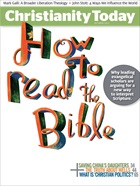
Visit ChristianBibleStudies.com for "How to Read the Bible," a Bible study based on this article.
Other Christianity Today articles on theology and exegesis include:
The Paul We Think We Know | How his 21st-century evangelical makeover distorts the New Testament reality. (July 22, 2011)
The Search for the Historical Adam | The center of the evolution debate has shifted from asking whether we came from earlier animals to whether we could have come from one man and one woman. (June 3, 2011)
The Jesus We'll Never Know | Why scholarly attempts to discover the 'real' Jesus have failed. And why that's a good thing. (April 9, 2010)
Man of the Bible | When it comes to careful exegesis and consistent theological systems, Calvin set the bar high. (September 9, 2009)
















 While we pray for peace, we need moral clarity about this war.
 As my doubts about his teachings grew, so did a secret fascination with Jesus.
 How groups like Hillsong learned to let go of the literal in favor of creative collaboration.españolPortuguês






