In a recent ecumenical meeting of Christian leaders discussing theology and worship, two evangelical representatives expressed a shared dilemma: How should they integrate concerns for justice and care for the poor into worship? One complained that modern praise songs do not speak about these issues. Given their nondenominational backgrounds, they were not sure where to turn for help.
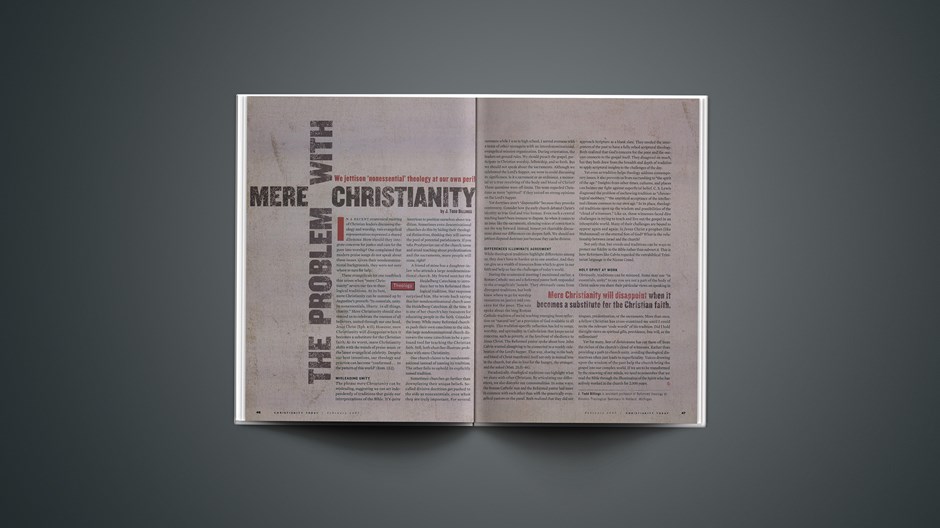
These evangelicals hit one roadblock that arises when "mere Christianity" severs our ties to theological traditions. At its best, mere Christianity can be summed up by Augustine's proverb: "In essentials, unity. In nonessentials, liberty. In all things, charity." Mere Christianity should also remind us to celebrate the oneness of all believers, united through our one head, Jesus Christ (Eph. 4:15). However, mere Christianity will disappoint when it becomes a substitute for the Christian faith. At its worst, mere Christianity shifts with the trends of praise music or the latest evangelical celebrity. Despite our best intentions, our theology and practice can become "conformed … to the pattern of this world" (Rom. 12:2).
Misleading Unity
The phrase mere Christianity can be misleading, suggesting we can act independently of traditions that guide our interpretations of the Bible. It's quite American to position ourselves above tradition. Sometimes even denominational churches do this by hiding their theological distinctives, thinking they will narrow the pool of potential parishioners. If you take Presbyterian out of the church name and avoid teaching about predestination and the sacraments, more people will come, right?
A friend of mine has a daughter-in-law who attends a large nondenominational church. My friend sent her the Heidelberg Catechism to introduce her to his Reformed theological tradition. Her response surprised him. She wrote back saying that her nondenominational church uses the Heidelberg Catechism all the time. It is one of her church's key resources for educating people in the faith. Consider the irony: While many Reformed churches push their own catechism to the side, this large nondenominational church discovers the same catechism to be a profound tool for teaching the Christian faith. Still, both churches illustrate problems with mere Christianity.
One church claims to be nondenominational instead of naming its tradition. The other fails to uphold its explicitly named tradition.
Sometimes churches go further than downplaying their unique beliefs. So-called divisive doctrines get pushed to the side as nonessentials, even when they are truly important. For several summers while I was in high school, I served overseas with a team of other teenagers with an interdenominational, evangelical mission organization. During orientation, the leaders set ground rules. We should preach the gospel, participate in Christian worship, fellowship, and so forth. But we should not speak about the sacraments. Although we celebrated the Lord's Supper, we were to avoid discussing its significance. Is it a sacrament or an ordinance, a memorial or a true receiving of the body and blood of Christ? These questions were off-limits. The team regarded Christians as more "spiritual" if they voiced no strong opinions on the Lord's Supper.
Yet doctrines aren't "dispensable" because they provoke controversy. Consider how the early church debated Christ's identity as true God and true human. Even such a central teaching hasn't been immune to dispute. So when it comes to an issue like the sacraments, silencing voices of conviction is not the way forward. Instead, honest yet charitable discussions about our differences can deepen faith. We should not jettison disputed doctrines just because they can be divisive.
Differences Illuminate Agreement
While theological traditions highlight differences among us, they don't have to harden us to one another. And they can give us a wealth of resources from which to grow in our faith and help us face the challenges of today's world.
During the ecumenical meeting I mentioned earlier, a Roman Catholic nun and a Reformed pastor both responded to the evangelicals' lament. They obviously came from divergent traditions, but both knew where to go for worship resources on justice and concern for the poor. The nun spoke about the long Roman Catholic tradition of social teaching emerging from reflection on "natural law" as a provision of God available to all people. This tradition-specific reflection has led to songs, worship, and spirituality in Catholicism that keeps social concerns, such as poverty, at the forefront of obedience to Jesus Christ. The Reformed pastor spoke about how John Calvin wanted almsgiving to be connected to a weekly celebration of the Lord's Supper. That way, sharing in the body and blood of Christ manifested itself not only in mutual love in the church, but also in love for the hungry, the stranger, and the naked (Matt. 25:31-46).
Paradoxically, theological traditions can highlight what we share with other Christians. By articulating our differences, we also discover our commonalities. In some ways, the Roman Catholic nun and the Reformed pastor had more in common with each other than with the generically evangelical pastors on the panel. Both realized that they did not approach Scripture as a blank slate. They needed the interpreters of the past to have a fully orbed scriptural theology. Both realized that God's concern for the poor and the outcast connects to the gospel itself. They disagreed on much, but they both drew from the breadth and depth of tradition to apply scriptural insights to the challenges of the day.
Article continues below
Yet even as tradition helps theology address contemporary issues, it also prevents us from succumbing to "the spirit of the age." Insights from other times, cultures, and places can bolster our fight against superficial belief. C. S. Lewis diagnosed the problem of eschewing tradition as "chronological snobbery," "the uncritical acceptance of the intellectual climate common to our own age." In its place, theological traditions open up the wisdom and possibilities of the "cloud of witnesses." Like us, these witnesses faced dire challenges in trying to teach and live out the gospel in an inhospitable world. Many of their challenges are bound to appear again and again: Is Jesus Christ a prophet (like Muhammad) or the eternal Son of God? What is the relationship between Israel and the church?
Not only that, but creeds and traditions can be ways to protect our fidelity to the Bible rather than subvert it. This is how Reformers like Calvin regarded the extrabiblical Trinitarian language in the Nicene Creed.
Holy Spirit at Work
Obviously, traditions can be misused. Some may use "in essentials, unity" to say you are not a part of the body of Christ unless you share their particular views on speaking in tongues, predestination, or the sacraments. More than once, a fellow Christian has cross-examined me until I could recite the relevant "code words" of his tradition: Did I hold the right views on spiritual gifts, providence, free will, or the millennium?
Yet for many, fear of divisiveness has cut them off from the riches of the church's cloud of witnesses. Rather than providing a path to church unity, avoiding theological distinctives often just leads to superficiality. Voices drawing upon the wisdom of the past help the church bring the gospel into our complex world. If we are to be transformed by the renewing of our minds, we need to remember that we read the Bible through the illumination of the Spirit who has actively worked in the church for 2,000 years.
Article continues below
J. Todd Billings is assistant professor of Reformed theology at Western Theological Seminary in Holland, Michigan.
What Is This Word? | The incomprehensible, intimate Christmas story. (December 21, 2006)
Christmas Shame | The year we had no tree, Mother planted within me a seed of discontent with all cultural displays of religion. (December 20, 2006)
Yes to Shame and Glory | Mary is a model of openness to the power of God. (December 19, 2006)
"Shall the Fundamentalists Win?" | An excerpt from Philip Jenkins' new book, The New Faces of Christianity: Believing the Bible in the Global South. (December 5, 2006)
God's Word in an Old Light | Philip Jenkins on how global South Christians read the Bible. (December 5, 2006)
Have something to add about this? See something we missed? Share your feedback here.
Our digital archives are a work in progress. Let us know if corrections need to be made.















 While we pray for peace, we need moral clarity about this war.
 A Christian reconciliation group in Israel and Palestine warned that war would come. Now the war threatens their relevance.españolالعربيةFrançaisрусскийУкраїнська
 The plan would organize UMC churches in four global regions, with each given more leeway around same-sex marriage and other theological issues.






