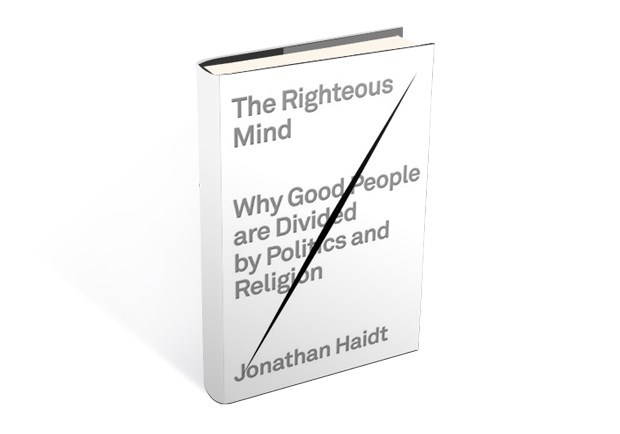
The Righteous Mind: Why Good People Are Divided by Politics and Religion
Author
Jonathan Haidt
Publisher
Pantheon
Release Date
March 13, 2012
Pages
448
Price
18.49
Conservatives have a lot of science in their favor these days. Bookshelves are bowed down with the studies of social science researchers, development psychologists, and neuroscientists that largely confirm the instincts of social conservatives. This research has so thoroughly overturned the tables that a liberal think tank fellow (the Brookings Institute's Isabel Sawhill) recently praised Dan Quayle's condemnation of Murphy Brown becoming a single parent on the 1992 sitcom.
The latest of these books is Jonathan Haidt's The Righteous Mind: Why Good People Are Divided by Politics and Religion (Pantheon). While many books implicitly affirm general evangelical views of morality, social relationships, and how healthy societies should be constructed, Haidt, a moral psychologist at the University of Virginia, explicitly compares liberal and conservative views of morality. Conservatives, he says, have a moral outlook that more fully accords with human nature.
Haidt splits his book into three parts. The first is an explanation of human moral tendencies. The big idea here is that our moral instincts come before our rationalization of them. Morality is based on "automatic processes" that guide our gut reactions to behaviors. Morality is innate, as Haidt says, "organized in advance of experience."
Part two discusses the palate of human moral instincts. Here, Haidt begins to address the differences between conservative and liberal morality. Westerners, mostly liberal ones, have studied morality by examining the views of Western Educated Industrial Rich and Democratic (WEIRD) individuals. Yet the moral tastes of these research subjects are extremely limited.
Through his research outside of WEIRD cultures, Haidt came up with a moral matrix that generally fits societies around the world. This matrix includes six core values: Care, Liberty, Fairness, Loyalty, Authority, and Sanctity. This matrix exists in all cultures—except the WEIRD ones.
Haidt chronicles how he learned to appreciate this broader moral palate while conducting interviews in a town in India. After three months, Haidt writes, "I could see beauty in a moral code that emphasized self-control, resistance to temptation, cultivation of one's higher, nobler self, and negation of the self's desires." While these virtues sometimes conflicted with Haidt's own emphasis on personal autonomy, he recognized that they served other moral goods and that it was Haidt who was deficient.
This explained why Haidt had previously discovered that liberals were unable to condemn morally repugnant behavior. Westerners, except social conservatives, exclusively valued Care as a moral category. As a result, they were unable to label behavior such as incest, cannibalism, or sex with a corpse as immoral. While these things might elicit disgust, unless they caused harm to a person, liberal interview subjects failed to find any grounds on which to condemn them. (It is easy to see that once activists are able to overcome the "ick factor" of a taboo—a stigma once attached to homosexual behavior—Western cultural values have no further ground to oppose it.)
Most cultures, on the other hand, including those sustained by American conservatives, have the full range of moral tastes. They value care for people and oppose oppressive behavior that limits individual liberty, just as liberals do. But they also value authority that gives a society structure. They invest ideas, images, and religion with sanctity. They prize loyalty to one's country and family, and they hold these values equally and in tension with each other. When asked why incest is wrong, they answer, "Because it is." When pressed, they answer, "Because it violates the dignity of the human body."
In part three, Haidt explains why conservatives are right to equally value the whole palate of moral values. Humans are social creatures, and for societies to run effectively and harmoniously, all these moral categories need to be present. Religion, it turns out, is essential to group cooperation. For example, while most of the many communes that began in the nineteenth century failed, the religious ones had a much higher success rate after 20 years (39 percent) than the secular ones (6 percent).
A Coherent Moral Framework
But Haidt's view of religion is incomplete. For him, it offers nothing more than an incentive for people to work together. In his view, doctrine is merely post hoc rationalization used to explain religious behavior. And, strangely, he doesn't include religious ritual among those things capable of inspiring awe in humans, but instead nature, hallucinogenic drugs, and night club raves.
Still, Haidt is unequivocal that societies need all six moral senses. "We evolved to live, trade, and trust within shared moral matrices. When societies lose their grip on individuals, allowing all to do as they please, the result is often a decrease in happiness and an increase in suicide." Haidt continues, "Societies that forgo … religion should reflect carefully on what will happen to them over several generations. We don't really know, because the first atheistic societies have only emerged in Europe in the last few decades. They are the least efficient societies ever known at turning resources (of which they have a lot) into offspring (of which they have few)." As the ultimate prize in Haidt's evolutionary views, this is a bad thing.
Article continues below
Haidt's main concern is to explain to liberals that the views of conservative moral thinkers (not Republicans) make a lot of sense. Liberals will continue to fail to attract voters until they expand their moral vision beyond concern for the care or harm of individuals and the free expression of their desires.
Liberals believe that conservatives vote against their own self-interest—represented by Democrats—because manipulative Republican politicians cynically appeal to their prejudices, their guns, and their God. Instead, Haidt explains to liberals, conservative thinkers have a coherent moral framework than accords with the latest social research in how society must be constructed for maximum human happiness.
Conservatives understand social and moral capital, and they see all the ways in which liberal pursuit of individual freedoms—enabled and upheld by the state—actually undermines healthy society. Observes Haidt:
Conservatives believe that people are inherently imperfect and are prone to act badly when all constraints and accountability are removed … Our reasoning is flawed and prone to overconfidence, so it's dangerous to construct theories based on pure reason, unconstrained by intuition and historical experience … Institutions emerge gradually as social facts, which we then respect and even sacralize, but if we strip these institutions of authority and treat them as arbitrary contrivances that exist only for our benefit, we render them less effective. We then expose ourselves to increased anomie [breakdown in moral standards] and social disorder.
Haidt is no convert to conservatism. He hopes liberals will use his book to broaden their moral categories, appealing to more voters, and discover a formula for greater electoral success. But his respect for conservative views will be welcome to most conservative readers.
Christians won't thoroughly agree with Haidt, but his work does suggest that there is a kind of foregone conclusion to the culture wars—one that is the opposite of what is now perceived to be historic inevitability. Happy, healthy, and effective societies require the morality of conservative communities. As the basis for such communities, the church is a refuge for those adrift in today's moral and social disorder. As the project of unconstrained individualism fails, people and families and communities will find the church to be the ideal environment in which humans flourish.
Rob Moll, CT editor at large, is the author of The Art of Dying: Living Fully into the Life to Come (InterVarsity) and a forthcoming book, What Your Body Knows About God.
Our Rating
Book Title
The Righteous Mind: Why Good People Are Divided by Politics and Religion















 While we pray for peace, we need moral clarity about this war.
 A Christian reconciliation group in Israel and Palestine warned that war would come. Now the war threatens their relevance.españolالعربيةFrançaisрусскийУкраїнська
 The rage of the mob is a poor substitute for real community.





