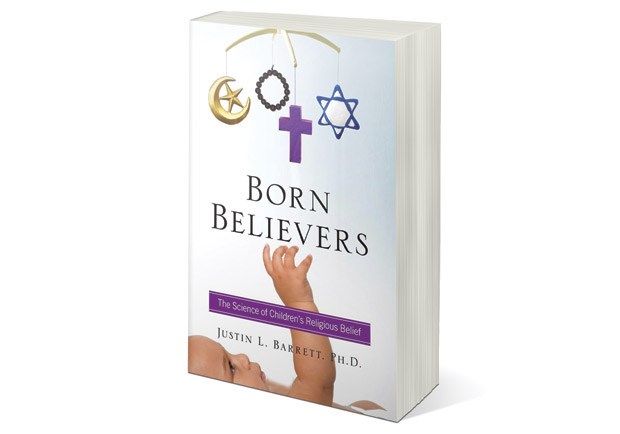
Children, argues Justin L. Barrett, are born receptive to the idea that there is a god. In Born Believers: The Science of Children's Religious Belief (Free Press), Barrett, a psychology professor at Fuller Theological Seminary, builds upon previous research on cognitive development to show that children naturally intuit design—and a Designer—when exposed to the natural world. Holly Catterton Allen, professor of Christian ministries at John Brown University, spoke with Barrett about the scientific evidence testifying to children's religious beliefs.
Why do you suggest children are "born believers"?
I'm using that term in a folk sense, the way we might say that Michael Jordan was a born basketball player, or Mozart was a born musician. I don't mean that Mozart came out of the womb playing the clavichord, but that given very minimal cultural and environmental input, he was going to take to it like ducks to water. Virtually all humans are essentially born believers—they have a natural receptivity to religious belief.
I'm contributing a new line of research that affirms [Swiss developmental psychologist Jean] Piaget's insight that children see design and purpose and meaning, but challenges his idea that they see human design or purpose. Piaget posited that young children believe that humans made the mountains or the sun. He thought they believed that God is just a human being involved in this creative process with other humans. But new research is showing that by the age of 4, children say that humans make some things, such as chairs and tables, but not mountains and trees. Even preschoolers know that humans are not the answer to the "who made the world?" question. Someone else is needed.
What scientific evidence do you see?
We are not starting with unformed blobs that can be shaped into anything we like. Research from developmental psychology suggests children learn some things more easily and are attracted to some ideas more than others. There are certain kinds of ideas that children can learn more easily and rapidly than others, and internalize more deeply, such as believing in gods.
Children have a natural disposition to see the natural world as having purpose. Research has shown that children have a strong inclination to see design in the world around them, but they are left wondering who did it. They also know design doesn't arise through random chance or mechanistic processes. In fact, children (and adults) automatically look for a person behind purpose or design. By five months old, infants already make the distinction between things that are acted upon and those things that do the acting, that is, intentional agents (like people). And preschoolers' default assumption is that these agents are super-knowing, are super-perceiving, and are not going to die. If a child is exposed to the idea of a god that is immortal, super-knowing, super-perceiving, the child doesn't have to do a lot of work to learn that idea; it fits the child's intuitions.
How do you respond to arguments that say that what you are describing is normal childish belief in magical creatures, such as Santa?
There are all kinds of childish beliefs, such as the idea that other people have minds, that there is a real world out there, that the laws of nature are stable, that my mother loves me. All these ideas are rooted in children's early developing intuitions. If that is someone's claim, I accept it; religious belief is in awfully good company.
There are interesting similarities to Santa Claus. He is an agent, with special powers to account for certain kinds of peculiar events in the world. But Santa falls terribly short in other domains. He matters only a few weeks of the year at best. He doesn't fill the conceptual gap about why the natural world is the way it is. There are limitations as to what Santa knows and doesn't know, what Santa perceives and doesn't perceive. At the core, the reason children believe in Santa is that Santa is propped up through ruse and deception. If that's all religions had going for them, they would die out pretty quickly.
What suggestions do you have for parents who wish to encourage their children's religious development?
I would encourage parents and Sunday school teachers not to sell children short by assuming that just because a concept seems difficult for adults, it must be difficult for children. We know this is not true for music or language learning. Why would it be for religion? An opportunity could be missed if we don't teach about God's attributes until children are 8 or 9 years old.
Also, children need to see parents and other members of their religious community acting like they believe. Their belief should be a natural, organic part of existence, rather than something special or set apart in terms of space—for example, only in church, or set apart in terms of the way we talk. Who says, "I believe there is oxygen"? The existence of oxygen is part of our ordinary understanding of our world, and our conversation never presumes otherwise. If parents are convinced God exists, they should simply talk that way. Otherwise, children will begin to perceive that belief is strange or suspect.
Article continues below
Most important, we should focus on God's relational character. As born believers, children may perceive that God is super-powerful, super-knowing, immortal, and morally interested. Other questions are critical: Is God distant and aloof? Or is God involved and loving? There is a difference between believing that there is a god and having a relationship with God. This relational aspect requires cultivation beyond the default intuition that God exists.
















 While we pray for peace, we need moral clarity about this war.
 We’ve got little information on Jesus’ appearance and personality. But that’s the way God designed it.españolFrançais
 Beyoncé’s right. Whether listening to Cowboy Carter or reading theology, diversity is a good thing.






