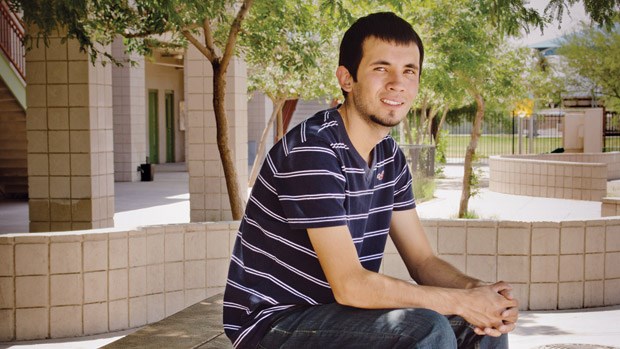
Alfonso Vazquez barely remembers life in Guanajuato, his childhood home north of Mexico City. Some snippets remain: His mother crying a lot, days when a plate of tortillas fed him and his five siblings, other days when the plate was empty. His mom made weekly phone calls to his father, who sent money every week to their village from wherever he was.
But there's a memory that's proved "one of the hardest things to forget to this day," says Vazquez. At age 4, Vazquez was carried by his mother through the Sonoran Desert, a 120,000-square-mile stretch of sweltering land that traverses the tough line between northwest Mexico and the southwest United States. "I remember a lot of crying. My dad was pushing my mom to continue north. I remember him saying, 'We're heading to El Norte.'" Their journey to the border was over 1,200 miles, and from there to Phoenix, the capital of Arizona, another 200.
From there, Vazquez's path to a stable life in El Norte has been delayed by many roadblocks. When he was 8 years old, he and his dad spotted people boarding a bus parked outside a gas station near their home in north-central Phoenix. His dad explained they were ice—Immigration Customs and Enforcement—buses. At that moment, Vazquez realized he'd need to hide. "To not be able to do normal things, to travel, but not be able to go back to Mexico and visit grandparents—it was hard."
When Vazquez was 14, his father left the family, and his mother had to choose to either stay in Phoenix without support or go back to Mexico without a future. They stayed, but as Vazquez faced his senior year of high school, he realized attending college—that distinctly American stepping stone from poverty to self-sufficiency—would be next to impossible without papers.
"I got caught between my parents wanting a better future for me and a system in the United States that is broken," says Vazquez, 20. "That's the most difficult thing, that nothing could be done in Washington after so many years."
Vazquez's story highlights issues that are deeply contested in the United States by Christians and non-Christians alike. Hopeless poverty put a strain on Mexicans and drove them north to a land of plenty. But illegal immigration has also put a tremendous strain on health and human services in the country, especially after the recent recession. Some Christians think law and order (enforcing immigration laws) is the highest priority; others believe compassion even toward lawbreakers is the church's primary calling. The debates are far from over.
But as the nation tries to repair what nearly everyone agrees is an inadequate immigration system, Christians in Phoenix are ministering to those caught in the middle under the scorching heat of their city's sun.
Not a New Problem
The immigrant's silhouette has been a feature of Arizona's landscape for most of its history. In 1942, 30 years after Arizona became the 48th state, Mexican workers began arriving as part of the Bracero Program (bracero means "strong arm"), instituted by President Franklin Roosevelt to shore up the nation's faltering wartime economy. Working with farmers, U.S. officials determined how many Mexicans were needed annually for the harvest, and Mexican officials distributed that number of work permits throughout northern Mexico. When permits ran out, workers desperate for income came north anyway.
"That was really the roots of illegal immigration, and the roots of migration, from Mexico to the Western U.S.," Judith Gans, manager of the immigration policy program at the University of Arizona, told Christianity Today. "A lot of the original sending regions are places where we get a lot of migrants from Mexico." By 1964, when the program formally ended, over 4.5 million Mexicans had been contracted for work in the States.
Mexicans continued to arrive in Arizona long after Bracero, an influx that proved to be key to Arizona's economic growth, particularly in Maricopa County (where Phoenix is). "Immigrants came wherever the jobs were," says Gans. "So their coming to Arizona was really tied to the growth of Arizona and its industries." Manufacturing, construction, and tourism in particular relied on the willing hands of illegal immigrants, who by 2008 numbered about 500,000 throughout the state, estimates Gans.
But within three years—during which Phoenix's housing market hit bottom—everything changed. The Department of Homeland Security estimated that by 2011, the number of illegal immigrants in Arizona had dwindled to 360,000, the lowest figure since 2000. Then in 2010, Arizona's governor signed into law what's become a signature, and hotly debated, piece of U.S. immigration legislation. Combined with the economic downturn, SB 1070—which allowed police to stop anyone reasonably suspected to be in the United States illegally at any time—has led to an exodus of Latinos from Maricopa County.
Article continues below
"Many of our churches have lost a lot of members," says Jose Gonzalez, Hispanic director of the nonprofit CityServe Arizona. "One 250-member church dwindled to 100." Gonzalez is a Mexican native who has helped plan crusades for evangelist Luis Palau, making him el conector for hundreds of Latino pastors throughout Phoenix. "Many people are going to another state, going back to Mexico or Latin America. A lot of families are being divided. They are afraid of SB 1070. They don't know the difference between Joe Arpaio and the police department." (Arpaio, self-proclaimed as "America's Toughest Sheriff," pushes strident anti-immigration tactics that have landed him in a civil-rights trial that began the week this story went to press.)
Ian Danley, youth pastor with Neighborhood Ministries, knows one congregation that "went from $6,000 in tithes to $1,500 in one week. The church building was foreclosed, and for the first time in 30 years of ministry, the pastor is looking for a day job."
Local Anglo churches' response to struggling Latinos has been mixed. Redemption Church, a multisite congregation, started serving immigrants back in 2002, when the poor treatment of day laborers was drawing public attention. Since then, pastor Tyler Johnson has advocated from the pulpit for a more compassionate immigration policy, and Redemption serves local Latinos through its Broadway Corridor Community Center, where job training, ESL classes, and child care are offered.
"People will argue about politics," says Johnson, "but you can't argue with experience. When [our members] get to know an immigrant, the change we see is astounding. Eventually they begin asking, 'What can we do to address this problem in the community?'"
Yet Gary Kinnaman, former pastor of a 6,000-member megachurch in nearby Mesa, says fellow Anglo leaders are still reticent to engage Latino neighbors, lest they anger members who favor tougher immigration policies. "When it comes to immigration," he says, "some people in our churches spend more time listening to talk radio or television than the Word of God. If a pastor even broaches the issue of immigration, there is often a firestorm of opposition."
Kinnaman experienced this directly in 2008, when he and 20 other evangelical leaders in Arizona wrote a letter to state officials calling for more compassionate laws on the heels of several raids ordered by Arpaio. "We must uphold the law, but when laws are used to raid churches and church events and separate children from families, then it indicates that something is wrong with these laws," Kinnaman said at the press conference.
Article continues below
"The reaction was overwhelming," Kinnaman told CT. "A Christian talk-radio host read our names on the air, mocked us, and used all kinds of inflammatory language against us. That's the kind of worldliness that has penetrated the church on this issue."
But Gonzalez paints a more positive picture. "I used to think Anglo churches weren't willing to connect with us, but I've found they really care about what Hispanic churches are going through. They ask me, 'Is there anything we can do?' They just don't know how to connect."
To provide those connections, this March Gonzalez and Kinnaman launched a School of Leadership for Hispanic pastors at the nondenominational Phoenix Seminary. Over 30 pastors are enrolled in the first course. "Our goal is to create a place where pastors get to know each other," says Kinnaman, chairman of the Arizona Council on Faith-Based and Community Initiatives, "and hopefully church partnerships can develop for their mutual development."
Meanwhile, Gonzalez has found support from an unlikely source: the Phoenix Police Department. Shortly after the Supreme Court upheld a key portion of SB 1070 this June—the section that says police may seek to determine the status of a person even if stopped for another reason—Gonzalez approached human resources at the warehouse where he is chaplain. He got permission to have a police officer speak to its 1,200 employees—80 percent of whom are Latino—to clear up their confusion over SB 1070. Detective Luis Samudio came in to clarify that his department would not require Latinos to carry federal registration cards or arrest them based on skin color, as rumors suggested. Through Gonzalez's friendship, Samudio, a Catholic, has spoken about SB 1070 at some 40 Hispanic churches throughout the county. "As SB 1070 came out, the Hispanic community felt very uncomfortable. Jose has helped us remarkably," says Samudio, noting that the Citizens Police Academy, a four-week program that introduces attendees to the various police bureaus, has started attracting Hispanic pastors, who take the lessons back to fearful congregants.
Article continues below
"My parents emigrated here legally from Central America, but their English isn't clear," says Samudio, a Phoenix officer for 12 years. "I hope that an officer who would stop them would treat them with dignity and respect. My kids have a Spanish accent, and I don't want them to be treated any differently."
Responses legal and not
While Anglo pastors find ways to befriend Hispanic leaders, many lay Christians are stepping up, some at great personal risk, to help illegal immigrants in several sectors across Phoenix, including business.
Bill (who spoke on condition of anonymity) has owned a construction business for more than 20 years, during which he's hired many undocumented migrants. "We've never paid an immigrant any less than we've paid an Anglo," he insists. "In fact, we often pay them more, because they are more skilled." Bill knows "many, many" fellow Christian business owners who are hiring illegal immigrants, despite the risk to their businesses.
"We pay taxes on all our workers, and we check their status with E-Verify because it's the law of the land." (E-Verify, a digital authorization system, is required of all Arizona employers, though it's frequently outsmarted by false identification and forged Social Security numbers.) And yet, he says, "I feel we have a moral obligation to break the law and help our neighbors."
Bill, who grew up in a largely Hispanic neighborhood, firmly believes immigrants are an asset to his city of 1.45 million. "They contribute to our economy and they pay taxes," he notes. "In fact, the government makes money from them because they cannot collect tax refunds or Social Security." Driving illegal immigrants out of Phoenix is misguided, he says. "We are not only harming our country, we are also doing great harm to those seeking a better life."
Due to the economic slowdown, Bill is not currently hiring anyone, illegal or otherwise. But in the meantime, he has developed relationships with employees that don't fade as easily as his profits. One such employee is Maria, whom he met while his mother was dying and needed a caretaker.
"None of the women sent by the agencies worked well," recalls Bill. "Then we hired Maria, an illegal. She didn't just do her job—she loved my mother. We thought she was dying. I truly believe Maria's care helped her recover. She added months to my mother's life. Afterward, I hired her for my business. I don't know how we could function without her."
Article continues below
Other immigrants besides Maria are contributing to Phoenix in more pronounced ways. Selina Alonzo, an English teacher for eight years at Maryvale High School, keenly understands what her students in the poor, Hispanic neighborhood of Sunset Knoll are facing, because she used to be one of them.
"People from this neighborhood who make it to college don't return," she says. "But if no one returns, how can it ever change? In order to make a difference, I had to come back."
After receiving Christ as a teenager through Young Life, Alonzo connected to Neighborhood Ministries, where she felt called to carry her passion for literature to Latinos. In 2009, she was awarded Teacher of the Year in the Phoenix Union High School District.
"I build relationships with my students, and they come to trust me. Teaching English gives many opportunities for students to share their stories."
Alonzo says fear clouds the classroom, stifling effective teaching. Some students' parents have been deported, leaving the students to care for their younger siblings. "It's hard to concentrate on Shakespeare when they're worried about a little brother or sister after school," notes Alonzo. The steady fear of deportation is debilitating.
She also notes a common irony: "I sit in a classroom of brown faces," she says, "but they are 100 percent American. They don't know a thing about life in Mexico."
Adding to Alonzo's challenge is the hopelessness many undocumented students feel. "Before the Dream Act"—which made provisions for moving students toward citizenship—"it was almost impossible to motivate these students. If they graduate from high school, most can never afford out-of-state college tuition. Then if they manage to graduate from college they can't work because they're undocumented."
Instilling hope has become a bit easier since President Obama's June announcement that he would grant temporary work permits to young, illegal immigrants who could otherwise be deported. Alonzo's desire is to use this hope to point to a greater reality. "I believe with my whole heart that as these students see me and others who are full of hope, we will have the opportunity to point them toward the ultimate hope in Christ."
Article continues below
Allison Williams, meanwhile, is offering hope to Latina women—specifically those who hope to escape abuse and live healthy lives.
As a graduate student at Arizona State in 2009, Williams studied the Violence Against Women Act (VAWA), a federal law passed in 1994. In the law is a proviso called the U visa: noncitizen victims who work with authorities to prosecute the perpetrator can earn a pathway to legal status, whether a temporary visa, work permit, or application for legal residency.
While leading a graduate project on the U visa, Williams recalled three women she knew through Neighborhood Ministries, where she had lived and served since 2001. The women, who had been sexually abused, had worked with police to find their abuser, then in jail. "I tracked down immigration lawyers who were able to give me the facts, and I told the women where they could apply for the U visa," says Williams. "These women are all legal, permanent residents now. That was my first step to advocacy from friendship."
This type of advocacy, in fact, may not be possible much longer. This May, the House passed a version of VAWA that removed many protections for immigrant women. Evangelical groups, including InterVarsity Christian Fellowship, World Relief, and the National Association of Evangelicals, sent an open letter to Congress warning that the new restrictions could endanger already-vulnerable women. Other groups, such as Concerned Women for America and the Southern Baptist's Ethics and Religious Liberty Commission, denounced VAWA as "obscuring real violence in order to promote the feminist agenda." Amid the political back-and-forth, Williams, of course, knows the real risk of striking the U visa: Undocumented women will stay in abusive situations for fear they would be deported if they report the abuse.
"Immigrants are afraid to report crimes, especially violent crimes, so violence and abuses like this are able to go on," says Williams. "They become people who have little hope that there is hope."
One way that Williams is currently promoting hope is by directing Madres para la Salud ("Mothers for Health"), a three-year study of heart disease and diabetes prevention among Latinas funded by the National Institutes of Health. The study, hosted by Arizona State's nursing college, surveyed 139 women, 121 of whom were born in Mexico. "We're trying to intervene at a crucial time in their life, after they have a baby, and help them lose weight and body fat and avoid postpartum depression," says Williams. The results of the survey will help the Maricopa County Health System and other Phoenix health-care providers (including Charlotte Thrall, page 30) treat Latinas' needs in an earlier and more cost-effective way.
Article continues below
In the meantime, the study forged supportive relationships. Two weeks ago, one of the women called Williams to announce she had left her violent husband and had found counseling and legal support at Shelter Without Walls, a Jewish agency recommended by Williams. "She called to thank us and let us know that she had just received her work permit.
"As a social worker, you learn to respond to the felt needs of the community," says Williams. "I was learning about those needs through relationships with my church and the neighborhood in which I lived." Now, members of Williams's neighborhood will give back in a similar way. This school year, 15 Latino youth from Neighborhood Ministries will attend college on the Wayne and Kit Danley Scholarship Fund, set up by the ministry's founders in 2008. Of the students, many plan to become social workers.
In the meantime—hope
For his whole life, Ian Danley (page 31) has watched his parents labor tirelessly through Neighborhood Ministries to serve low-income Latinos in central Phoenix, a work that has touched thousands of brown- and white-skinned Phoenicians alike since 1981. But he's also watched Neighborhood Ministries recognize the limits of their approach: Kit, Wayne, and the staff have poured years of love and energy into children, only to find them dead-ended at the brick wall blocking the path to legal status in this country.
"You can case-by-case your way through an education, but not immigration," argues Danley. "Immigration requires a policy solution," a belief that puts him in the camp of evangelical leaders from Focus on the Family's Jim Daly to Sojourners' Jim Wallis, who alike support comprehensive immigration reform on the federal level. But until the dust settles from this November's election, they'll have to wait to see if the government will act. In the meantime, the Danleys have put one person's life—Alfonso Vazquez's—on the path of hope, if not the path of full citizenship. Vazquez, a recipient of the scholarship, is studying criminal justice at Phoenix College in Mesa.
"I was a kid who many saw as a future gangster, a future felon," says Vazquez, who wants to be a detective. "Neighborhood Ministries just led me to God. They provided me with leaders who had a big influence in my life."
Article continues below
When asked what sustains him, Vazquez says he trusts God, praying "that one day things will get better for my siblings and the millions of others who have faced the struggle I faced." For those millions who have arrived in El Norte under the blazing Phoenix sky, a combination of prayer and policy is the path to abundant life.
Katelyn Beaty is editorial director of This Is Our City. Skye Jethani is an ordained pastor and senior editor of Leadership Journal. Additional reporting provided by Jasmine Young and Nathan Clarke.
Have something to add about this? See something we missed? Share your feedback here.















 While we pray for peace, we need moral clarity about this war.
 A Christian reconciliation group in Israel and Palestine warned that war would come. Now the war threatens their relevance.españolالعربيةFrançaisрусскийУкраїнська
 The rage of the mob is a poor substitute for real community.






