Jump directly to the content

Supreme Court's Health-Care Ruling Could Weaken Charity Tax Breaks

Why some religious nonprofits' worries aren't about the contraception mandate.
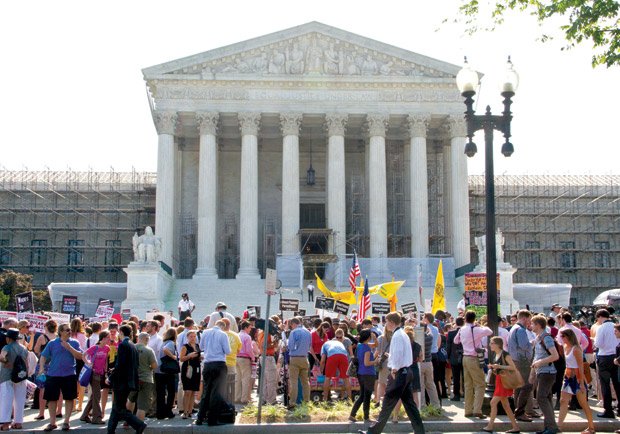
Photo by Stephan Boitano / Polaris / Newscom

Supreme Court's Health-Care Ruling Could Weaken Charity Tax Breaks

The U.S. Supreme Court's ruling upholding the Affordable Care Act—or "Obamacare," as some have dubbed it—has advocates of faith-based nonprofits concerned about potential unintended "collateral damage" to their bottom lines.

The worry: Chief Justice John Roberts's nod to lawmakers' wide discretion to impose taxes—and to condition taxes to influence behavior—could pose threats both to charities' tax exemptions and to donors' tax deductions.

"It's an issue that's definitely on our radar," said Rhett Butler, government liaison for the Association of Gospel Rescue Missions.

W. Scott Brown, vice president of the Christian Leadership Alliance, echoed Butler: "We are following this issue closely."

Stanley Carlson-Thies, president of the Institutional Religious Freedom Alliance, said he'd be surprised if the health-care decision doesn't spark "new activism" on the tax front.

"There's no reason to say the sky is falling before it's falling," he said. "But if it's getting darker, we ought to pay attention."

In a recent piece for The Chronicle of Philanthropy, nonprofit experts Suzanne Garment and Leslie Lenkowsky maintained that Roberts's majority opinion "makes it clear that if lawmakers voted to impose restrictions on tax-deductibility or tax exemption, they would not face any constitutional obstacles."

In the decision, Roberts wrote that "taxes that seek to influence conduct are nothing new."

Some advocates fear that the ruling could embolden efforts to limit exemptions to only nonprofits that serve the poor and minorities, or to only those that provide services the government cannot.

Any reduction in deductions for charitable contributions would "negatively impact churches and many other exempt organizations that depend on such contributions to carry out their respective missions," said Dan Busby, president of the Evangelical Council for Financial Accountability.

Two forces contribute heavily to these concerns, advocates said:

• Lawmakers at all levels of government are seeking ways to increase revenues and balance budgets amid trying economic conditions. In May, New Hampshire's Supreme Court ruled that cities can tax churches on portions of their property deemed not to be used for religious purposes.

"On both sides of the [political] aisle, everything is on the table," said Butler.

• Certain activists are eager to place more conditions and rules on tax-exempt groups—efforts aimed variously at limiting what counts as charitable activity or fighting mission statements and hiring practices deemed discriminatory.

Given how readily many activists label as discrimination "many of the religiously rooted practices of faith-based organizations," Carlson-Thies said, the Supreme Court's ruling could be seen as a "flashing danger signal."

For rescue missions across the nation, recent years already have brought budget crunches, Butler said. The missions, most of which rely on private giving for half to three-quarters of their income, have trimmed overhead and operating costs.

"Any drops in private giving from donors would go straight to frontline services for the hungry and homeless, the abused and addicted," he said.

But he's preparing for a fight. "I think the Supreme Court decision could embolden some people who want to take control of the money that goes to charities," Butler said. "I think that's a very serious problem."

Correction: The print version of this article incorrectly named the state whose Supreme Court recently ruled on church property. It was New Hampshire, not New Jersey.



From Issue:
September 2012, Vol. 56, No. 8, Pg 16, "The Tax Man Cometh?"
More from Christianity Today
A Fractured and Beautiful Faith

A Fractured and Beautiful Faith

How songwriter Audrey Assad transcended "positive and encouraging" to create music for the church.
A Terrifying Grace

A Terrifying Grace

Why God’s omniscience is good news for us.

Streaming This Weekend, May 24, 2013

What to watch this weekend (hint: don't make a huge mistake).
Can a Christian Family Ever Be Too Big?

Can a Christian Family Ever Be Too Big?

Experts weigh in.
Get Instant Access
Christianity Today Magazine
Subscribe now for a year (10 issues) at $24.95 for print, iPad, and instant web access.

International Orders

Comments

J Thomas

September 06, 2012  2:54pm

The thing from the DNC most relevant to Christians is not being covered by Christianity Today. The Democrats took all references to God and Jerusalem out of their party platform, which has never happened before. That's a huge development with immediate relevance and significance for Christians. Christians have an interest in whether or not a political party is distancing itself from them, and whether or not that party is committed to helping the Jews remain in Jerusalem.

Report Abuse

J Thomas

September 04, 2012  11:42pm

The Obama administration also tried to go through the judicial branch to force churches to hire according to federal standards, meaning that they could no longer hire according to religious preference. It's in the case Hosanna-Tabor v. EEOC. How 'bout an atheist for a pastor, eh? All for the sake of 'diversity'. Kinda sounds like what we left England for in the first place. There is no freedom in worship when you don't even have the freedom to pick your own clergy. The only way to push back against these intrusions is to vote out the Obama administration, and then to speak loudly and clearly to the next and the next and the next administrations. We can no longer afford to remain silent. We must stand up now and be counted or else we'll allow ourselves to be marginalized and pushed into dark alleys and home bible studies like the Romans before Constantine. Vote these guys out ASAP.

Report Abuse

Jack Ratekin

September 04, 2012  4:24pm

What is all this about? There was never any constitutional guarantee of no taxes for non-profits. Congress decided to not tax churches, etc. long ago by arguing that the good they do is worth more than any taxes that might be collected. Congress gave and Congress can take away. But it's highly unlikely any congressman will vote to strip non-profits of tax exempt status. They would lose the next election if they did. Do you really have nothing better to do all day than make up conspiracy theories and spread fear? If not, get in touch with me. I have several opportunities for you to do some real good in the world instead of spreading fear, lies, slander and innuendo.

Report Abuse
You must be a Christianity Today subscriber to post comments
(on articles open to the public, you must at least register for a free account).
Login
or
Subscribe
or
Register

Don't Miss

Rob Bell's 'Ginormous' Mirror

Rob Bell's 'Ginormous' Mirror

To read his book is to read about our fascination with ourselves.
Losing my Edge

Losing my Edge

When your initial enthusiasm fades, you need a plan if you're going to bring your best to your calling

War and Peace

War and Peace

Pastor Tullian Tchividjian survived a leadership coup by finding rest in the liberating power of the gospel.

more | current issue

Today's Christian Woman

Ministering to Military Families

Ministering to Military Families

Five tangible ways to...

Books & Culture

A Measure of Forgiveness

A Measure of Forgiveness

Memories of a British...

Small Groups

Conflict in Small Groups

Conflict in Small Groups

Work through conflict...

Out of Ur

Review: Missio Alliance Gathering 2013

Review: Missio Alliance Gathering 2013

Reflections on mission...

Facebook

CT eBooks & Bible Studies


Shopping