Jump directly to the content

Discipleship Is Messy

Insider movements can lead to syncretism, yes. But less so if we all stay connected.

Discipleship Is Messy

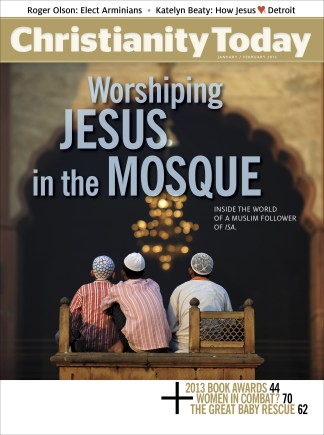
The most telling comment in the interview with Abu Jaz, a Muslim follower of Christ (page 22), is this: "We cannot rule out syncretism at the beginning of a new believer's life …. When they put their faith in Jesus, they may have at the same time Muhammad in their heart."

It harkens to another quote from a recent CT interview, this one with author-pastor Max Lucado, given in response to someone who asks if preaching grace might encourage sin: "My experience has been, yes, for a time. There will be people who will say, 'You know what? God is going to forgive me. I'm going to go get drunk again.'"

Whether the context is Christian America or the Muslim world, discipleship is a messy business. Growth in Christ is usually slow, sometimes agonizingly slow, subject to repeated misunderstanding, backsliding, and even heterodoxy.

That's why many new converts and missiologists say that new converts from Islam or Hinduism, for example, should repudiate their religion, and even their culture, especially if that religion has permeated culture to prevent people from hearing the gospel. There is something right and true about this approach for many believers.

Other converts and missiologists encourage new believers to remain in their culture as long as possible, as long as Scripture doesn't explicitly forbid the practices in question. This approach has been very effective at introducing Muslims to Christ, exponentially even, as the article by missiologist Phil Parshall shows (page 31). There is also something right and true about this approach.

History shows that the threat of syncretism or even heresy, while a cause for concern, is not an end point.

Recently, some missionaries have advocated a more radical approach. New believers are encouraged to retain their religious identity and to worship and follow Jesus as Lord and Savior within their community. They reject or reinterpret features of their religion when necessary (e.g., Muhammad can no longer be the prophet, though he can still be viewed as a prophet of God and honored as such), but they otherwise follow Jesus in the midst of their religion. As the interview with Abu Jaz shows, there is something right and true about this approach as well.

Like many, we are cautiously optimistic about this deep insider strategy. Optimistic because we believe this is an effective way to introduce large numbers of Muslims or Hindus, for example, to Christ—especially when their cultural and religious setting makes it nearly impossible to hear the gospel as good news, rather than a foreign religion or an American import.

We're cautious because the hazards—such as syncretism—are obvious, as Abu Jaz notes.

Still, church history shows that the threat of syncretism or even heresy, while a cause for concern, is not necessarily an end point. In the 3rd and 4th centuries, the "gospel" in much of southeastern and central Europe was more Arian until orthodoxy finally triumphed in the 6th and 7th centuries.

Another example: Christianity in Japan was forced to become a deeply insider movement in the early 1600s. These Kakure Kirishitans, or "hidden Christians," continued to practice Christianity in secret. Figures of the saints and the Virgin Mary were transformed into traditional statues of the Buddha and bodhisattvas. The prayers began to sound like Buddhist chants, and the Bible and other parts of the liturgy were passed down orally.


From Issue:
January/February 2013, Vol. 57, No. 1, Pg 69, "Discipleship Is Messy"
More from Christianity Today
Los samaritanos del día de hoy

Los samaritanos del día de hoy

Jesucristo nos muestra que bajo la piel, todos somos parientes.
The 'Handicap Icon' Gets New Life

The 'Handicap Icon' Gets New Life

New York’s revamped accessibility symbol began at a Christian college.
Sponsoring a Movement

Sponsoring a Movement

Former sponsored children like Moses Pulei pay it forward in their hometowns.
Sidelining the Stigma of Mental Illness

Sidelining the Stigma of Mental Illness

Amy Simpson challenges the church to step up its ministry to a vulnerable population.
Get Instant Access
Christianity Today Magazine
Subscribe now for a year (10 issues) at $24.95 for print, iPad, and instant web access.

International Orders

Join the Conversation

Displaying 1–5 of 10 comments

James B

January 31, 2013  1:28pm

"I can attest that the mosque is controlled by seducing spirits that keep its adherents in chains" Perhaps, but so is your local shopping mall Salaam. Its a temple to mammon and the liturgy is preformed at the till. Even staying home is dangerous - Just look what happened to King David when he prayed on his roof! Maybe we should hide under our beds? No, believers need not fear territories. Fear of territory belongs to the magic worldview not Christian. What we need to fear/avoid is walking outside of the Spirits guidance/God's will. That is something different altogether. I'm not saying one should wander willy nilly into a mosque, or that one should take part in all the worship, just saying lets not embrace unbiblical (magic) concepts of territory.

Report Abuse

Salaam Corniche

January 25, 2013  3:50pm

Dear Editor: I too am disturbed that you seemed to choose sensationalism over solid theology. A former Muslim I know read the title of your journal and said, "If they have gone to the mosque to worship Jesus they are lost." Sadly your contributors Travis, and Daniels play on the ignorance of Westerners who think that mosque attendance and the like is neutral. From living in an Islamic context for more than a decade I can attest that the mosque is controlled by seducing spirits that keep its adherents in chains. This is not some cute missiological experiment. Unfortunately you did not mention those statistics in Bangladesh and in the Balkans where a sort of hybrid "Christian-Muslim" ritual was tried. Guess what? All paths led back to Islam. Why? The spiritual force. A French convert to Islam noted that all mosques are connected like a bicycle wheel to the Ka'aba which is the sacred building in Mecca. For good reason it is black, has a black stone, and is cubic in form."

Report Abuse

DAVE COLES

January 21, 2013  6:05pm

It appears you failed to notice the vast difference between a person or group being a “religious” or “socioreligious” insider (Travis’ description) andbeing a cultural insider but not a religious insider (Abu Jaz’ description). Given the importance of this issue, I’m disappointed that you’ve blurred a vital distinction at one of the most crucial points of the discussion, making it appear that Abu Jaz and his movement illustrate a type of religious contextualization more radical than their actual practice. I hope you will rectify the confusion caused by the mixing of Abu Jaz’ contextual approach (cultural insider) and Travis’ approach (religious insider). Thank you.

Report Abuse

DAVE COLES

January 21, 2013  6:04pm

I appreciate CT tackling this issue. Sadly, though, your framing of it tends to increase confusion. Your title (“Worshiping Jesus in the Mosque") and what Travis describes (remaining “inside the religious communities of their birth”) is very different than what Abu Jaz described in his movement. Abu Jaz states numerous times that his movement is culturally Muslim, but not religiously Muslim. He said: • "The church should reflect Muslim culture, not Muslim theology." • “when they understand the gospel more clearly, they don't want to have an Islamic religious identity. Yet they also do not want to let go of their cultural identity as Muslims,” • "Who are these people? These people are not Christians. These people are not Muslims. " • "I went back and restored my former Islamic cultural identity." Thus it seems misleading that you write, “…they otherwise follow Jesus in the midst of their religion. As the interview with Abu Jaz shows, there is something right and true about this..."

Report Abuse

James B

January 21, 2013  4:06am

T David, a better comparison would be the Catholic church. A few 100 yrs ago Catholics & Protestants were deadly enemies. For many (eg in England) there were political aspects to this hate & fear of Catholics. The English nation & identity felt threatened by the power of Catholicism in Europe & so the Pope was portrayed as the Anti-Christ. Later it was USSR threatening the West & they became Anti-Christ warned of in sermons & books. Now it is the Islamic world. How convenient for governments our political enemies become the Anti-Christ! How naive we Christians still fall for this manipulation! Thankfully these days there are only very few evangelical “haters” that would say it is impossible to follow Christ within the Catholic church (even if we have problems with some aspects of their official theology). Lots of cultural Protestants, Catholics, and Muslims may not be “saved” but plenty ARE! They are dedicated followers of Christ seeking to see these religious cultures transformed.

Report Abuse
See All 10 Comments
Use your Christianity Today login to leave a comment on this article.
Not part of the community? Subscribe now, or register for a free account.
Login
or
Subscribe
or
Register

Don't Miss

Want to Change the World? Sponsor a Child

Want to Change the World? Sponsor a Child

A top economist shares the astounding news about that little picture hanging on our refrigerator.
Bumbling the Great Commission

Bumbling the Great Commission

Is our discipleship too narrow?

The Sightless, Wordless, Helpless Theologian

The Sightless, Wordless, Helpless Theologian

How our daughter's brief life showed us eternity.

more | current issue

Books & Culture

Our Lives, Our Fortunes, and Our Sacred Honor

Our Lives, Our Fortunes, and Our Sacred ...

The grand debate that...

Today's Christian Woman

The Perfect Wife Scorecard

The Perfect Wife Scorecard

I just knew I was failing...

Small Groups

Silence and Solitude

Silence and Solitude

These spiritual disciplines...

Out of Ur

Superman: Sermon Notes from Exile

Superman: Sermon Notes from Exile

Why I wrote sermon notes...

Facebook

CT eBooks & Bible Studies


Shopping