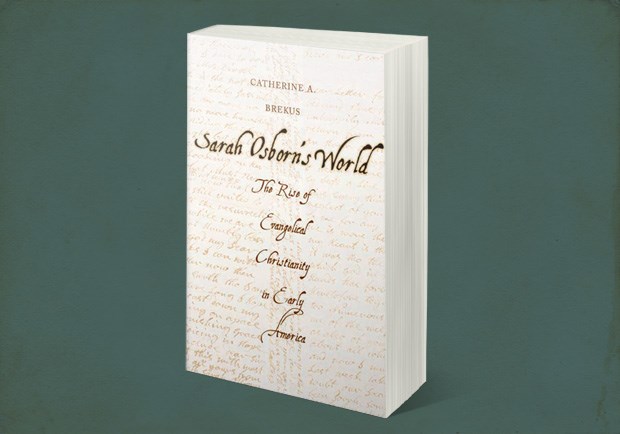
Sarah Osborn's World: The Rise of Evangelical Christianity in Early America (New Directions in Narrative History)
Author
Catherine A. Brekus
Publisher
Yale University Press
Release Date
January 8, 2013
Pages
448
Price
10.0
"What can the story of an eighteenth-century woman's life tell us about the rise of evangelical Christianity in America?" When University of Chicago historian Catherine Brekus raises this question at the opening of Sarah Osborn's World: The Rise of Evangelical Christianity in Early America (Yale University Press), you know that her answer will be "a lot." Nonetheless, it's astonishing just how much Brekus is able to reveal about Osborn, 18th-century America, and the origins of evangelicalism—especially in light of the disparate and challenging sources she had to work with.
Osborn (not to be confused with Salem Witch Trial victim Sarah Osborne, who lived a century earlier) was born in London in 1714. Her family moved to New England in 1722 and settled in bustling Newport, Rhode Island, in 1729. Her remarkable life there forms the through-line of the book, as Brekus dramatically narrates her fraught relationships, aching poverty, spiritual struggles, evolving attitudes, and controversial leadership of a revival in the 1760s. Celebrated as a near-saint upon her death in 1796, Osborn was subsequently disregarded as "an anachronism, a relic of an evangelical past that few wanted to remember." Her God was too stern, her view of suffering too stoic for the progress-oriented evangelicals of the 19th century and beyond.
Brekus pieced Osborn's life story together from a 1743 memoir, ten diaries, an anonymously published tract, and hundreds of letters. Some of these had been published previously, but Brekus also spent countless hours with manuscripts, parsing Osborn's nonstandard grammar and scrutinizing her crowded handwriting with a magnifying glass. This work alone justifies the book, yet Brekus adds deep and sensitive readings of sermons, devotional literature, prescriptive literature, Osborn's favorite Scripture texts, theology, philosophy, other religious narratives, and a wide variety of social history documents. The result is a master class in historical method.
All of these sources together serve to situate Osborn in her world, as Brekus telescopes in and out from one woman's experiences to broader trends. Chapter three, for example, places Osborn's youthful thoughts of suicide, the birth of her son, and the early death of her first husband in the context of early 18th-century notions of anger, suffering, and Providence. In chapter eight, Osborn acts as a giver and receiver of charity amid both the French and Indian War and the formulation of "disinterested benevolence" as the signal exercise of Christian virtue. Sometimes these larger stories help Brekus interpret the notes Osborn left behind. At other times, Osborn's story complicates received narratives. Only very rarely does an excursion into supplemental sources on, say, childbirth customs or the local prison system feel extraneous.
The development that most interests Brekus is the shift from Puritanism to early republican evangelicalism, and she identifies several contributing forces. Increasing consumer choice, along with the adoption of representative government, made strict belief in predestination harder to hold, so evangelicals softened their inherited Calvinism. (The fastest-growing 19th-century evangelical churches, Baptist and Methodist, dispensed with predestination entirely.) Humanitarianism, a movement that elevated human happiness as the chief pursuit of individuals and societies, pushed evangelicals to explain suffering as a means to a better end, rather than the righteous but inscrutable judgment of God.
Spiritual Leader
The most profound force acting on evangelicalism was the Enlightenment. Though other historians have interpreted it as a frontal assault on religion, not to mention a coercive privileging of rational, white masculinity, Brekus describes the Enlightenment as a multifaceted revolution that molded evangelicalism in some salutary ways. Specifically, because the Enlightenment touted experience as reliable evidence, anyone who had an experience gained authority to speak about it. In churches, this meant testimony could trump theological training.
This change allowed Osborn, a self-educated schoolteacher whose income was never high enough to be taxed, to become a spiritual leader in Newport, hosting prayer meetings that drew hundreds of people to her home weekly. The crowds included men and women, black and white, though to preserve decorum separate demographic groups met on different nights. This change also helps explain why some of Osborn's writings were published during and immediately after her lifetime, part of a wave of women's religious publishing. Most important, according to Brekus, this change birthed evangelicalism, which she defines as "a heart-centered, experiential, individualistic, and evangelistic form of Protestantism that was intertwined with the rise of the modern world." Evangelicals were ambivalent about the Enlightenment, as they were about individualism, the market economy, and much else in the 18th century, but their religious tradition took shape as they simultaneously resisted and absorbed its ideas.
Article continues below
All of this might sound like heady stuff, and it is, in the sense that scholars of evangelicalism and of early America should take it very seriously. But Sarah Osborn's World is by no means an inaccessible book. Throughout the text, Brekus identifies characters, defines terms, and calls only minimal attention to her historiographic contributions. She also employs novelistic techniques, such as the scene-setting at the opening of the final chapter: "August 1796. Sarah Osborn lies in her room, her breathing labored, and listens to a friend reading the Bible aloud. In her eighty-two years she has often dreamed about dying and going to heaven, but now she knows that the time is near." Every element of this passage is attested to in the extant record, so it is still good history, but it hardly sounds like a typical university press tome. Yale University Press is to be commended for encouraging this blended approach in the "New Directions in Narrative History" series, in which this volume is an early entry.
Neither Osborn nor evangelicalism comes off without criticism here. Osborn could be stubborn and insensitive, or she could wallow in self-loathing. She refused to mourn when her 11-year-old son died, except to lament that he had not experienced conversion, and she nearly sold her only slave away from his mother despite considering the woman a sister in Christ. (Osborn came to oppose slavery at the end of her life, as did her minister, Samuel Hopkins.) Evangelicalism, too, retains discomfiting amounts of Puritan fatalism, and it fails to live up to its egalitarian impulses. Nonetheless, both the woman and her faith are recognizable kin for contemporary evangelical readers. They are gifts from the past, offered by a truly gifted historian.
Elesha Coffman is assistant professor of church history at the University of Dubuque Theological Seminary. Her forthcoming book, available in May, is The Christian Century and the Rise of the Protestant Mainline (Oxford University Press).
Our Rating
Book Title
Sarah Osborn's World: The Rise of Evangelical Christianity in Early America (New Directions in Narrative History)














 While we pray for peace, we need moral clarity about this war.
 A Christian reconciliation group in Israel and Palestine warned that war would come. Now the war threatens their relevance.españolالعربيةFrançaisрусскийУкраїнська
 The plan would organize UMC churches in four global regions, with each given more leeway around same-sex marriage and other theological issues.





