Reader, I confess: I clicked “unfriend” last month. Several times.
Understand, I wasn’t ending friendships. I was respecting them—by refusing to let Facebook’s limitations do them further harm. It troubled me to see conversations we might have enjoyed in person go so horribly awry on social media. And anyway, our heated arguments attracted other angry voices, voices that overwhelmed our debate with snark, hostility, bullying, even hatred. I had to shut things down.
Nevertheless, I lose sleep at night over that “unfriending.” It feels like unforgiveness. It feels like despair.
So Arrival, the new science-fiction feature from director Denis Villeneuve, kicked me where I already hurt.
Arrival, based on Ted Chang’s novella The Story of Your Life, is the kind of mind-bending science fiction that cannot be discussed very thoroughly without revealing the movie’s huge surprises. But I promise to proceed with caution here, so that you can discover its challenging, rewarding, and—for some—confounding revelations for yourself.
Louise (played by Amy Adams) is a linguist who previously worked for the US government. In a time of crisis, she is called upon to help translate strange messages from alien visitors. Twelve spaceships—they look like stylish tower speakers in an extremely expensive 12.1 surround sound system—have come to hover just above the ground at locations all around the world. Where have they come from? What is their purpose here? Is this an act of war or an invitation to a meaningful relationship?
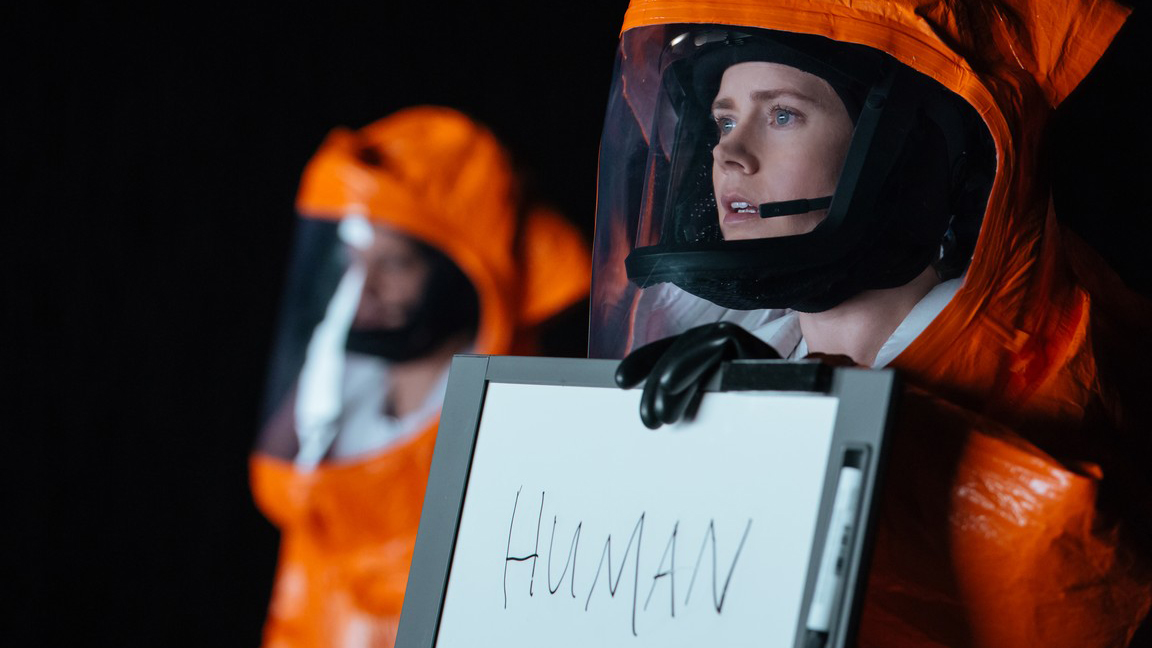
When Louise comes face-to-face with the aliens—quite literally through a glass darkly—she is braver than others in her company. While they remain insulated, fearing contamination, she dares to throw down her armor and reach out.
At this point, Arrival becomes a movie about communication, and what it reveals about our perspective, our experience, and our relationship with time. As Louise opens herself to the way the aliens experience reality, her own perception changes. As she learns to translate their speech, her own speech begins to confuse her colleagues.
This shows why it can be such a frightful prospect to welcome those whose faith, minds, cultures, languages, and perspectives differ from ours. We know that—for better or worse, we will be changed by relationship.
Arrival shows why it can be such a frightful prospect to welcome those whose faith, minds, cultures, languages, and perspectives differ from ours.
In Arrival, the global community—represented by a screen full of anxious ambassadors’ faces—shares information, investigates theories, and attempts to cooperate. But as scientists and linguists struggle to understand the Others, riots break out around the world. Nations arm themselves to deport these illegals with force. Unions collapse. Nations lose hope and give in to fear. And one by one, those ambassadors’ faces slam the door on conversation.
That’s what hurt the most as I watched Arrival. While the movie’s central story is inspirational—I can’t say more without spoilers—I came away burdened by what I’d seen.
I embrace God’s exhortation to his people: “The foreigner residing among you must be treated as your native-born. Love them as yourself, for you were foreigners in Egypt” (Lev. 19:34). Jesus constantly endorsed that command through sermons, parables, and practice, telling us to love our neighbors, no matter how foreign, even at the cost of our lives.
So Arrival’s nightmarish scenario plays for me like an apocalyptic vision of fear conquering the world. It’s like watching the nations of the world “unfriend” one another. It’s like watching my own online neighborhood implode.
Have I successfully avoided spoilers? I think so. I’ll leave you to discover Arrival’s big surprises. (It’s complicated. So complicated, in fact, that even though I paid close attention, I completely misunderstood the film’s big twist. Fans of Chiang’s novella had to set me straight.)
There are a lot of profound ideas to discuss after we watch Arrival. But the idea most important to me, right now, is this: Can we learn to proceed with caution and courage, approaching those we perceive as dangerous aliens, in the expectation of meaningful relationship?
I want to believe. I still have faith that conversation can lead to mutual enlightenment, and that we can—through gracious correspondence that prioritizes listening—learn from our differences and become stronger together. Let’s take those risks. You go first.
[I recommend Arrival to adults who love the challenges of intelligent science fiction. I won’t lie—the movie is often disturbing. But most of its fans praise its inspirational qualities.]
- In the opening scenes of Arrival, Villeneuve portrays a familiar big-screen crisis: the arrival of aliens. Talk about the way he builds suspense, inspires our curiosity and fear, and slowly reveals the truth. Are his directorial decisions effective? How is his approach to this scenario different from other “arrivals” we’ve seen at the movies?
- Talk about the aliens: What was so… alien about them? How are they similar to, or different from, other aliens in art and entertainment you’ve encountered?
- Imagine something like this occurring—a global emergency that threatened everything you know. What would you do in those first minutes? Whom would you call? How would you prepare in those hours of uncertainty? What do your answers suggest about your priorities and your faith?
- Does this movie’s plot confuse you? What do you think Louise’s experience suggests to us about how we should approach risk and challenges in our lives?
- Do you find Arrival primarily hopeful or pessimistic?
- In what ways do the events in Arrival remind you of actual events unfolding in the world today? What do you think the movie suggests as a lesson or a recommendation for how to strive for a better world?
- Can you think of an experience you’ve had in which you had to risk relationship with someone you found different, difficult, or threatening? Did that experience change you? How? What did you learn?
- Can you think of a time when you have been trusted, served, even embraced by someone who had no good reason to trust you? What was that experience like for both of you?
- What parallels do you see between Arrival’s vision (of uncertainty, faith, self-sacrifice, and transcendence) and the vision of the gospel?