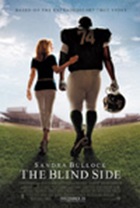
Inspired by author Michael Lewis' best-selling true story, The Blind Side is not the film you might expect judging solely from the previews and marketing. Bearing the burden of being potentially schmaltzy, the film instead threads an almost impossible needle, pulling off a surprisingly moving and inspirational story of compassion, self-discovery and hope.
Michael Oher (Quinton Aaron) has never slept in a real bed a single night in his life. Over-sized and under-educated, Michael is one of eight children, each of whom was fathered by a different man. His mother, a drug addict, drifts between Nashville streets and ramshackle low income housing projects. It is only a matter of time before Michael is also hopelessly entrapped.
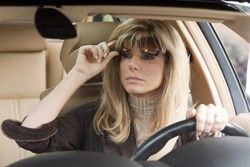
Sandra Bullock as Leigh Anne Tuohy
Fate intervenes when Michael's uncle shows his nephew off to the football coach (Ray McKinnon) of a local, well-heeled, private school. Though untested, the coach sees potential in Michael, if for no other reason than he would be the largest thing on two legs to step foot on the field. The school board is not inclined to give Michael a scholarship; after all, the boy's grades are abysmal. But the coach contends that they have a sacred duty to let Michael in. "Last I checked," he argues, "our sign had the word 'Christian' on it. We either take that seriously or we paint over it."
Be it a self-serving argument or a pure expression of belief, his argument works and soon Michael is admitted, the lone African-American student in a sea of wealthy, white faces. What school administrators do no know is the extent of Michael's poverty—he has only two pairs of clothes, the second set of which he carries around in a plastic grocery bag. He has begun secretly sleeping in the gymnasium, feeding himself on bags of popcorn left over from various sporting events.
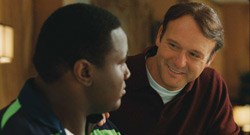
Quinton Aaron as Michael Oher, Tim McGraw as Sean Tuohy
Enter Leigh Anne Tuohy (Sandra Bullock), a woman who would surely be a steel magnolia caricature if she weren't based on fact. A no-nonsense personality, when Leigh Anne sets her sights on something, she is an unstoppable force of nature. So it is that when she discovers Michael's predicament, she takes him into her house without a second's hesitation. For Michael, who has known only the street, the Touhys' palatial home—set amongst a neighborhood of white picket fences, white church steeples, and white women jogging with $1000 strollers—is like entering another country complete with a culture shock that he cannot intellectually or emotionally process.
At first the placid, soft-spoken Michael is hard to read. "He's like an onion," Leigh Anne's husband, Sean (Tim McGraw), says. "It takes time to peel back the layers to see what's inside." "Not if you use a knife" is her true-to-form retort. To his credit, Sean never questions his wife's altruism. Nor do her children, vivacious young S.J. (the uproarious Jae Head) or teenaged Collins (Lily Collins). But just as S.J. and Collins are the object of much bewilderment and even scorn at school for their peculiar living arrangements, so too does Leigh Anne face puzzlement from her upper crust social circles, who have made a showy game of contributing to various causes, but have never actually gotten dirt beneath their manicured fingernails a day in their lives.
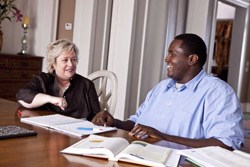
Though it takes some time to find his footing, Michael quickly begins to shine on the football field—so much that agents and college coaches (playing themselves) are soon knocking down Michael's door. But if Michael wants to go to college, his grades will require almost supernatural intervention. Leigh Anne hires a permanent, live-in tutor (Kathy Bates) to boost Michael's grades. But just as it appears that Michael's future is yawning open with possibility, his old life rears its ugly head and threatens to swallow him whole.
I confess I was prepared to dislike The Blind Side—not only for its potential schmaltz, but also for its potential to seem like another White Man to the Rescue flick. (My friend Tim Gordon, former film critic for Black Entertainment Television, calls these "Mighty Whitey" films, where a white protagonist saves people of color without whose "superior intervention" they would surely have been lost.) While not necessarily exempt because of it, a film based on real events complicates this dynamic. But The Blind Side never falls into this trap because it respects its characters, including Michael, too much to become an unsavory cliché. The whiteness and blackness of the characters is traded instead for a look at those things that lie beneath the skin. Leigh Anne is not driven by liberal guilt or "white supremacy," but by a heart that is far softer than her exterior would suggest, one that breaks to see another person in pain. Period. (The real-life Sean and Leigh Anne Tuohy are devout Christians.) Likewise, Michael is shown to be someone who is willing to sacrifice anything, including himself, to protect those he loves. In a truly colorblind society, these characters' race would be irrelevant and we would focus instead on one human being unconditionally loving another human being.
Article continues below
This stance benefits the film in another way. While The Blind Side is the sort of story that traditionally degrades into sentimentality, the film remains grounded, avoiding easy, emotional potshots. If it draws tears, it earns them. Much of this anti-maudlin mentality is a result of identifying with a mama bear too ornery to shed a tear for just anything. When Leigh Anne is told she is changing Michael's life and she replies, "No, he's changing mine," we don't laugh at the sappiness of the line because it is delivered with such utter earnestness.
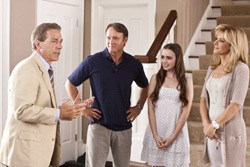
Real-life coaches like Alabama's Nick Saban made recruiting visits in the film
Leigh Anne Tuohy is unique in a Hollywood film—a non-stereotypical Christian. Christians used to portrayals of themselves as close-minded bigots or spaced-out nut jobs will see instead someone who is humble, down to earth, and instantly relatable. If Leigh Anne adheres to certain clichés, particularly those at the intersection of faith and southern Republican politics, we must remind ourselves that certain stereotypes are, after all, based on truths. While the film never uses her faith as a bludgeon, it is not shy whatsoever with letting its audience know that it is because of her beliefs that Leigh Anne acts the way she does. She doesn't need to preach; her actions do all the talking. She is quick to thank God for his blessings and beseech him for aid when her own strength is inadequate.
It is pretty clear that young Michael Oher never dreamed of the day he would be welcomed into a loving family—or that he would be a first-round pick (by the Baltimore Ravens) in the 2009 NFL draft. Nor did a rich, Southern white woman ever dream of adopting a young black man twice her size. Life, The Blind Side says, is defined by our reactions to what we don't see coming. While most films with an "out of the blue" thematic element focus on the apocalyptic trials that come out of nowhere to clobber us, it's nice to see something that says that blessings can be every bit as sneaky and just as profound.
Talk About It
Discussion starters
Did you find Leigh Anne's faith was satisfactorily portrayed? Why are many portrayals of Christians in the secular media stereotypically negative? Conversely, why do many religious films create equally stereotypical caricatures?
Have you ever done something as radically benevolent as what was portrayed in this film? Were you ever the recipient of such grace?
What did Jesus say on the subject of caring for the poor?
Article continues below
Many people live in fear of the unknown. Why are we so quick to distrust what we can't see despite the fact that blessings are just as likely?
Have you ever been convicted that you considered yourself superior to someone else? What did you do about it?
The Family Corner
For parents to consider
The Blind Side is rated PG-13 for one scene involving brief violence, drug and sexual references. While these are issues that would normally concern for parents, they are uniformly presented as negative attributes within the film and never glorified. The one instance of fisticuffs—which coincides with the drug and alcohol use—occurs when local gangsters try to pull Michael back into his old street life. Language, considered so minor that the MPAA doesn't even feel the need to mention it, is extremely rare and is greeted with a stern reprimand. The context of the sexual reference is in something Leigh Anne says she will do to a certain anatomical area should Michael decide to have sex outside of wedlock!
The government plans to close its porous border with Myanmar to boost security, separating ethnic groups that straddle the boundary.
Surinder Kaur and Angela Lu Fulton
The Blind Side
1 of 4
Sandra Bullock as Leigh Anne TuohyQuinton Aaron as Michael Oher, Tim McGraw as Sean TuohyMiss Sue (Kathy Bates) tutored MichaelReal-life coaches like Alabama's Nick Saban made recruiting visits in the film













 While we pray for peace, we need moral clarity about this war.
 A Christian reconciliation group in Israel and Palestine warned that war would come. Now the war threatens their relevance.españolالعربيةFrançaisрусскийУкраїнська
 The government plans to close its porous border with Myanmar to boost security, separating ethnic groups that straddle the boundary.