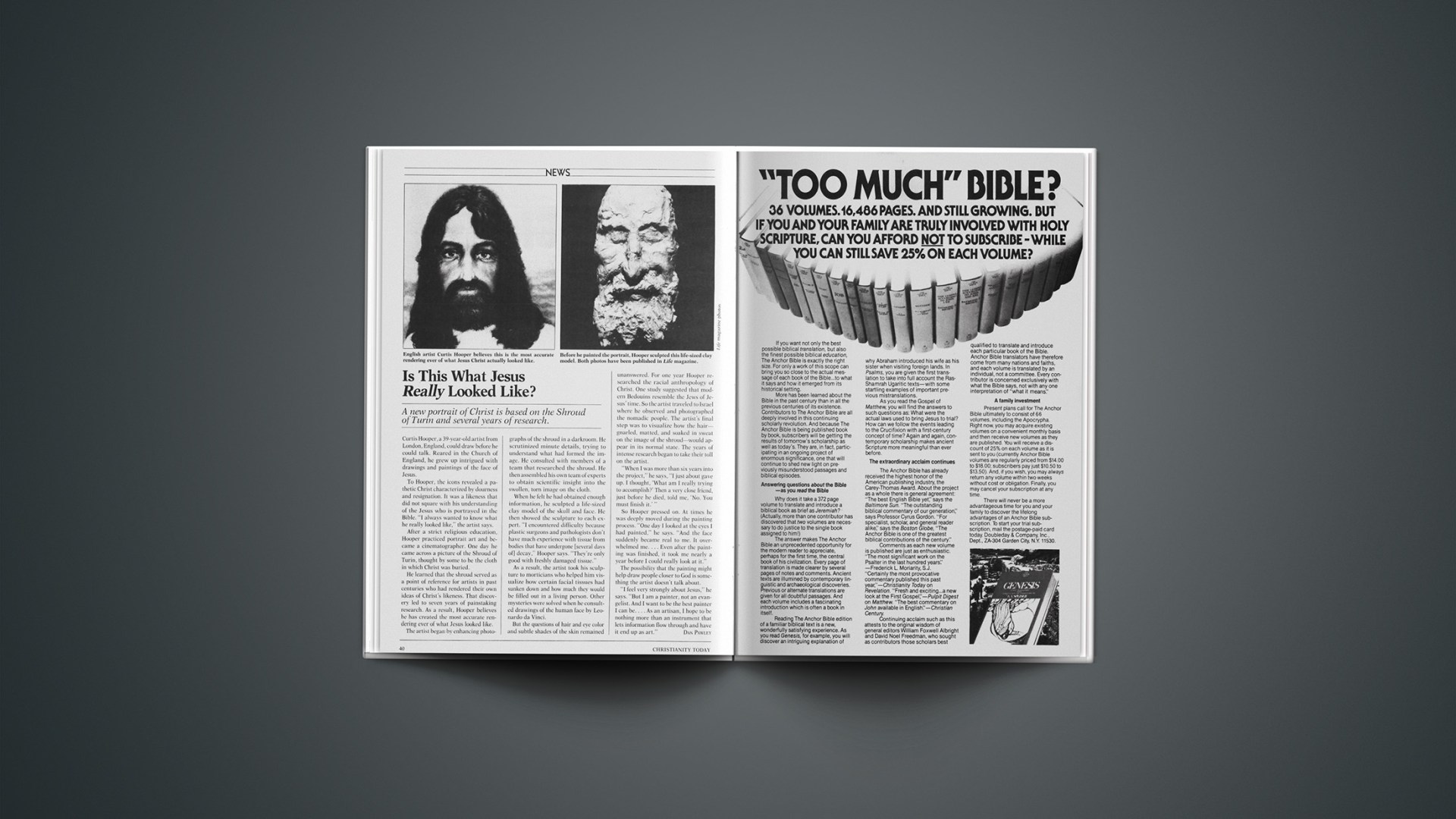

A new portrait of Christ is based on the Shroud of Turin and several years of research.
Curtis Hooper, a 39-year-old artist from London, England, could draw before he could talk. Reared in the Church of England, he grew up intrigued with drawings and paintings of the face of Jesus.
To Hooper, the icons revealed a pathetic Christ characterized by dourness and resignation. It was a likeness that did not square with his understanding of the Jesus who is portrayed in the Bible. “I always wanted to know what he really looked like,” the artist says.
After a strict religious education, Hooper practiced portrait art and became a cinematographer. One day he came across a picture of the Shroud of Turin, thought by some to be the cloth in which Christ was buried.
He learned that the shroud served as a point of reference for artists in past centuries who had rendered their own ideas of Christ’s likeness. That discovery led to seven years of painstaking research. As a result, Hooper believes he has created the most accurate rendering ever of what Jesus looked like.
The artist began by enhancing photographs of the shroud in a darkroom. He scrutinized minute details, trying to understand what had formed the image. He consulted with members of a team that researched the shroud. He then assembled his own team of experts to obtain scientific insight into the swollen, torn image on the cloth.
When he felt he had obtained enough information, he sculpted a life-sized clay model of the skull and face. He then showed the sculpture to each expert. “I encountered difficulty because plastic surgeons and pathologists don’t have much experience with tissue from bodies that have undergone [several days of] decay,” Hooper says. “They’re only good with freshly damaged tissue.”
As a result, the artist took his sculpture to morticians who helped him visualize how certain facial tissues had sunken down and how much they would be filled out in a living person. Other mysteries were solved when he consulted drawings of the human face by Leonardo da Vinci.
But the questions of hair and eye color and subtle shades of the skin remained unanswered. For one year Hooper researched the racial anthropology of Christ. One study suggested that modern Bedouins resemble the Jews of Jesus’ time. So the artist traveled to Israel where he observed and photographed the nomadic people. The artist’s final step was to visualize how the hair—gnarled, matted, and soaked in sweat on the image of the shroud—would appear in its normal state. The years of intense research began to take their toll on the artist.
“When I was more than six years into the project,” he says, “I just about gave up. I thought, ‘What am I really trying to accomplish?’ Then a very close friend, just before he died, told me, ‘No. You must finish it.’ ”
So Hooper pressed on. At times he was deeply moved during the painting process. “One day I looked at the eyes I had painted,” he says. “And the face suddenly became real to me. It overwhelmed me.… Even after the painting was finished, it took me nearly a year before I could really look at it.”
The possibility that the painting might help draw people closer to God is something the artist doesn’t talk about.
“I feel very strongly about Jesus,” he says. “But I am a painter, not an evangelist. And I want to be the best painter I can be.… As an artisan, I hope to be nothing more than an instrument that lets information flow through and have it end up as art.”