





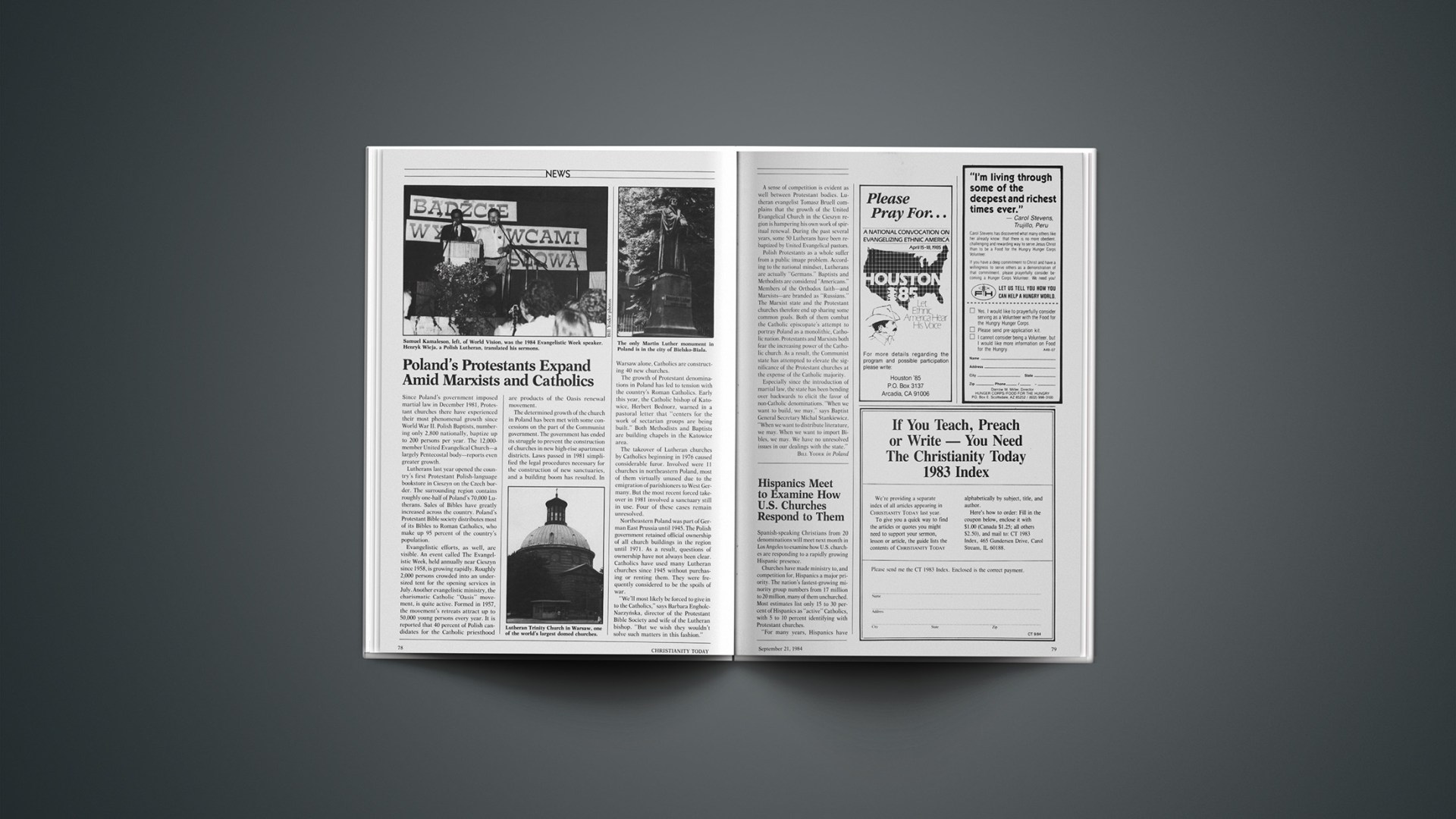

Since Poland’s government imposed martial law in December 1981, Protestant churches there have experienced their most phenomenal growth since World War II. Polish Baptists, numbering only 2,800 nationally, baptize up to 200 persons per year. The 12,000-member United Evangelical Church—a largely Pentecostal body—reports even greater growth.
Lutherans last year opened the country’s first Protestant Polish-language bookstore in Cieszyn on the Czech border. The surrounding region contains roughly one-half of Poland’s 70,000 Lutherans. Sales of Bibles have greatly increased across the country. Poland’s Protestant Bible society distributes most of its Bibles to Roman Catholics, who make up 95 percent of the country’s population.
Evangelistic efforts, as well, are visible. An event called The Evangelistic Week, held annually near Cieszyn since 1958, is growing rapidly. Roughly 2,000 persons crowded into an undersized tent for the opening services in July. Another evangelistic ministry, the charismatic Catholic “Oasis” movement, is quite active. Formed in 1957, the movement’s retreats attract up to 50,000 young persons every year. It is reported that 40 percent of Polish candidates for the Catholic priesthood are products of the Oasis renewal movement.
The determined growth of the church in Poland has been met with some concessions on the part of the Communist government. The government has ended its struggle to prevent the construction of churches in new high-rise apartment districts. Laws passed in 1981 simplified the legal procedures necessary for the construction of new sanctuaries, and a building boom has resulted. In Warsaw alone, Catholics are constructing 40 new churches.
The growth of Protestant denominations in Poland has led to tension with the country’s Roman Catholics. Early this year, the Catholic bishop of Katowice, Herbert Bednorz, warned in a pastoral letter that “centers for the work of sectarian groups are being built.” Both Methodists and Baptists are building chapels in the Katowice area.
The takeover of Lutheran churches by Catholics beginning in 1976 caused considerable furor. Involved were 11 churches in northeastern Poland, most of them virtually unused due to the emigration of parishioners to West Germany. But the most recent forced takeover in 1981 involved a sanctuary still in use. Four of these cases remain unresolved.
Northeastern Poland was part of German East Prussia until 1945. The Polish government retained official ownership of all church buildings in the region until 1971. As a result, questions of ownership have not always been clear. Catholics have used many Lutheran churches since 1945 without purchasing or renting them. They were frequently considered to be the spoils of war.
“We’ll most likely be forced to give in to the Catholics,” says Barbara Engholc-Narzyńska, director of the Protestant Bible Society and wife of the Lutheran bishop. “But we wish they wouldn’t solve such matters in this fashion.”
A sense of competition is evident as well between Protestant bodies. Lutheran evangelist Tomasz Bruell complains that the growth of the United Evangelical Church in the Cieszyn region is hampering his own work of spiritual renewal. During the past several years, some 50 Lutherans have been rebaptized by United Evangelical pastors.
Polish Protestants as a whole suffer from a public image problem. According to the national mindset, Lutherans are actually “Germans.” Baptists and Methodists are considered “Americans.” Members of the Orthodox faith—and Marxists—are branded as “Russians.” The Marxist state and the Protestant churches therefore end up sharing some common goals. Both of them combat the Catholic episcopate’s attempt to portray Poland as a monolithic, Catholic nation. Protestants and Marxists both fear the increasing power of the Catholic church. As a result, the Communist state has attempted to elevate the significance of the Protestant churches at the expense of the Catholic majority.
Especially since the introduction of martial law, the state has been bending over backwards to elicit the favor of non-Catholic denominations. “When we want to build, we may,” says Baptist General Secretary Michal Stankiewicz. “When we want to distribute literature, we may. When we want to import Bibles, we may. We have no unresolved issues in our dealings with the state.”
BILL YODERin Poland







