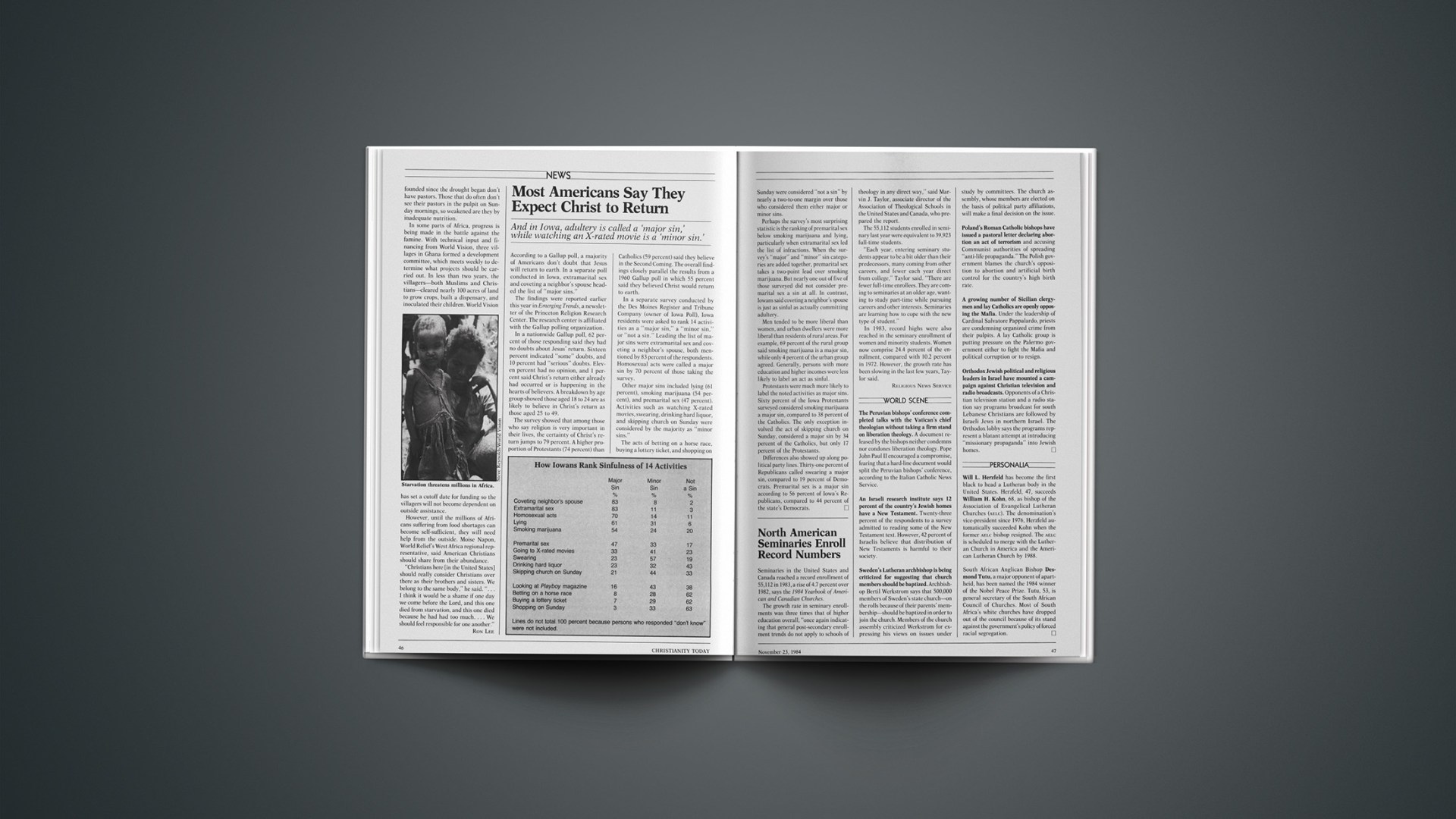

According to a Gallup poll, a majority of Americans don’t doubt that Jesus will return to earth. In a separate poll conducted in Iowa, extramarital sex and coveting a neighbor’s spouse headed the list of “major sins.”
The findings were reported earlier this year in Emerging Trends, a newsletter of the Princeton Religion Research Center. The research center is affiliated with the Gallup polling organization.
In a nationwide Gallup poll, 62 percent of those responding said they had no doubts about Jesus’ return. Sixteen percent indicated “some” doubts, and 10 percent had “serious” doubts. Eleven percent had no opinion, and 1 percent said Christ’s return either already had occurred or is happening in the hearts of believers. A breakdown by age group showed those aged 18 to 24 are as likely to believe in Christ’s return as those aged 25 to 49.
The survey showed that among those who say religion is very important in their lives, the certainty of Christ’s return jumps to 79 percent. A higher proportion of Protestants (74 percent) than Catholics (59 percent) said they believe in the Second Coming. The overall findings closely parallel the results from a 1960 Gallup poll in which 55 percent said they believed Christ would return to earth.
In a separate survey conducted by the Des Moines Register and Tribune Company (owner of Iowa Poll), Iowa residents were asked to rank 14 activities as a “major sin,” a “minor sin,” or “not a sin.” Leading the list of major sins were extramarital sex and coveting a neighbor’s spouse, both mentioned by 83 percent of the respondents. Homosexual acts were called a major sin by 70 percent of those taking the survey.
Other major sins included lying (61 percent), smoking marijuana (54 percent), and premarital sex (47 percent). Activities such as watching X-rated movies, swearing, drinking hard liquor, and skipping church on Sunday were considered by the majority as “minor sins.”
The acts of betting on a horse race, buying a lottery ticket, and shopping on Sunday were considered “not a sin” by nearly a two-to-one margin over those who considered them either major or minor sins.
Perhaps the survey’s most surprising statistic is the ranking of premarital sex below smoking marijuana and lying, particularly when extramarital sex led the list of infractions. When the survey’s “major” and “minor” sin categories are added together, premarital sex takes a two-point lead over smoking marijuana. But nearly one out of five of those surveyed did not consider premarital sex a sin at all. In contrast, Iowans said coveting a neighbor’s spouse is just as sinful as actually committing adultery.
Men tended to be more liberal than women, and urban dwellers were more liberal than residents of rural areas. For example, 69 percent of the rural group said smoking marijuana is a major sin, while only 4 percent of the urban group agreed. Generally, persons with more education and higher incomes were less likely to label an act as sinful.
Protestants were much more likely to label the noted activities as major sins. Sixty percent of the Iowa Protestants surveyed considered smoking marijuana a major sin, compared to 38 percent of the Catholics. The only exception involved the act of skipping church on Sunday, considered a major sin by 34 percent of the Catholics, but only 17 percent of the Protestants.
Differences also showed up along political party lines. Thirty-one percent of Republicans called swearing a major sin, compared to 19 percent of Democrats. Premarital sex is a major sin according to 56 percent of Iowa’s Republicans, compared to 44 percent of the state’s Democrats.