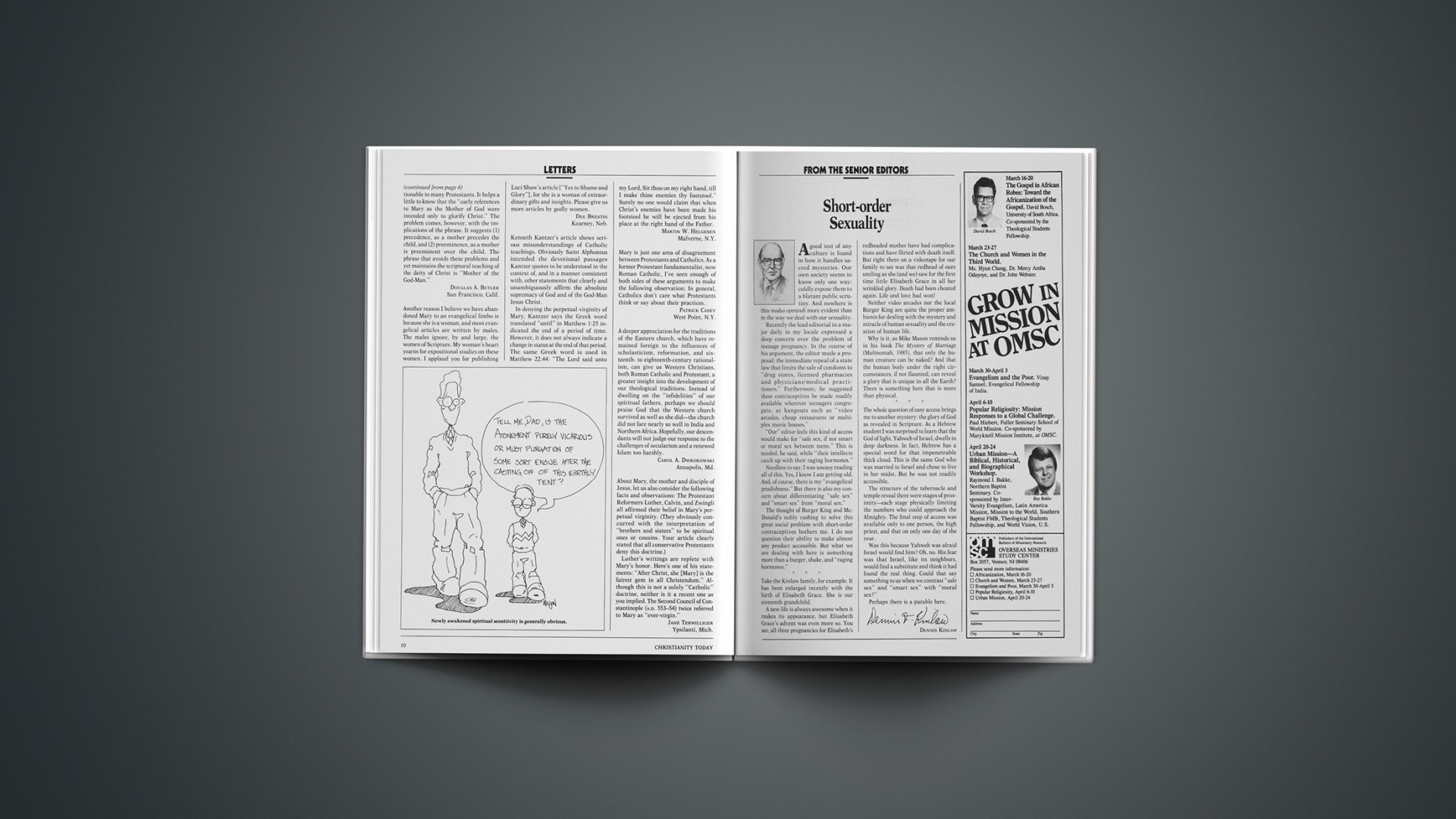

A good test of any culture is found in how it handles sacred mysteries. Our own society seems to know only one way: coldly expose them to a blatant public scrutiny. And nowhere is this modus operandi more evident than in the way we deal with our sexuality.
Recently the lead editorial in a major daily in my locale expressed a deep concern over the problem of teenage pregnancy. In the course of his argument, the editor made a proposal: the immediate repeal of a state law that limits the sale of condoms to “drug stores, licensed pharmacies and physicians/medical practitioners.” Furthermore, he suggested these contraceptives be made readily available wherever teenagers congregate, at hangouts such as “video arcades, cheap restaurants or multiplex movie houses.”
“Our” editor feels this kind of access would make for “safe sex, if not smart or moral sex between teens.” This is needed, he said, while “their intellects catch up with their raging hormones.” Needless to say, I was uneasy reading all of this. Yes, I know I am getting old. And, of course, there is my “evangelical prudishness.” But there is also my concern about differentiating “safe sex” and “smart sex” from “moral sex.”
The thought of Burger King and McDonald’s nobly rushing to solve this great social problem with short-order contraceptives bothers me. I do not question their ability to make almost any product accessible. But what we are dealing with here is something more than a burger, shake, and “raging hormones.”
Take the Kinlaw family, for example. It has been enlarged recently with the birth of Elisabeth Grace. She is our sixteenth grandchild.
A new life is always awesome when it makes its appearance, but Elisabeth Grace’s advent was even more so. You see, all three pregnancies for Elisabeth’s redheaded mother have had complications and have flirted with death itself. But right there on a videotape for our family to see was that redhead of ours smiling as she (and we) saw for the first time little Elisabeth Grace in all her wrinkled glory. Death had been cheated again. Life and love had won!
Neither video arcades nor the local Burger King are quite the proper ambients for dealing with the mystery and miracle of human sexuality and the creation of human life.
Why is it, as Mike Mason reminds us in his book The Mystery of Marriage (Multnomah, 1985), that only the human creature can be naked? And that the human body under the right circumstances, if not flaunted, can reveal a glory that is unique in all the Earth? There is something here that is more than physical.
The whole question of easy access brings me to another mystery: the glory of God as revealed in Scripture. As a Hebrew student I was surprised to learn that the God of light, Yahweh of Israel, dwells in deep darkness. In fact, Hebrew has a special word for that impenetrable thick cloud. This is the same God who was married to Israel and chose to live in her midst. But he was not readily accessible.
The structure of the tabernacle and temple reveal there were stages of proximity—each stage physically limiting the numbers who could approach the Almighty. The final step of access was available only to one person, the high priest, and that on only one day of the year.
Was this because Yahweh was afraid Israel would find him? Oh, no. His fear was that Israel, like its neighbors, would find a substitute and think it had found the real thing. Could that say something to us when we contrast “safe sex” and “smart sex” with “moral sex?”
Perhaps there is a parable here.
DENNIS KINLAW