
RELIGIOUS LIBERTY
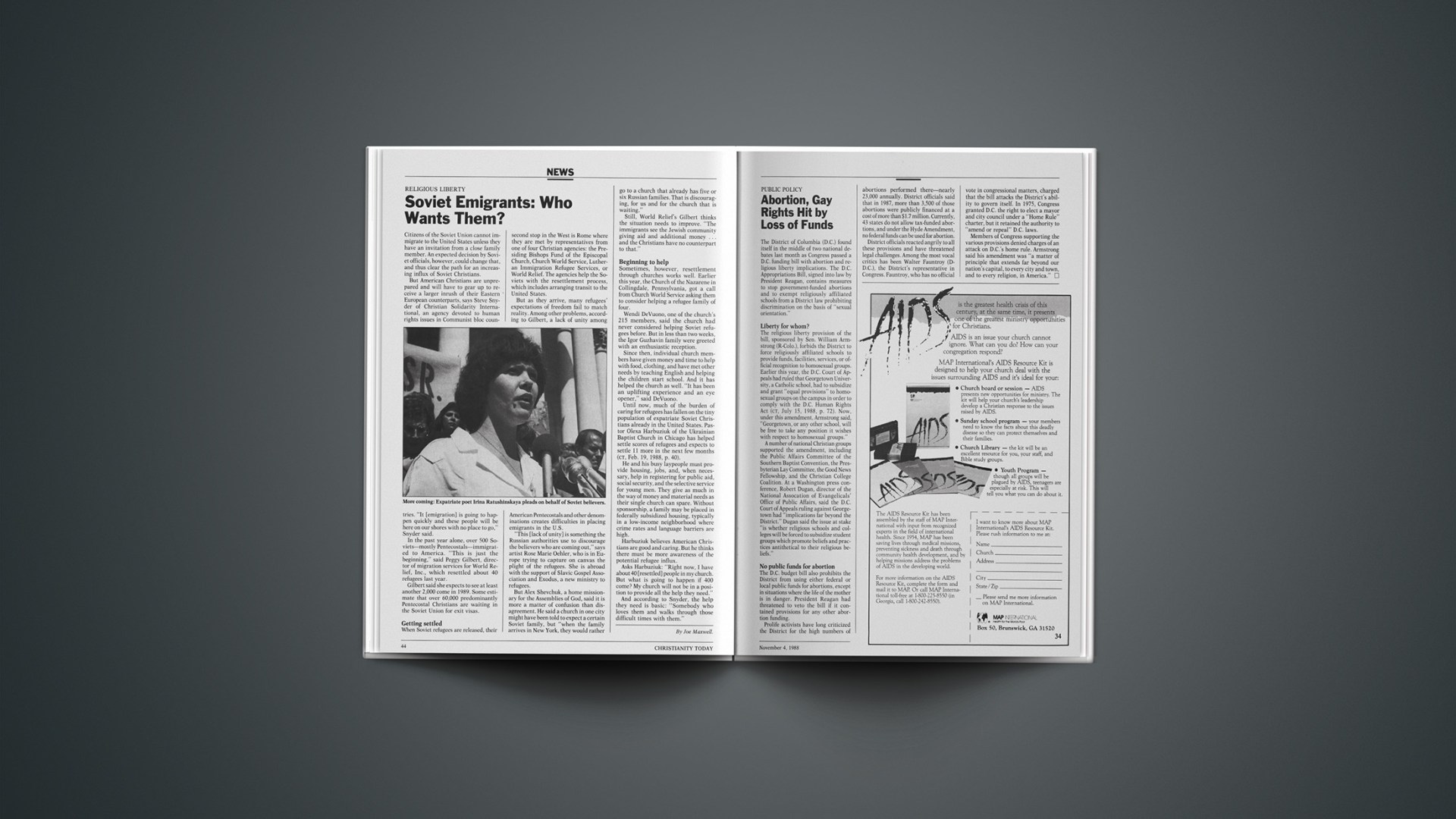
Citizens of the Soviet Union cannot immigrate to the United States unless they have an invitation from a close family member. An expected decision by Soviet officials, however, could change that, and thus clear the path for an increasing influx of Soviet Christians.
But American Christians are unprepared and will have to gear up to receive a larger inrush of their Eastern European counterparts, says Steve Snyder of Christian Solidarity International, an agency devoted to human rights issues in Communist bloc countries. “It [emigration] is going to happen quickly and these people will be here on our shores with no place to go,” Snyder said.
In the past year alone, over 500 Soviets—mostly Pentecostals—immigrated to America. “This is just the beginning,” said Peggy Gilbert, director of migration services for World Relief, Inc., which resettled about 40 refugees last year.
Gilbert said she expects to see at least another 2,000 come in 1989. Some estimate that over 60,000 predominantly Pentecostal Christians are waiting in the Soviet Union for exit visas.
Getting Settled
When Soviet refugees are released, their second stop in the West is Rome where they are met by representatives from one of four Christian agencies: the Presiding Bishops Fund of the Episcopal Church, Church World Service, Lutheran Immigration Refugee Services, or World Relief. The agencies help the Soviets with the resettlement process, which includes arranging transit to the United States.
But as they arrive, many refugees’ expectations of freedom fail to match reality. Among other problems, according to Gilbert, a lack of unity among American Pentecostals and other denominations creates difficulties in placing emigrants in the U.S.
“This [lack of unity] is something the Russian authorities use to discourage the believers who are coming out,” says artist Rose Marie Oehler, who is in Europe trying to capture on canvas the plight of the refugees. She is abroad with the support of Slavic Gospel Association and Exodus, a new ministry to refugees.
But Alex Shevchuk, a home missionary for the Assemblies of God, said it is more a matter of confusion than disagreement. He said a church in one city might have been told to expect a certain Soviet family, but “when the family arrives in New York, they would rather go to a church that already has five or six Russian families. That is discouraging, for us and for the church that is waiting.”
Still, World Relief’s Gilbert thinks the situation needs to improve. “The immigrants see the Jewish community giving aid and additional money … and the Christians have no counterpart to that.”
Beginning To Help
Sometimes, however, resettlement through churches works well. Earlier this year, the Church of the Nazarene in Collingdale, Pennsylvania, got a call from Church World Service asking them to consider helping a refugee family of four.
Wendi DeVuono, one of the church’s 215 members, said the church had never considered helping Soviet refugees before. But in less than two weeks, the Igor Guzhavin family were greeted with an enthusiastic reception.
Since then, individual church members have given money and time to help with food, clothing, and have met other needs by teaching English and helping the children start school. And it has helped the church as well. “It has been an uplifting experience and an eye opener,” said DeVuono.
Until now, much of the burden of caring for refugees has fallen on the tiny population of expatriate Soviet Christians already in the United States. Pastor Olexa Harbuziuk of the Ukrainian Baptist Church in Chicago has helped settle scores of refugees and expects to settle 11 more in the next few months (CT, Feb. 19, 1988, p. 40).
He and his busy laypeople must provide housing, jobs, and, when necessary, help in registering for public aid, social security, and the selective service for young men. They give as much in the way of money and material needs as their single church can spare. Without sponsorship, a family may be placed in federally subsidized housing, typically in a low-income neighborhood where crime rates and language barriers are high.
Harbuziuk believes American Christians are good and caring. But he thinks there must be more awareness of the potential refugee influx.
Asks Harbuziuk: “Right now, I have about 40 [resettled] people in my church. But what is going to happen if 400 come? My church will not be in a position to provide all the help they need.”
And according to Snyder, the help they need is basic: “Somebody who loves them and walks through those difficult times with them.”
By Joe Maxwell.