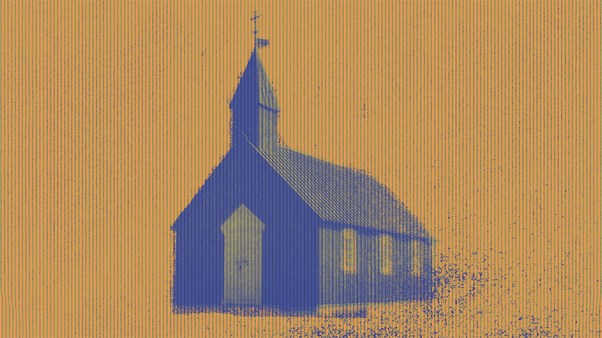
After years of focus on the large church, there is now renewed interest in the rural church-congregations whose attendance would not make a decent Sunday school class in a megachurch.
As the pastor of four small, rural churches, I welcome this interest. But I have noticed a troubling trend: discussions of the rural church have the air of a family of a terminally ill patient. Unless drastic and dramatic measures are taken, so the thinking seems, the rural church will be lost.
Nonsense. Although the rural church needs help, it is not in danger of extinction. In fact, the rural church holds many inherent strengths.
The strengths usually cited are “soft” features: rural congregations function as a small group; relationships are close; concern is felt and expressed among the members. These features are seen as a consolation for the lack of “hard,” numerical strengths.
Actually, rural churches can boast of some impressive numerical facts.
Percentage of community penetration
The five communities I serve have approximately 1,000 people, and our congregations minister directly to more than one-third of them. To be specific, there are roughly 292 households, and of these, 108 are directly connected with our Lower Granville congregations. That is, at least one person from each of these homes is a member or regular attender.
Such deep community penetration is not unique to our churches; I know other rural parishes that can claim a similar percentage. I grew up in a congregation, for example, that currently has 229 members in a community of about 1,500. Even the largest megachurches cannot claim that sort of community penetration.
The penetration statistics grow even stronger when you realize our churches regularly minister to, or relate to, an additional one-third of the community. Weddings, funerals, youth programs, and so forth-combined with regular outside contact between members and nonmembers-mean our churches contact about two-thirds of our communities.
Again, such figures are common for rural congregations. I know many that minister to 90 or 100 percent of their community’s grade-school children in Sunday school and other programs.
It’s important not to let small actual numbers obscure the statistically significant impact of rural congregations on their community.
Percentage of members involved in leadership
All churches complain about lack of leadership. A friend told me of a six-hundred-member church trying to fill about ninety leadership roles. Only thirty people had volunteered.
Our congregations cannot fill large numbers of leadership positions. On the other hand, about 60 percent of our members hold some office or leadership role-often more than one. In a rural congregation, it often is easier to name the people without jobs-and easier to understand their reasons for not accepting such jobs.
In short, rural congregations tend to mobilize extremely high percentages of active members for leadership tasks. In our congregations, for example, the number, and percentage, of people in leadership are as follows:
Granville Beach congregation: 11 of 17 members (64 percent)
Port Royal congregation: 6 of 9 (66 percent)
Port Wade congregation: 12 of 16 (75 percent)
Victoria Beach congregation: 20 of 35 (57 percent)
This is not the situation just in our congregations. The Wilmot United Baptist Church, for example, involves approximately 70 percent of its 101 members in leadership. Despite the myth that one or two people run a rural church, most rural churches I know effectively spread the leadership around.
Renewed interest in rural churches is welcome, because, I believe, focused attention can only help. We must keep in mind, though, that the search for solutions takes place among congregations that, in many ways, are doing quite well.
-Randolph F. Legassie
Lower Granville United Baptist Churches
Granville Beach, Port Royal, Port Wade,
and Victoria Beach, Nova Scotia
Copyright © 1990 by the author or Christianity Today/Leadership Journal. Click here for reprint information on Leadership Journal.