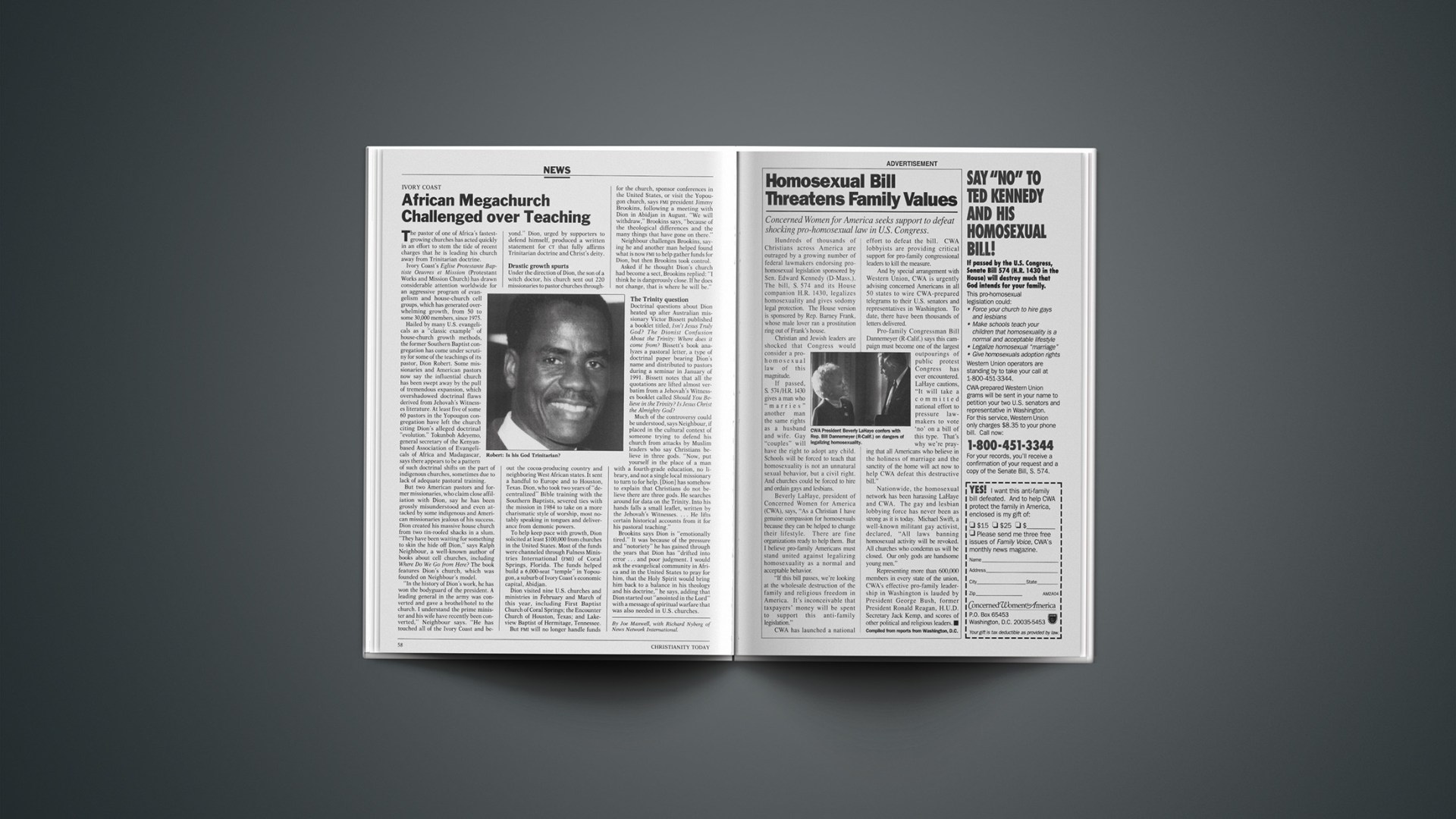

The pastor of one of Africa’s fastest-growing churches has acted quickly in an effort to stem the tide of recent charges that he is leading his church away from Trinitarian doctrine.
Ivory Coast’s Eglise Protestante Baptiste Oeuvres et Mission (Protestant Works and Mission Church) has drawn considerable attention worldwide for an aggressive program of evangelism and house-church cell groups, which has generated overwhelming growth, from 50 to some 30,000 members, since 1975.
Hailed by many U.S. evangelicals as a “classic example” of house-church growth methods, the former Southern Baptist congregation has come under scrutiny for some of the teachings of its pastor, Dion Robert. Some missionaries and American pastors now say the influential church has been swept away by the pull of tremendous expansion, which overshadowed doctrinal flaws derived from Jehovah’s Witnesses literature. At least five of some 60 pastors in the Yopougon congregation have left the church citing Dion’s alleged doctrinal “evolution.” Tokunboh Adeyemo, general secretary of the Kenyan-based Association of Evangelicals of Africa and Madagascar, says there appears to be a pattern of such doctrinal shifts on the part of indigenous churches, sometimes due to lack of adequate pastoral training.
But two American pastors and former missionaries, who claim close affiliation with Dion, say he has been grossly misunderstood and even attacked by some indigenous and American missionaries jealous of his success. Dion created his massive house church from two tin-roofed shacks in a slum. “They have been waiting for something to skin the hide off Dion,” says Ralph Neighbour, a well-known author of books about cell churches, including Where Do We Go from Here? The book features Dion’s church, which was founded on Neighbour’s model.
“In the history of Dion’s work, he has won the bodyguard of the president. A leading general in the army was converted and gave a brothel/hotel to the church. I understand the prime minister and his wife have recently been converted,” Neighbour says. “He has touched all of the Ivory Coast and beyond.” Dion, urged by supporters to defend himself, produced a written statement for CT that fully affirms Trinitarian doctrine and Christ’s deity.
Drastic Growth Spurts
Under the direction of Dion, the son of a witch doctor, his church sent out 220 missionaries to pastor churches throughout the cocoa-producing country and neighboring West African states. It sent a handful to Europe and to Houston, Texas. Dion, who took two years of “decentralized” Bible training with the Southern Baptists, severed ties with the mission in 1984 to take on a more charismatic style of worship, most notably speaking in tongues and deliverance from demonic powers.
To help keep pace with growth, Dion solicited at least $100,000 from churches in the United States. Most of the funds were channeled through Fulness Ministries International (FMI) of Coral Springs, Florida. The funds helped build a 6,000-seat “temple” in Yopougon, a suburb of Ivory Coast’s economic capital, Abidjan.
Dion visited nine U.S. churches and ministries in February and March of this year, including First Baptist Church of Coral Springs; the Encounter Church of Houston, Texas; and Lake-view Baptist of Hermitage, Tennessee.
But FMI will no longer handle funds for the church, sponsor conferences in the United States, or visit the Yopougon church, says FMI president Jimmy Brookins, following a meeting with Dion in Abidjan in August. “We will withdraw,” Brookins says, “because of the theological differences and the many things that have gone on there.”
Neighbour challenges Brookins, saying he and another man helped found what is now FMI to help gather funds for Dion, but then Brookins took control.
Asked if he thought Dion’s church had become a sect, Brookins replied: “I think he is dangerously close. If he does not change, that is where he will be.”
The Trinity Question
Doctrinal questions about Dion heated up after Australian missionary Victor Bissett published a booklet titled, Isn’t Jesus Truly God? The Dionist Confusion About the Trinity: Where does it come from? Bissett’s book analyzes a pastoral letter, a type of doctrinal paper bearing Dion’s name and distributed to pastors during a seminar in January of 1991. Bissett notes that all the quotations are lifted almost verbatim from a Jehovah’s Witnesses booklet called Should You Believe in the Trinity? Is Jesus Christ the Almighty God?
Much of the controversy could be understood, says Neighbour, if placed in the cultural context of someone trying to defend his church from attacks by Muslim leaders who say Christians believe in three gods. “Now, put yourself in the place of a man with a fourth-grade education, no library, and not a single local missionary to turn to for help. [Dion] has somehow to explain that Christians do not believe there are three gods. He searches around for data on the Trinity. Into his hands falls a small leaflet, written by the Jehovah’s Witnesses.… He lifts certain historical accounts from it for his pastoral teaching.”
Brookins says Dion is “emotionally tired.” It was because of the pressure and “notoriety” he has gained through the years that Dion has “drifted into error.… and poor judgment. I would ask the evangelical community in Africa and in the United States to pray for him, that the Holy Spirit would bring him back to a balance in his theology and his doctrine,” he says, adding that Dion started out “anointed in the Lord” with a message of spiritual warfare that was also needed in U.S. churches.