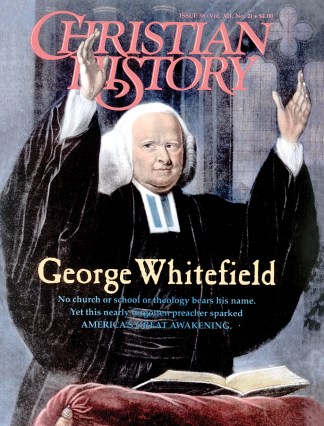
Though little known today, George Whitefield was America’s first celebrity. About 80 percent of all American colonists heard him preach at least once. Other than royalty, he was perhaps the only living person whose name would have been recognized by any colonial American.
America’s Great Awakening was sparked largely by Whitefield’s preaching tour of 1739–40. Though only 25 years old, the evangelist took America by storm. Whitefield’s farewell sermon on Boston Common drew 23,000 people—more than Boston’s entire population. It was probably the largest crowd that had ever gathered in America.
In his search for God before his conversion, Whitefield fasted to the point that he broke his health and, under doctor’s orders, was confined to bed for seven weeks.
Whitefield preached at both Harvard and New Haven College (Yale). At Harvard it was reported that “The College is entirely changed. The students are full of God.” Yet Harvard’s leading professors later wrote a pamphlet denouncing Whitefield.
Brutal mobs sometimes attacked Whitefield and his followers, maiming people and stripping women naked. Whitefield received three letters with death threats, and once he was stoned until nearly dead.
Whitefield usually awoke at 4 A.M. before beginning to preach at 5 or 6 A.M. In one week he often preached a dozen times or more and spent 40 or 50 hours in the pulpit.
George Whitefield married a woman he barely knew. Though he and his bride had corresponded, they had probably spent less than a week together before marrying. As many as four different ministers refused to marry the couple.
John Wesley is known as founder of the Methodist movement, but Whitefield formed a methodist society first. In fact, Whitefield pioneered most methods used in the 1700s’ evangelical awakenings: preaching in fields rather than churches, publishing a magazine, and holding conferences.
Whitefield pushed himself so hard and preached with such intensity that often afterward he had “a vast discharge from the stomach, usually with a considerable quantity of blood.”
Whitefield became close friends with Benjamin Franklin. Franklin once estimated that Whitefield, without any amplification, could be heard by more than 30,000 people.
George Whitefield traveled seven times to America, more than a dozen times to Scotland, and to Ireland, Bermuda, and Holland.
In his lifetime, Whitefield preached at least 18,000 times. He addressed perhaps 10,000,000 hearers.
When his 4-month-old son died, Whitefield did not stop preaching; he preached 3 times before the funeral and was preaching as the bells rang for the service itself.
Though Whitefield has been praised as “the greatest preacher that England has ever produced,” he spent little time formally preparing sermons. Whitefield’s secretary said, “I believe he knew nothing about such a kind of exercise.”
Whitefield was made the butt of several off-color songs and a satirical play. Yet he was honored by famous poets Charles Wesley, William Cowper, and later, John Greenleaf Whittier, who described Whitefield as “That life of pure intent / That voice of warning yet eloquent, / Of one on the errands of angels sent.”
Copyright © 1993 by the author or Christianity Today/Christian History magazine. Click here for reprint information on Christian History.