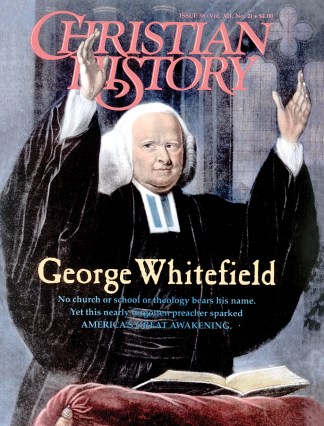
On George Whitefield’s first journey to America, in 1738, he took “thirteen hundred pounds contributed for the poor of Georgia and for charity schools.” Whitefield surveyed the state of Savannah’s children and later wrote, “What I have most at heart is the building of an orphan-house.”
Returning to America the following year, Whitefield took many gifts, which were sold in Philadelphia to finance the erection of the orphan house. Whitefield also made appeals in his sermons; as Benjamin Franklin put it, “He made large collections, for his eloquence had a wonderful power over the hearts and purses of his hearers.” The donations allowed work to begin on what Whitefield called, “Bethesda,” the “House of Mercy.”
The day after his arrival in Savannah, Whitefield inspected a 500-acre plot ten miles north of town. Soon, Whitefield, along with a carpenter and surveyor, found themselves forced to make architectural decisions. Many of the laborers came from English prisons and proved incapable. Added expenses drained the treasury. One writer openly questioned, “Where is the fund for its support: and what service can an orphan-house be in a desert and a forsaken colony?”
On March 25, 1740, Whitefield noted in his journal that “nearly forty children are under my care, and nearly a hundred mouths are daily supplied with food from our store.… The expense is great, but our great and good God, I am persuaded, will enable me to defray it.” Whitefield believed assistance would come from wealthy friends in Britain and America.
Before long, though, disagreement arose between Whitefield and the trustees, who withdrew their support. Then supplies bound for the orphanage were stolen. Soon Whitefield owed about 500 pounds—20 years’ wages.
Worse, William Seward, who had supported the endeavor, died without a will. A distraught Whitefield confessed: “I was embarrassed with Mr. Seward’s death. He died without making any provision for me, and I was at the same time much indebted for the Orphan House.” Earlier that same year, in near total despair, Whitefield declared: “I am almost tempted to wish I had never undertaken the Orphan House.”
The debt against Bethesda put Whitefield in jeopardy of being jailed. In a letter to one creditor, Whitefield pleaded, “If possible I shall discharge the debt within six months, but I am afraid it will be out of my power, having met with many disappointments. As we are brethren of the same Lord, and as the debt was contracted for him, I hope you will be patient with me.” Whitefield felt the debt as “lying like a dead weight upon me.” To relieve his debt, Whitefield even purchased a plantation and slaves in South Carolina.
Many years later, in Scotland, in 1768, Whitefield received a legacy. “The Orphan House shall have it all,” he said. Whitefield the debtor was free at last.
Copyright © 1993 by the author or Christianity Today/Christian History magazine. Click here for reprint information on Christian History.