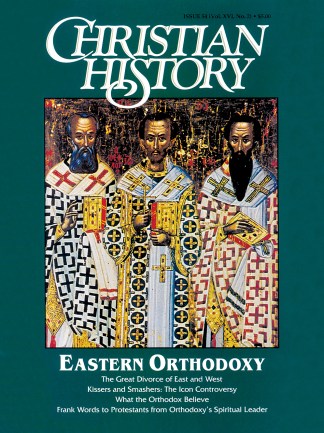
For many Protestants, Orthodoxy is an unsettling mix—a culturally foreign faith that at times feels very Protestant.
Harold O. J. Brown, professor of theology Trinity Evangelical Divinity School in Deerfield, Illinois, has been fascinated with Orthodoxy since his graduate school days, when he studied Irenaeus and other early church fathers. He is a member of Evangelical Free Church and a leading commentator on theology and society. He has written a number of books, including, Heresies: The Image of Christ in the Mirror of Heresy and Orthodoxy from the Apostles to the Present (Baker, 1988). He talked with Christian History about his views on Orthodoxy.
What about Orthodoxy do you appreciate most?
The Orthodox have a tremendous sense of the continuity of the people of God, that is, tradition. Also, they have a deep respect for Scripture; their services are primarily Scripture verses added one to another. And, of course, there is the beauty and majesty of Orthodox services.
Not as well-known is the freedom allowed in Orthodoxy. Though it retains a great many traditions, it doesn’t make non-scriptural matters mandatory. For example, in 1951 the Roman Catholic Church decreed the Assumption of the Virgin Mary to be a doctrine necessary to believe for salvation. The Orthodox have for centuries celebrated this belief (that Mary was assumed body and soul into heaven at the end of her life) in their Feast of the Dormition (“falling asleep”) of Mary. But they have never made it mandatory to believe.
What does strong tradition and liturgy give the Orthodox?
Stability. I have an Orthodox friend who teaches at a well-known seminary. While studying at Harvard Divinity School, he became intellectually skeptical about the truth of the gospel. But because he was an Orthodox priest at the time, every Sunday he had to lead the liturgy, which is saturated with Scripture and sound theology. On Sundays, he had to act as though he believed it.
Eventually, he worked through his intellectual doubts, and he partly credits the weekly liturgy. It kept pulling him back into the Christian world until his faith was made whole again. Most Protestant students who begin doubting their faith do not have such a tradition to steady them.
One Orthodox historian has said that the Orthodox have more in common with evangelicals than with Catholics. Do you agree?
In many ways, yes. First, the Orthodox place Scripture at the forefront of their faith. Tradition for them is a handing down of things entrusted to the church, and Scripture is the primary thing entrusted to the church. They regard tradition as an interpretation of Scripture, not as an independent source of religious truth.
Furthermore, great emphasis is placed on the person of Christ, on his work and on the mystery of his Incarnation and Resurrection.
Also, the Orthodox do not accept the universal supremacy of the pope. They acknowledge the pope as the head of the church of his jurisdiction but not of the whole church.
A small but significant group of evangelicals have recently converted to Orthodoxy, including Franky Schaeffer. What is the attraction for them?
Besides the things already mentioned, they have been troubled by the chaos of Protestantism. They see mainline denominations playing fast and loose with doctrine, questioning everything from the Virgin Birth to the Trinity.
They’re troubled also by the disorderly behavior of evangelicals who run from one fad to another. Protestantism to them feels rootless, without a connection to the people of God through the centuries.
The Orthodox have deep roots, which keeps them steady on many issues. For example, since the courts permitted abortion, Protestants have debated what they believe about abortion. The Orthodox, however, have a tradition that long ago determined abortion was wrong. So they weren’t confused by Roe v. Wade and have been able to speak with a clear, strong voice on the matter.
In addition, Protestantism tends to be rational and word centered. There’s an awful lot of talk in Protestant worship. The Orthodox have a liturgy that enlists beauty—in icons, hymns, and symbolism—and promotes contemplation and nurtures at a deep level the feeling that God is truly present.
This was one reason Franky Schaeffer, for example, joined the Greek Orthodox Church. He felt that evangelicals didn’t have sufficient appreciation for the role of art and beauty in the Christian life.
What features of Orthodoxy trouble you most?
One of the things I admire most: tradition. Sometimes customs become merely dead tradition that stifles the church. For example, the liturgy of the Russian Orthodox Church is still sung in Old Church Slovonic, a language hardly anyone knows today. This makes it difficult for Russians to hold on to their youth and to attract new people to their church.
We have to be fair: Protestants can also cling to outmoded traditions, but this seems to be a greater temptation in Orthodoxy.
Another concern would be icons. Orthodox theology on this point is good: the Orthodox say they do not “worship” icons but only “honor” or “reverence” them. I’m sure this is true for many Orthodox. But it’s not hard to imagine that countless Orthodox worshipers don’t see the difference and that, in many cases, icons are simply worshiped.
Finally, Orthodoxy is still an ethnic faith. There are exceptions, but often to be Orthodox means also to be Greek or Serbian or Russian. And sometimes being Greek Orthodox (or whatever) is more important than being an orthodox Christian.
Why have you remained Protestant in spite of your obvious respect for Orthodoxy?
In spite of the real confusion in Protestantism, there is still a considerable unity at the center: most Protestants affirm the Incarnation, the Trinity, and a host of ethical imperatives. Besides, Orthodoxy (and Catholicism, for that matter) endures its share of chaos; the conflicts that erupt between Orthodox churches and theologians are just as confusing as in Protestantism.
True unity has to do with staying within the doctrine and teaching of the apostles, and in a fellowship of people who believe that, no matter their church tradition. You can’t promote unity of belief merely by going to some church with a particular label. In the end, it is the Holy Spirit, not human organization, who keep us in the truth.
Copyright © 1997 by the author or Christianity Today/Christian History magazine. Click here for reprint information on Christian History.