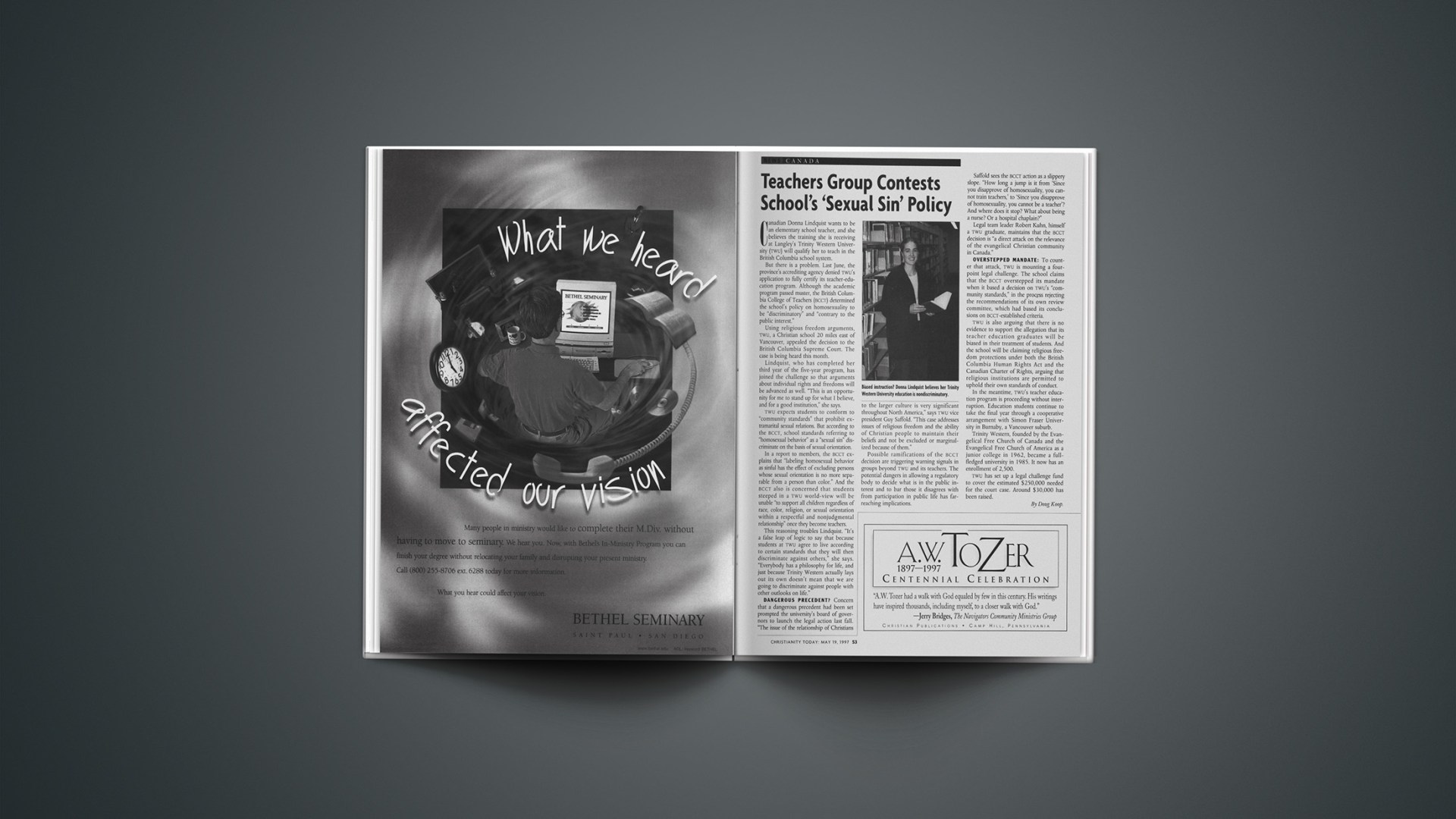

Canadian Donna Lindquist wants to be an elementary school teacher, and she believes the training she is receiving at Langley’s Trinity Western University (TWU) will qualify her to teach in the British Columbia school system.
But there is a problem. Last June, the province’s accrediting agency denied TWU’s application to fully certify its teacher-education program. Although the academic program passed muster, the British Columbia College of Teachers (BCCT) determined the school’s policy on homosexuality to be “discriminatory” and “contrary to the public interest.”
Using religious freedom arguments, TWU, a Christian school 20 miles east of Vancouver, appealed the decision to the British Columbia Supreme Court. The case is being heard this month.
Lindquist, who has completed her third year of the five-year program, has joined the challenge so that arguments about individual rights and freedoms will be advanced as well. “This is an opportunity for me to stand up for what I believe, and for a good institution,” she says.
TWU expects students to conform to “community standards” that prohibit extramarital sexual relations. But according to the BCCT, school standards referring to “homosexual behavior” as a “sexual sin” discriminate on the basis of sexual orientation.
In a report to members, the BCCT explains that “labeling homosexual behavior as sinful has the effect of excluding persons whose sexual orientation is no more separable from a person than color.” And the BCCT also is concerned that students steeped in a TWU world-view will be unable “to support all children regardless of race, color, religion, or sexual orientation within a respectful and nonjudgmental relationship” once they become teachers.
This reasoning troubles Lindquist. “It’s a false leap of logic to say that because students at TWU agree to live according to certain standards that they will then discriminate against others,” she says. “Everybody has a philosophy for life, and just because Trinity Western actually lays out its own doesn’t mean that we are going to discriminate against people with other outlooks on life.”
DANGEROUS PRECEDENT? Concern that a dangerous precedent had been set prompted the university’s board of governors to launch the legal action last fall. “The issue of the relationship of Christians to the larger culture is very significant throughout North America,” says TWU vice president Guy Saffold. “This case addresses issues of religious freedom and the ability of Christian people to maintain their beliefs and not be excluded or marginalized because of them.”
Possible ramifications of the BCCT decision are triggering warning signals in groups beyond TWU and its teachers. The potential dangers in allowing a regulatory body to decide what is in the public interest and to bar those it disagrees with from participation in public life has far-reaching implications.
Saffold sees the BCCT action as a slippery slope. “How long a jump is it from ‘Since you disapprove of homosexuality, you cannot train teachers,’ to ‘Since you disapprove of homosexuality, you cannot be a teacher’? And where does it stop? What about being a nurse? Or a hospital chaplain?”
Legal team leader Robert Kuhn, himself a TWU graduate, maintains that the BCCT decision is “a direct attack on the relevance of the evangelical Christian community in Canada.”
OVERSTEPPED MANDATE: To counter that attack, TWU is mounting a four-point legal challenge. The school claims that the bcct overstepped its mandate when it based a decision on TWU’s “community standards,” in the process rejecting the recommendations of its own review committee, which had based its conclusions on BCCT-established criteria.
TWU is also arguing that there is no evidence to support the allegation that its teacher education graduates will be biased in their treatment of students. And the school will be claiming religious freedom protections under both the British Columbia Human Rights Act and the Canadian Charter of Rights, arguing that religious institutions are permitted to uphold their own standards of conduct.
In the meantime, TWU’s teacher education program is proceeding without interruption. Education students continue to take the final year through a cooperative arrangement with Simon Fraser University in Burnaby, a Vancouver suburb.
Trinity Western, founded by the Evangelical Free Church of Canada and the Evangelical Free Church of America as a junior college in 1962, became a full-fledged university in 1985. It now has an enrollment of 2,500.
TWU has set up a legal challenge fund to cover the estimated $250,000 needed for the court case. Around $30,000 has been raised.
Copyright © 1997 Christianity Today. Click for reprint information.