
The following report by David L. Goetz, senior associate editor for Christianity Today‘s companion publication Leadership journal, summarizes a recent national survey the journal conducted (using Scanland Research, Inc.) of pastors and their finances. The report was published in the Spring 1997 issue of Leadership.
You were young then. While your friends applied to law, medical, or business school, you applied to theological school. Now, years later, your friends drive Eddie Bauer edition Ford Explorers; you drive used, four-door sedans. Your friends take winter vacations in Colorado; you take road trips to your in-laws. Your friends sock away money for their children’s college tuition and for retirement; you can do neither adequately.
Just to confirm the obvious, here are several average or median salaries of professionals in 1996: director of engineering: $100,000; school superintendent: $96,229; manufacturing vice-president: $97,000; top executive officer (nonprofit administration): $160,000.
According to the LEADERSHIP survey, while 3 percent of pastors in the survey indicated their salary equaled $75,000 or more, the majority of pastors—60 percent—make between $25,000 and $49,999 a year. The median salary of pastors is about $33,000. That figure includes money pastors are given to spend: base salary, housing and utilities allowances, and an allowance for social security/self-employment tax. It does not include the cost to a church to provide health insurance or other benefits.
Though pastors are weakly paid compared to other professionals, they tend to be generous with their money. They’re also in debt. Here are the facts the survey revealed:
—While almost half of pastors say they do not feel financially content, 70 percent of pastors indicated they rarely or never feel resentful.
—According to the study, 13 percent of full-time pastors are moonlighting to handle their bills.
—Of pastors who have a spouse working full-time, 29 percent say their median household income is almost $60,000.
—While 55 percent of pastors pay off their credit-card balance each month, the median balance of those who carry one is about $3,000 (about half of the average American’s, which Money magazine recently listed as $5,800).
—Most pastors in our survey—90 percent—believe it is appropriate for a pastor to ask for a raise, but of those who felt discontented financially, 63 percent have never done so. Those who asked, received: Only 13 percent of those who asked for a raise said they didn’t get one.
—Thirty-eight percent of pastors said their churches do not have a policy for raises—not even for a cost-of-living raise.
—Pastors are givers. Almost two-thirds of pastors—63 percent—say their family practices a 10 percent, pretax tithe. If you add those who say they give away 10 percent after taxes, the total practicing some form of the tithe jumps to 76 percent.
—Oddly, while pastors tithe, they don’t tell their congregations to. The study revealed that 35 percent of pastors don’t preach what they practice.
Pastors, of all people, realize that more money does not mean more happiness. Most would just like to get out of debt, help pay for their children’s education, and set a little aside for retirement. Yet, in one sense, money is at least a distant cousin to happiness. In our research, pastors in the top quartile of salary were more likely to own their homes, feel less resentful about their salary, be more likely to have a spouse employed because she or he wants to be, get raises when they ask for them, and have more money socked away for retirement.
To subscribe to Leadership: A Practical Journal for Church Leaders, call 1-800-777-3136.
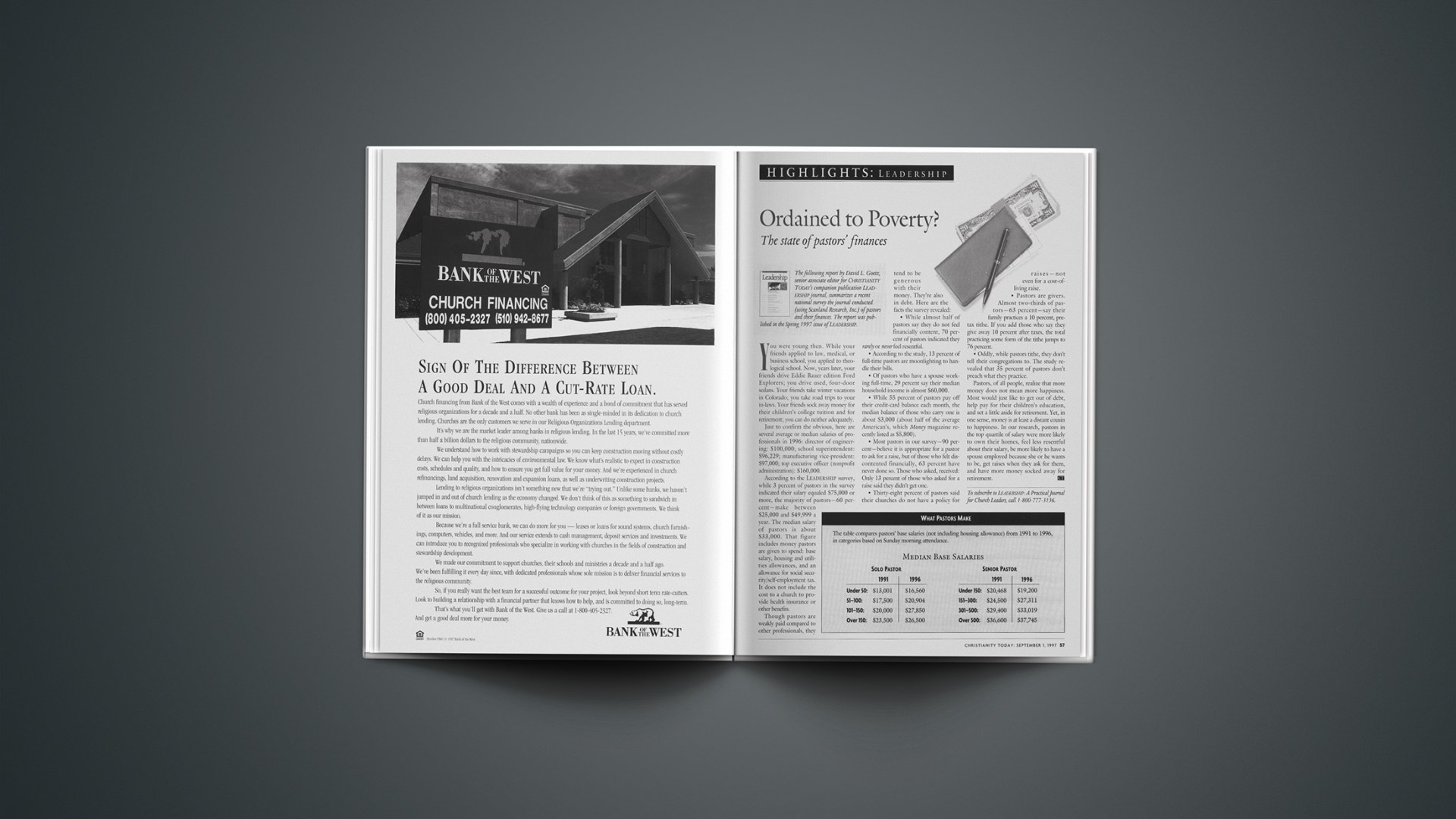
Click here to view table comparing pastor’s base salaries from 1991 to 1996 (based on Sunday morning attendance).
Copyright © 1997 Christianity Today. Click for reprint information.