Racial minorities in America have fought hard to win civil rights, yet the goal of racial reconciliation still seems far off, say Christian leaders.
Chris Rice, president of Reconcilers Fellowship, says on-campus Christians find themselves dealing not as intensively with the familiar issues of the civil-rights struggle, such as voting rights, housing, and employment, but rather with multiculturalism, an academic perspective that is often at odds with orthodox Christianity.
Rice says Christians need to think beyond the past methods of social ministry and seek “new concepts and paradigms.” He says, “My hope is that we will see a weaving together of reconciliation-minded leaders on the college campus who will commit to each other to making racial healing and justice a major focus of their campuses over the next 20 years.”
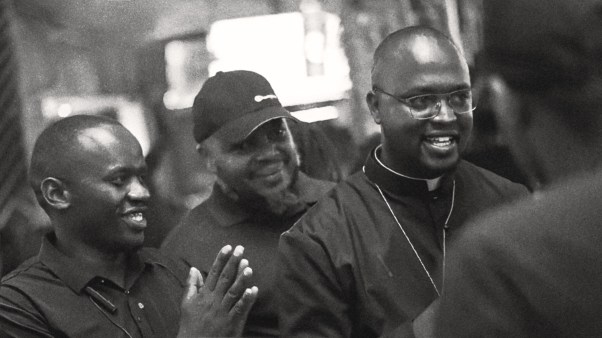
For three days in January, nearly 300 campus leaders from 50 schools gathered to plant seeds for new models of student ministry and reconciliation at a Reconcilers Fellowship meeting in Jackson, Mississippi. Their goal was to make an “honest search for answers.”
“The conference was a major source of encouragement and help,” says Samuel Barkat, vice president for multiethnic ministry at InterVarsity Christian Fellowship. “Instead of producing guilt, the conference stressed hope and possibilities.” Barkat says participants were urged to think biblically about ethnic reconciliation and to embark on a reconciliation journey.
The event became all the more poignant when national reconciliation leader Spencer Perkins collapsed of a diabetic seizure. He recovered in time to deliver the event’s closing address, only to die suddenly after heart failure three days later (CT, March 2, 1998, p. 73).
Lisa Sung, InterVarsity regional theological coordinator, says, “Spencer’s life was extended before our eyes so that we absolutely could not miss this wake-up call.”
Andy Crouch, campus minister with InterVarsity at Harvard University, says talks by Rice and Perkins instilled in him how far most ministries have to go in incorporating racial healing and justice.
“I came away from the conference dreaming of the day when InterVarsity will not have ‘directors of black, Asian, and Hispanic student ministries,’ ” Crouch told CT. “We will be so thoroughly multicultural; that whites will not be seen as normal and others exceptional. Instead, we’ll all be partners together.”
The Coalition for Christian Colleges and Universities, InterVarsity Christian Fellowship, the National Black Evangelical Association, and two local colleges—the predominantly white Belhaven College and predominantly black Tougaloo College—cosponsored the conference.
Copyright © 1998 Christianity Today. Click for reprint information.