
Christianity Today published this editorial following the Columbine High School shooting in 1999.
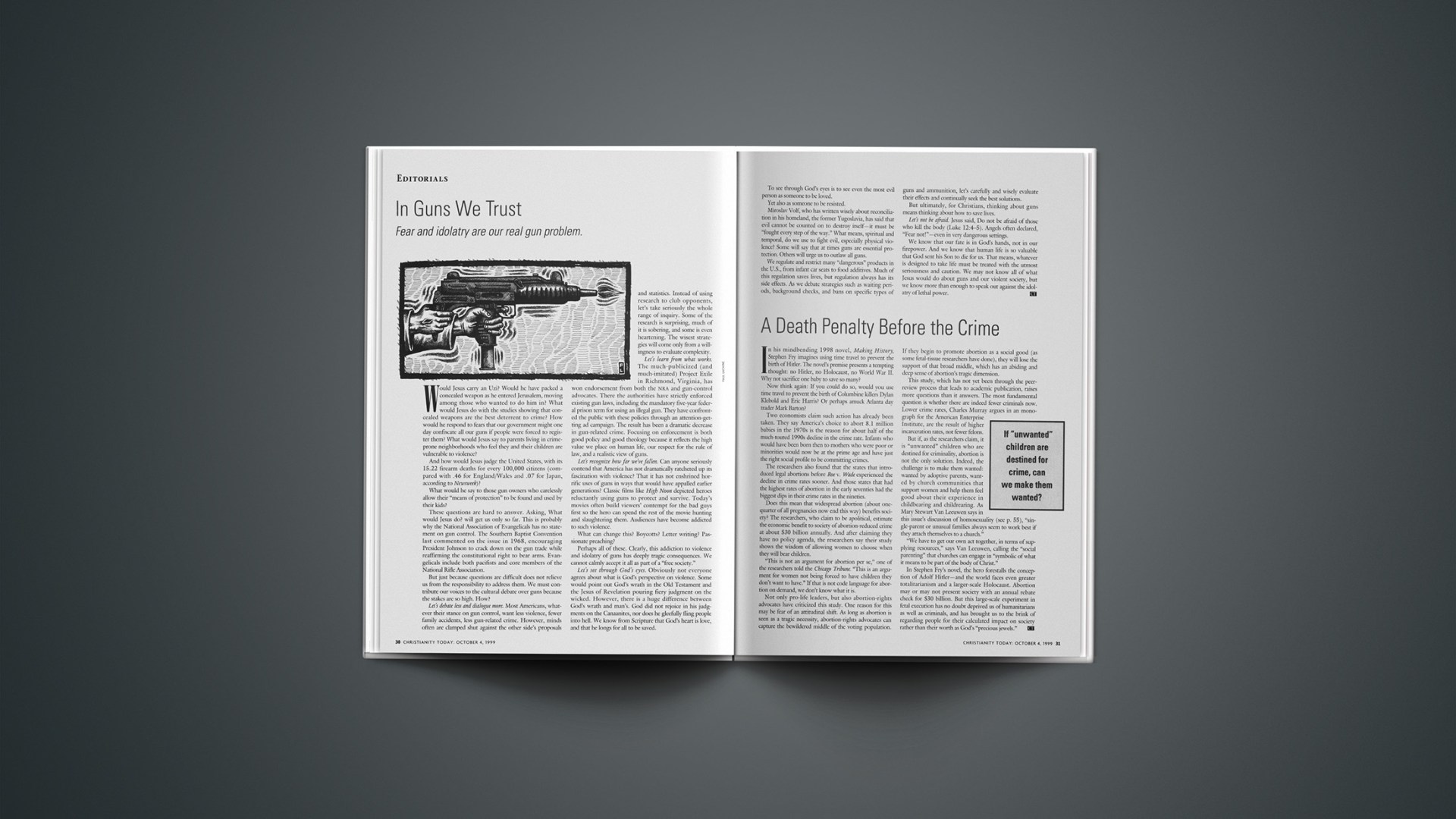
Would Jesus carry an Uzi? Would he have packed a concealed weapon as he entered Jerusalem, moving among those who wanted to do him in? What would Jesus do with the studies showing that concealed weapons are the best deterrent to crime? How would he respond to fears that our government might one day confiscate all our guns if people were forced to register them? What would Jesus say to parents living in crime-prone neighborhoods who feel they and their children are vulnerable to violence?
And how would Jesus judge the United States, with its 15.22 firearm deaths for every 100,000 citizens (compared with .46 for England/Wales and .07 for Japan, according to Newsweek)?
What would he say to those gun owners who carelessly allow their "means of protection" to be found and used by their kids?
These questions are hard to answer. Asking, What would Jesus do? will get us only so far. This is probably why the National Association of Evangelicals has no statement on gun control. The Southern Baptist Convention last commented on the issue in 1968, encouraging President Johnson to crack down on the gun trade while reaffirming the constitutional right to bear arms. Evangelicals include both pacifists and core members of the National Rifle Association.
But just because questions are difficult does not relieve us from the responsibility to address them. We must contribute our voices to the cultural debate over guns because the stakes are so high. How?
Let's debate less and dialogue more. Most Americans, whatever their stance on gun control, want less violence, fewer family accidents, less gun-related crime. However, minds often are clamped shut against the other side's proposals and statistics. Instead of using research to club opponents, let's take seriously the whole range of inquiry. Some of the research is surprising, much of it is sobering, and some is even heartening. The wisest strategies will come only from a willingness to evaluate complexity.
Let's learn from what works. The much-publicized (and much-imitated) Project Exile in Richmond, Virginia, has won endorsement from both the NRA and gun-control advocates. There the authorities have strictly enforced existing gun laws, including the mandatory five-year federal prison term for using an illegal gun. They have confronted the public with these policies through an attention-getting ad campaign. The result has been a dramatic decrease in gun-related crime. Focusing on enforcement is both good policy and good theology because it reflects the high value we place on human life, our respect for the rule of law, and a realistic view of guns.
Let's recognize how far we've fallen. Can anyone seriously contend that America has not dramatically ratcheted up its fascination with violence? That it has not enshrined horrific uses of guns in ways that would have appalled earlier generations? Classic films like High Noon depicted heroes reluctantly using guns to protect and survive. Today's movies often build viewers' contempt for the bad guys first so the hero can spend the rest of the movie hunting and slaughtering them. Audiences have become addicted to such violence.
What can change this? Boycotts? Letter writing? Passionate preaching?
Perhaps all of these. Clearly, this addiction to violence and idolatry of guns has deeply tragic consequences. We cannot calmly accept it all as part of a "free society."
Let's see through God's eyes. Obviously not everyone agrees about what is God's perspective on violence. Some would point out God's wrath in the Old Testament and the Jesus of Revelation pouring fiery judgment on the wicked. However, there is a huge difference between God's wrath and man's. God did not rejoice in his judgments on the Canaanites, nor does he gleefully fling people into hell. We know from Scripture that God's heart is love, and that he longs for all to be saved.
To see through God's eyes is to see even the most evil person as someone to be loved.
Yet also as someone to be resisted.
Miroslav Volf, who has written wisely about reconciliation in his homeland, the former Yugoslavia, has said that evil cannot be counted on to destroy itself—it must be "fought every step of the way." What means, spiritual and temporal, do we use to fight evil, especially physical violence? Some will say that at times guns are essential protection. Others will urge us to outlaw all guns.
We regulate and restrict many "dangerous" products in the U.S., from infant car seats to food additives. Much of this regulation saves lives, but regulation always has its side effects. As we debate strategies such as waiting periods, background checks, and bans on specific types of guns and ammunition, let's carefully and wisely evaluate their effects and continually seek the best solutions.
But ultimately, for Christians, thinking about guns means thinking about how to save lives.
Let's not be afraid. Jesus said, Do not be afraid of those who kill the body (Luke 12:4–5). Angels often declared, "Fear not!"—even in very dangerous settings.
We know that our fate is in God's hands, not in our firepower. And we know that human life is so valuable that God sent his Son to die for us. That means, whatever is designed to take life must be treated with the utmost seriousness and caution. We may not know all of what Jesus would do about guns and our violent society, but we know more than enough to speak out against the idolatry of lethal power.
Copyright © 1999 Christianity Today. Click for reprint information.