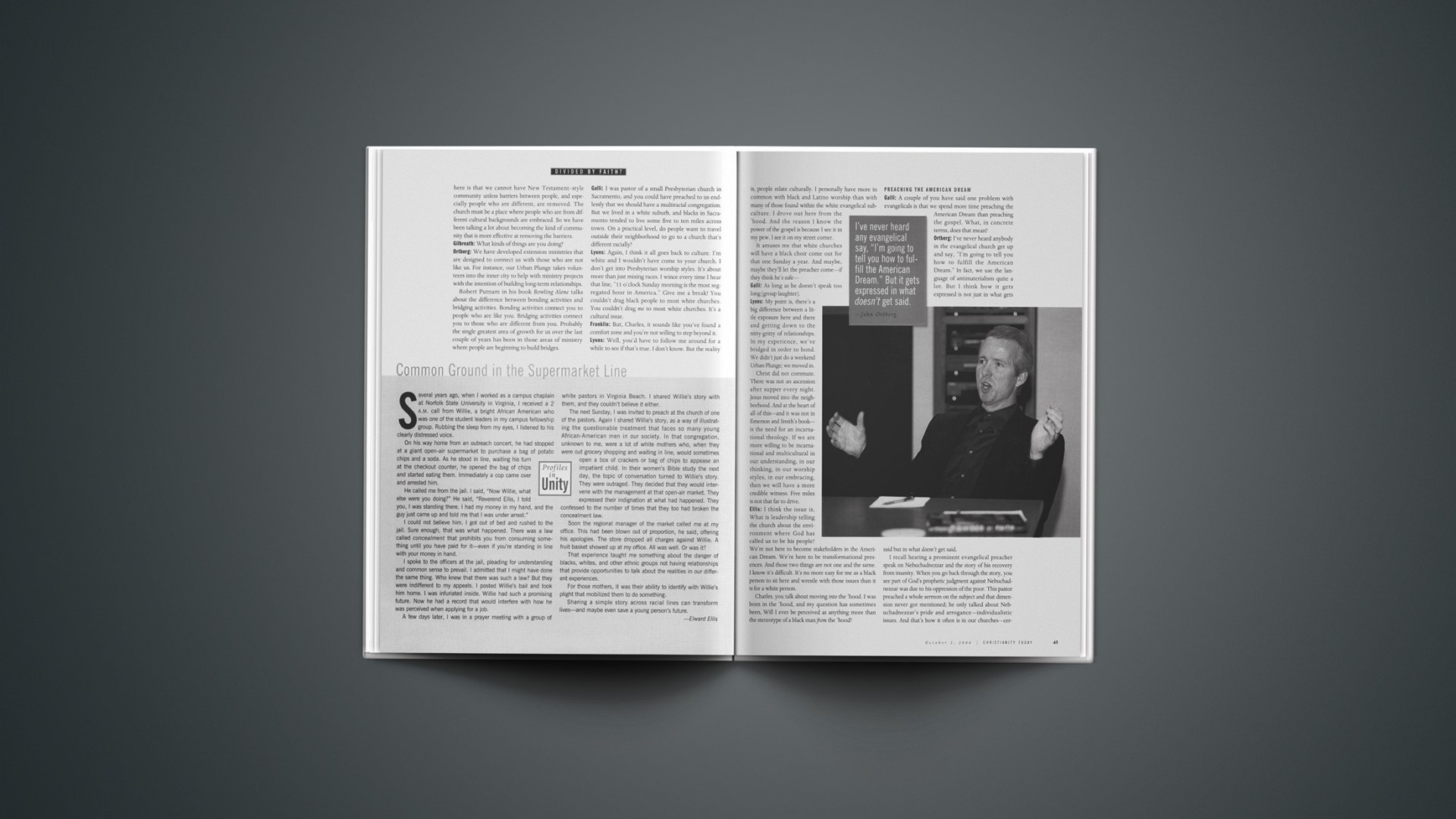

Several years ago, when I worked as a campus chaplain at Norfolk State University in Virginia, I received a 2 a.m. call from Willie, a bright African American who was one of the student leaders in my campus fellowship group. Rubbing the sleep from my eyes, I listened to his clearly distressed voice.On his way home from an outreach concert, he had stopped at a giant open-air supermarket to purchase a bag of potato chips and a soda. As he stood in line, waiting his turn at the checkout counter, he opened the bag of chips and started eating them. Immediately a cop came over and arrested him.He called me from the jail. I said, “Now Willie, what else were you doing?” He said, “Reverend Ellis, I told you, I was standing there. I had my money in my hand, and the guy just came up and told me that I was under arrest.”I could not believe him. I got out of bed and rushed to the jail. Sure enough, that was what happened. There was a law called concealment that prohibits you from consuming something until you have paid for it—even if you’re standing in line with your money in hand.I spoke to the officers at the jail, pleading for understanding and common sense to prevail. I admitted that I might have done the same thing. Who knew that there was such a law? But they were indifferent to my appeals. I posted Willie’s bail and took him home. I was infuriated inside. Willie had such a promising future. Now he had a record that would interfere with how he was perceived when applying for a job.A few days later, I was in a prayer meeting with a group of white pastors in Virginia Beach. I shared Willie’s story with them, and they couldn’t believe it either.The next Sunday, I was invited to preach at the church of one of the pastors. Again I shared Willie’s story, as a way of illustrating the questionable treatment that faces so many young African-American men in our society. In that congregation, unknown to me, were a lot of white mothers who, when they were out grocery shopping and waiting in line, would sometimes open a box of crackers or bag of chips to appease an impatient child. In their women’s Bible study the next day, the topic of conversation turned to Willie’s story. They were outraged. They decided that they would intervene with the management at that open-air market. They expressed their indignation at what had happened. They confessed to the number of times that they too had broken the concealment law.Soon the regional manager of the market called me at my office. This had been blown out of proportion, he said, offering his apologies. The store dropped all charges against Willie. A fruit basket showed up at my office. All was well. Or was it?That experience taught me something about the danger of blacks, whites, and other ethnic groups not having relationships that provide opportunities to talk about the realities in our different experiences.For those mothers, it was their ability to identify with Willie’s plight that mobilized them to do something.Sharing a simple story across racial lines can transform lives—and maybe even save a young person’s future.
Elward Ellis is senior pastor of Crossroads Presbyterian Church, a multiracial congregation in Stone Mountain, Georgia, and the former national director of black campus ministries for InterVarsity Christian Fellowship.
Related Elsewhere
Christianity Today‘s series on evangelicals and racial reconciliation began Friday and will continue all week. Our earlier stories include:The Lord in Black Skin | As a white pastor of a black church, I found the main reason prejudice and racism hurt so much: because we are so much alike. (Sept. 25, 2000) Divided by Faith? | A recent study argues that American evangelicals cannot foster genuine racial reconciliation. Is our theology to blame? (Sept. 22, 2000) Color-Blinded | Why 11 o’clock Sunday morning is still a mostly segregated hour. An excerpt from Divided by Faith. (Sept. 22, 2000)Other Christianity Today stories about social justice include:Mighty to Save | The gospel is holistic, serving as a change agent for social justice and penetrating the realm of body, mind, and soul or spirit. (Feb. 11, 2000) CT Classic: Confessions of a Racist | (Jan. 17, 2000) Martin Luther King, Jr.: A History | No Christian played a more prominent role in the century’s most significant social justice movement than Martin Luther King, Jr. (Jan. 17, 2000)
Copyright © 2000 Christianity Today. Click for reprint information.