
Churches suspend Communion for more than a month.
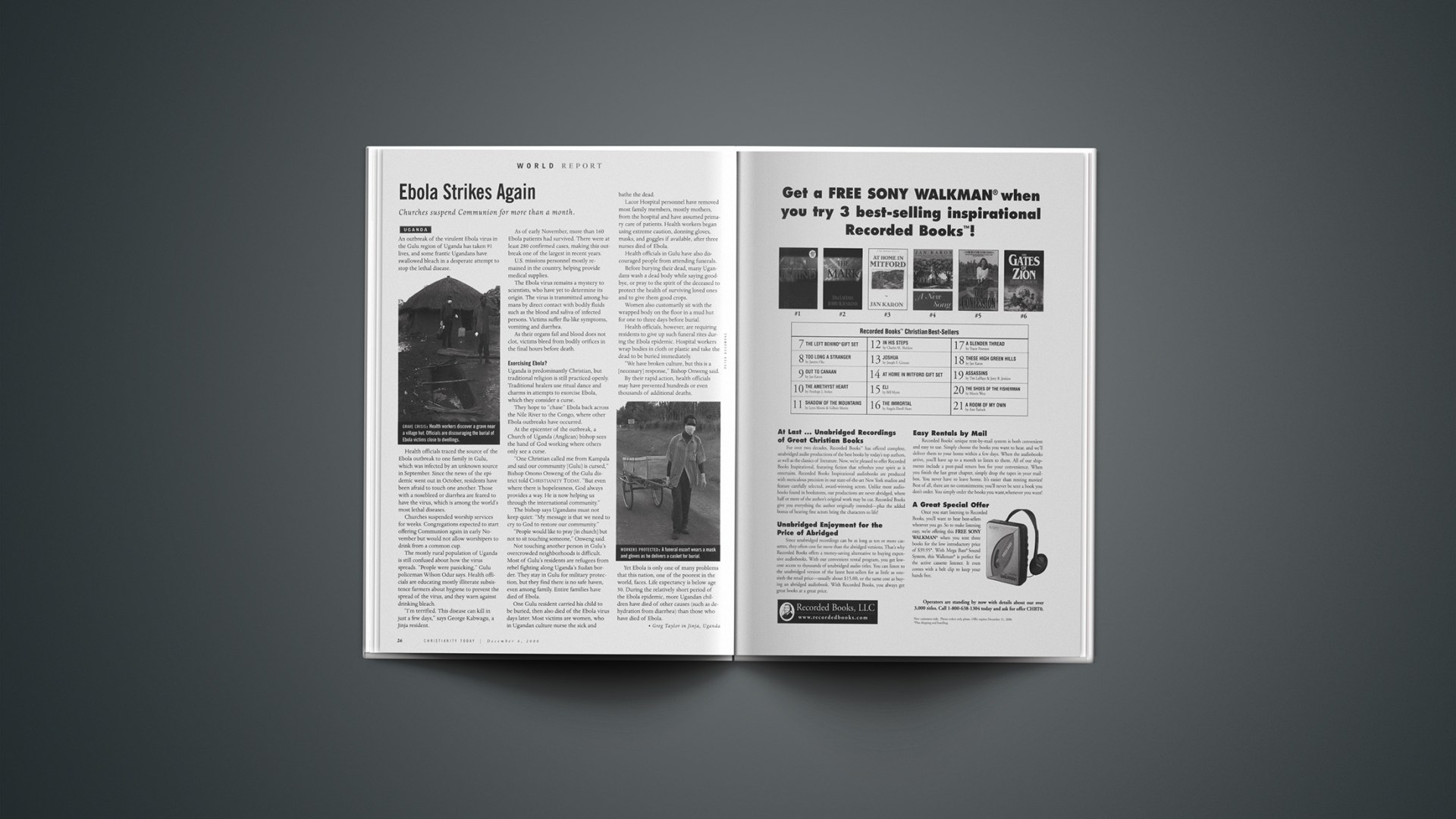
An outbreak of the virulent Ebola virus in the Gulu region of Uganda has taken 91 lives, and some frantic Ugandans have swallowed bleach in a desperate attempt to stop the lethal disease.
Health officials traced the source of the Ebola outbreak to one family in Gulu, which was infected by an unknown source in September. Since the news of the epidemic went out in October, residents have been afraid to touch one another. Those with a nosebleed or diarrhea are feared to have the virus, which is among the world’s most lethal diseases.
Churches suspended worship services for weeks. Congregations expected to start offering Communion again in early November but would not allow worshipers to drink from a common cup.
The mostly rural population of Uganda is still confused about how the virus spreads. “People were panicking,” Gulu policeman Wilson Odur says. Health officials are educating mostly illiterate subsistence farmers about hygiene to prevent the spread of the virus, and they warn against drinking bleach.
“I’m terrified. This disease can kill in just a few days,” says George Kabwagu, a Jinja resident.
As of early November, more than 160 Ebola patients had survived. There were at least 280 confirmed cases, making this outbreak one of the largest in recent years.
U.S. missions personnel mostly remained in the country, helping provide medical supplies.
The Ebola virus remains a mystery to scientists, who have yet to determine its origin. The virus is transmitted among humans by direct contact with bodily fluids such as the blood and saliva of infected persons. Victims suffer flu-like symptoms, vomiting and diarrhea.
As their organs fail and blood does not clot, victims bleed from bodily orifices in the final hours before death.
Exorcising Ebola?
Uganda is predominantly Christian, but traditional religion is still practiced openly. Traditional healers use ritual dance and charms in attempts to exorcise Ebola, which they consider a curse.
They hope to “chase” Ebola back across the Nile River to the Congo, where other Ebola outbreaks have occurred.
At the epicenter of the outbreak, a Church of Uganda (Anglican) bishop sees the hand of God working where others only see a curse.
“One Christian called me from Kampala and said our community [Gulu] is cursed,” Bishop Onono Onweng of the Gulu district told Christianity Today. “But even where there is hopelessness, God always provides a way. He is now helping us through the international community.”
The bishop says Ugandans must not keep quiet: “My message is that we need to cry to God to restore our community.”
“People would like to pray [in church] but not to sit touching someone,” Onweng said.
Not touching another person in Gulu’s overcrowded neighborhoods is difficult. Most of Gulu’s residents are refugees from rebel fighting along Uganda’s Sudan border. They stay in Gulu for military protection, but they find there is no safe haven, even among family. Entire families have died of Ebola.
One Gulu resident carried his child to be buried, then also died of the Ebola virus days later. Most victims are women, who in Ugandan culture nurse the sick and bathe the dead.
Lacor Hospital personnel have removed most family members, mostly mothers, from the hospital and have assumed primary care of patients. Health workers began using extreme caution, donning gloves, masks, and goggles if available, after three nurses died of Ebola.
Health officials in Gulu have also discouraged people from attending funerals.
Before burying their dead, many Ugandans wash a dead body while saying goodbye, or pray to the spirit of the deceased to protect the health of surviving loved ones and to give them good crops.
Women also customarily sit with the wrapped body on the floor in a mud hut for one to three days before burial.
Health officials, however, are requiring residents to give up such funeral rites during the Ebola epidemic. Hospital workers wrap bodies in cloth or plastic and take the dead to be buried immediately.
“We have broken culture, but this is a [necessary] response,” Bishop Onweng said.
By their rapid action, health officials may have prevented hundreds or even thousands of additional deaths.
Yet Ebola is only one of many problems that this nation, one of the poorest in the world, faces. Life expectancy is below age 50. During the relatively short period of the Ebola epidemic, more Ugandan children have died of other causes (such as dehydration from diarrhea) than those who have died of Ebola.
Copyright © 2000 Christianity Today. Click for reprint information.