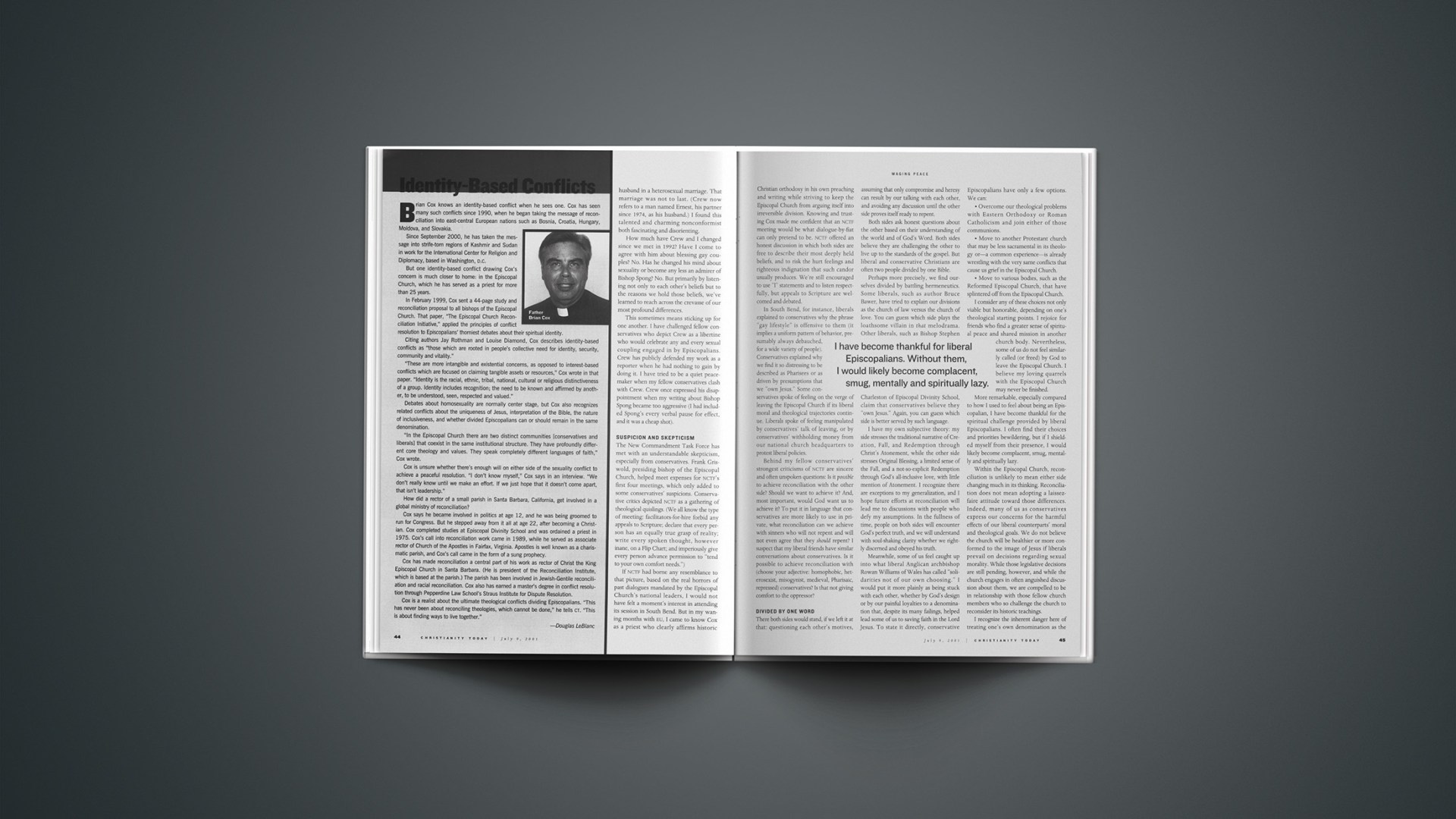

Brian Cox knows an identity-based conflict when he sees one. Cox has seen many such conflicts since 1990, when he began taking the message of reconciliation into east-central European nations such as Bosnia, Croatia, Hungary, Moldova, and Slovakia.
Since September 2000, he has taken the message into strife-torn regions of Kashmir and Sudan in work for the International Center for Religion and Diplomacy, based in Washington, D.C.
But one identity-based conflict drawing Cox’s concern is much closer to home: in the Episcopal Church, which he has served as a priest for more than 25 years.
In February 1999, Cox sent a 44-page study and reconciliation proposal to all bishops of the Episcopal Church. That paper, “The Episcopal Church Reconciliation Initiative,” applied the principles of conflict resolution to Episcopalians’ thorniest debates about their spiritual identity.
Citing authors Jay Rothman and Louise Diamond, Cox describes identity-based conflicts as “those which are rooted in people’s collective need for identity, security, community and vitality.”
“These are more intangible and existential concerns, as opposed to interest-based conflicts which are focused on claiming tangible assets or resources,” Cox wrote in that paper. “Identity is the racial, ethnic, tribal, national, cultural or religious distinctiveness of a group. Identity includes recognition; the need to be known and affirmed by another, to be understood, seen, respected and valued.”
Debates about homosexuality are normally center stage, but Cox also recognizes related conflicts about the uniqueness of Jesus, interpretation of the Bible, the nature of inclusiveness, and whether divided Episcopalians can or should remain in the same denomination.
“In the Episcopal Church there are two distinct communities [conservatives and liberals] that coexist in the same institutional structure. They have profoundly different core theology and values. They speak completely different languages of faith,” Cox wrote.
Cox is unsure whether there’s enough will on either side of the sexuality conflict to achieve a peaceful resolution. “I don’t know myself,” Cox says in an interview. “We don’t really know until we make an effort. If we just hope that it doesn’t come apart, that isn’t leadership.”
How did a rector of a small parish in Santa Barbara, California, get involved in a global ministry of reconciliation?
Cox says he became involved in politics at age 12, and he was being groomed to run for Congress. But he stepped away from it all at age 22, after becoming a Christian. Cox completed studies at Episcopal Divinity School and was ordained a priest in 1975. Cox’s call into reconciliation work came in 1989, while he served as associate rector of Church of the Apostles in Fairfax, Virginia. Apostles is well known as a charismatic parish, and Cox’s call came in the form of a sung prophecy.
Cox has made reconciliation a central part of his work as rector of Christ the King Episcopal Church in Santa Barbara. (He is president of the Reconciliation Institute, which is based at the parish.) The parish has been involved in Jewish-Gentile reconciliation and racial reconciliation. Cox also has earned a master’s degree in conflict resolution through Pepperdine Law School’s Straus Institute for Dispute Resolution.
Cox is a realist about the ultimate theological conflicts dividing Episcopalians. “This has never been about reconciling theologies, which cannot be done,” he tells CT. “This is about finding ways to live together.”
Copyright © 2001 Christianity Today. Click for reprint information.
Related Elsewhere:
Related articles appearing on our site today include:
Waging Peace | How two Episcopalians—one liberal, one conservative—have learned to say reconciliation. (July 6, 2001)Getting Personal | Behind Douglas LeBlanc’s story of reconciliation in the Episcopal Church. (July 6, 2001)
Anglican Voice has Brian Cox’s report on the Episcopal Church Reconciliation Initiative.
The Reconciliation Institute based at the Christ the King Episcopal Church in Santa Barbara lays out a five-fold purpose of reconciliation.
Mainstream press coverage of Episcopalian liberal-conservative relations includes: The Post-Gazette, Seattle Times, and Los Angeles Times.