Trounced
In a detail from Andrea di Bonaiuto’s fourteenth-century fresco The Triumph of Saint Thomas Aquinas, heretics Averroes and Arius crouch beneath the enthroned Aquinas. Averroes (also called Ibn Rushd; 1126-1198) was a Muslim philosopher who, according to Aquinas, made a hash of Aristotle and led many medieval Christians astray. Arius (c. 250-c. 336) denied Christ’s full divinity by positing that “there was [a time] when the son was not.”
Aquinas participated in no physical crusades against heresy, but he did believe that heretics “deserve not only to be separated from the Church by excommunication, but also to be severed from the world by death.”
Fancy meeting you here
Aquinas and several of his enemies make appearances in James Joyce’s daunting 1922 novel Ulysses. In chapter one, a character is asked for his views on Hamlet but replies, “I’m not equal to Thomas Aquinas and the fiftyfive reasons he has made to prop it up. Wait till I have a few pints in me first.” Arius, Sabellius (the third heretic at Aquinas’s feet in The Triumph), Averroes, and Moses Maimonides (see page 37) pop up as well.
Heeding the call
Franciscans in Assisi will soon enjoy a new feature in their habits: cell phone pockets. Some critics consider the innovation inappropriate, but Elisabetta Biancheri, who designed the habits, said, “It is simply a functional item of clothing. Even monks make phone calls.” Biancheri is right about the phones, but she shouldn’t call Franciscans “monks”—they’re friars, and, as Thomas well knew, there is a difference (see page 23).
Word-aholic
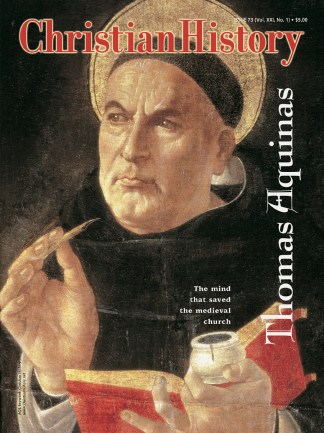
Thomas did not even live to see his fiftieth birthday, but he produced an enormous body of writing: more than 10,000,000 words in some 60 works. Thomas lacked the time to pen so many words, and if he had written them, no one would be able to read them (he had notoriously bad handwriting). Instead, he dictated to secretaries—sometimes several at once. A thirteenth-century source avers that Thomas “used to dictate in his cell to three secretaries, and even occasionally to four, on different subjects at the same time.”
Lighten up
Because Thomas wrote on just about every subject, he eventually touched on entertainment, but the way he approached it (in his Commentary on the Ethics of Aristotle) suggests that it wasn’t one of his strong suits: “Amusement does have an aspect of good inasmuch as it is useful for human living. As man sometimes needs to give his body rest from labors, so also he sometimes needs to rest his soul from mental strain that ensues from his application to serious affairs. This is done by amusement.” He did, however, dispute at least one completely silly question in his career: “Whether truth is stronger than either wine, the king, or woman.”
Copyright © 2002 by the author or Christianity Today/Christian History magazine. Click here for reprint information on Christian History.