
Even before the dust settled on the Enron eruption—the biggest bankruptcy in American history—regulators, legislators, and prosecutors were sifting through the rubble seeking an explanation for such a massive ethical collapse. How could the auditors be so negligent? Is there no way to safeguard against this in the future? What new regulations are needed?
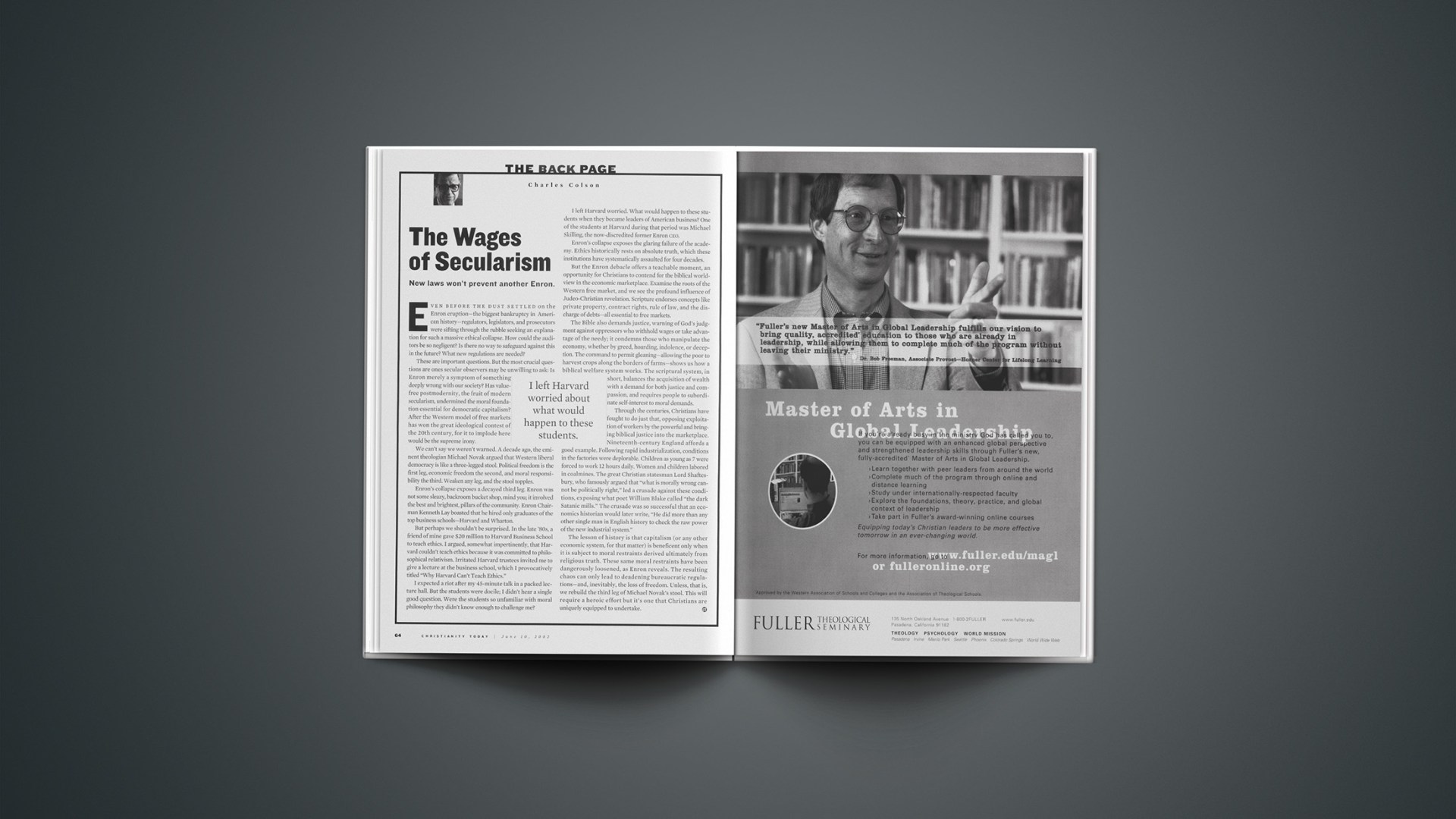
These are important questions. But the most crucial questions are ones secular observers may be unwilling to ask: Is Enron merely a symptom of something deeply wrong with our society? Has value-free postmodernity, the fruit of modern secularism, undermined the moral foundation essential for democratic capitalism? After the Western model of free markets has won the great ideological contest of the 20th century, for it to implode here would be the supreme irony.
We can’t say we weren’t warned. A decade ago, the eminent theologian Michael Novak argued that Western liberal democracy is like a three-legged stool. Political freedom is the first leg, economic freedom the second, and moral responsibility the third. Weaken any leg, and the stool topples.
Enron’s collapse exposes a decayed third leg. Enron was not some sleazy, backroom bucket shop, mind you; it involved the best and brightest, pillars of the community. Enron Chairman Kenneth Lay boasted that he hired only graduates of the top business schools—Harvard and Wharton.
But perhaps we shouldn’t be surprised. In the late ’80s, a friend of mine gave $20 million to Harvard Business School to teach ethics. I argued, somewhat impertinently, that Harvard couldn’t teach ethics because it was committed to philosophical relativism. Irritated Harvard trustees invited me to give a lecture at the business school, which I provocatively titled “Why Harvard Can’t Teach Ethics.”
I expected a riot after my 45-minute talk in a packed lecture hall. But the students were docile; I didn’t hear a single good question. Were the students so unfamiliar with moral philosophy they didn’t know enough to challenge me?
I left Harvard worried. What would happen to these students when they became leaders of American business? One of the students at Harvard during that period was Jeffrey Skilling, the now-discredited former Enron CEO.
Enron’s collapse exposes the glaring failure of the academy. Ethics historically rests on absolute truth, which these institutions have systematically assaulted for four decades.
But the Enron debacle offers a teachable moment, an opportunity for Christians to contend for the biblical worldview in the economic marketplace. Examine the roots of the Western free market, and we see the profound influence of Judeo-Christian revelation. Scripture endorses concepts like private property, contract rights, rule of law, and the discharge of debts—all essential to free markets.
The Bible also demands justice, warning of God’s judgment against oppressors who withhold wages or take advantage of the needy; it condemns those who manipulate the economy, whether by greed, hoarding, indolence, or deception. The command to permit gleaning—allowing the poor to harvest crops along the borders of farms—shows us how a biblical welfare system works. The scriptural system, in short, balances the acquisition of wealth with a demand for both justice and compassion, and requires people to subordinate self-interest to moral demands.
Through the centuries, Christians have fought to do just that, opposing exploitation of workers by the powerful and bringing biblical justice into the marketplace. Nineteenth-century England affords a good example. Following rapid industrialization, conditions in the factories were deplorable. Children as young as 7 were forced to work 12 hours daily. Women and children labored in coalmines. The great Christian statesman Lord Shaftesbury, who famously argued that “what is morally wrong cannot be politically right,” led a crusade against these conditions, exposing what poet William Blake called “the dark Satanic mills.” The crusade was so successful that an economics historian would later write, “He did more than any other single man in English history to check the raw power of the new industrial system.”
The lesson of history is that capitalism (or any other economic system, for that matter) is beneficent only when it is subject to moral restraints derived ultimately from religious truth. These same moral restraints have been dangerously loosened, as Enron reveals. The resulting chaos can only lead to deadening bureaucratic regulations—and, inevitably, the loss of freedom. Unless, that is, we rebuild the third leg of Michael Novak’s stool. This will require a heroic effort but it’s one that Christians are uniquely equipped to undertake.
Copyright © 2002 Christianity Today. Click for reprint information.
Related Elsewhere
A ready-to-download Bible Study on this article is available at ChristianBibleStudies.com. These unique Bible studies use articles from current issues of Christianity Today to prompt thought-provoking discussions in adult Sunday school classes or small groups.
For news coverage of the Enron controversy, see Yahoo! full coverage.
Christianity Today sister publication Books & Culture recently examined the lessons of the Enron scandal.
Recent Charles Colson columns for Christianity Today include:
More Doctrine, Not LessWe need to proclaim truth to a truth-impaired generation. (April 15, 2001)
Post-Truth SocietyThe recent trend of lying is no accident. (March 4, 2002)
Drawing the Battle LinesWe need to be informed and discerning about the Islamic worldview. (Jan. 9, 2002)
Wake-up CallIf September 11 was a divine warning, it’s God’s people who are being warned. (Nov. 5, 2001)
The New TyrannyBiotechnology threatens to turn humanity into raw material. (Oct. 5, 2001)
Merchants of CoolWe should be angry that the media hawks violence and that parents allow it. (June 6, 2001)
Slouching into SlothThe XFL is but the latest sign of the coarsening of our culture. (Apr. 17, 2001)
Checks and (out of) BalanceMoral truth is in jeopardy when the courts enter the business of making law. (Feb. 27, 2001)
Pander PoliticsPoll-driven elections turn voters into self-seeking consumers.(Jan. 3, 2001)
Neighborhood OutpostChanging a culture takes more than politics. (Nov.8, 2000)
MAD No MoreIn this post-Cold War era, it’s time to rethink our nation’s defensive strategy. (Sept. 27, 2000)
Salad-Bar ChristianityToo many believers pick and choose their own truths. (Aug. 8, 2000)
A Healthy ‘Cult’A lively response by one unusual audience shows how God’s power transforms culture. (June 12, 2000)