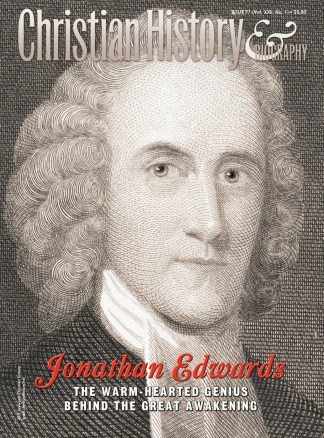
“And confessed that they were strangers and pilgrims on the earth. For they that say such things declare plainly that they seek a country.”
—Hebrews 11:13-14
This world is not our abiding place. Our continuance here is but very short. … If God has given us ample estates, and children, or other pleasant friends, it is with no such design, that we should be furnished here, as for a settled abode; but with a design that we should use them for the present, and then leave them in a very little time.
When we are called to any secular business, or charged with the care of a family, if we improve our lives to any other purpose, than as a journey toward heaven, all our labour will be lost. If we spend our lives in the pursuit of a temporal happiness; as riches, or sensual pleasures; credit and esteem from men; delight in our children, and the prospect of seeing them well brought up, and well settled, &c.—
All these things will be of little significancy to us. Death will blow up all our hopes, and will put an end to these enjoyments. “The places that have known us, will know us no more:” and “the eye that has seen us, shall see us no more.”
Heaven is that place alone where our highest end, and highest good is to be obtained. God hath made us for himself. “Of him, and through him, and to him are all things.” Therefore, then do we attain to our highest end, when we are brought to God: but that is by being brought to heaven; for that is God’s throne, the place of his special presence. There is but a very imperfect union with God to be had in this world, a very imperfect knowledge of him in the midst of much darkness: a very imperfect conformity to God, mingled with abundance of estrangement. Here we can serve and glorify God, but in a very imperfect manner; our service being mingled with sin, which dishonours God. But when we get to heaven, (if ever that be) we shall be brought to a perfect union with God, and have more clear views of him.
There we shall be fully conformed to God, without any remaining sin: for “we shall see him as he is.” There we shall serve God perfectly; and glorify him in an exalted manner, even to the utmost of the powers and capacity of our nature. Then we shall perfectly give up ourselves to God: our hearts will be pure and holy offerings, presented in a flame of divine love.
God is the highest good of the reasonable creature; and the enjoyment of him is the only happiness with which our souls can be satisfied. To go to heaven fully to enjoy God, is infinitely better than the most pleasant accommodations here. Fathers and mothers, husbands, wives, or children, or the company of earthly friends, are but shadows; but the enjoyment of God is the substance. These are but scattered beams; but God is the sun. These are but streams; but God is the fountain. These are but drops; but God is the ocean.
—Works of President Edwards, ed. S. B. Dwight, vol. 7.
Copyright © 2003 by the author or Christianity Today/Christian History magazine. Click here for reprint information on Christian History.