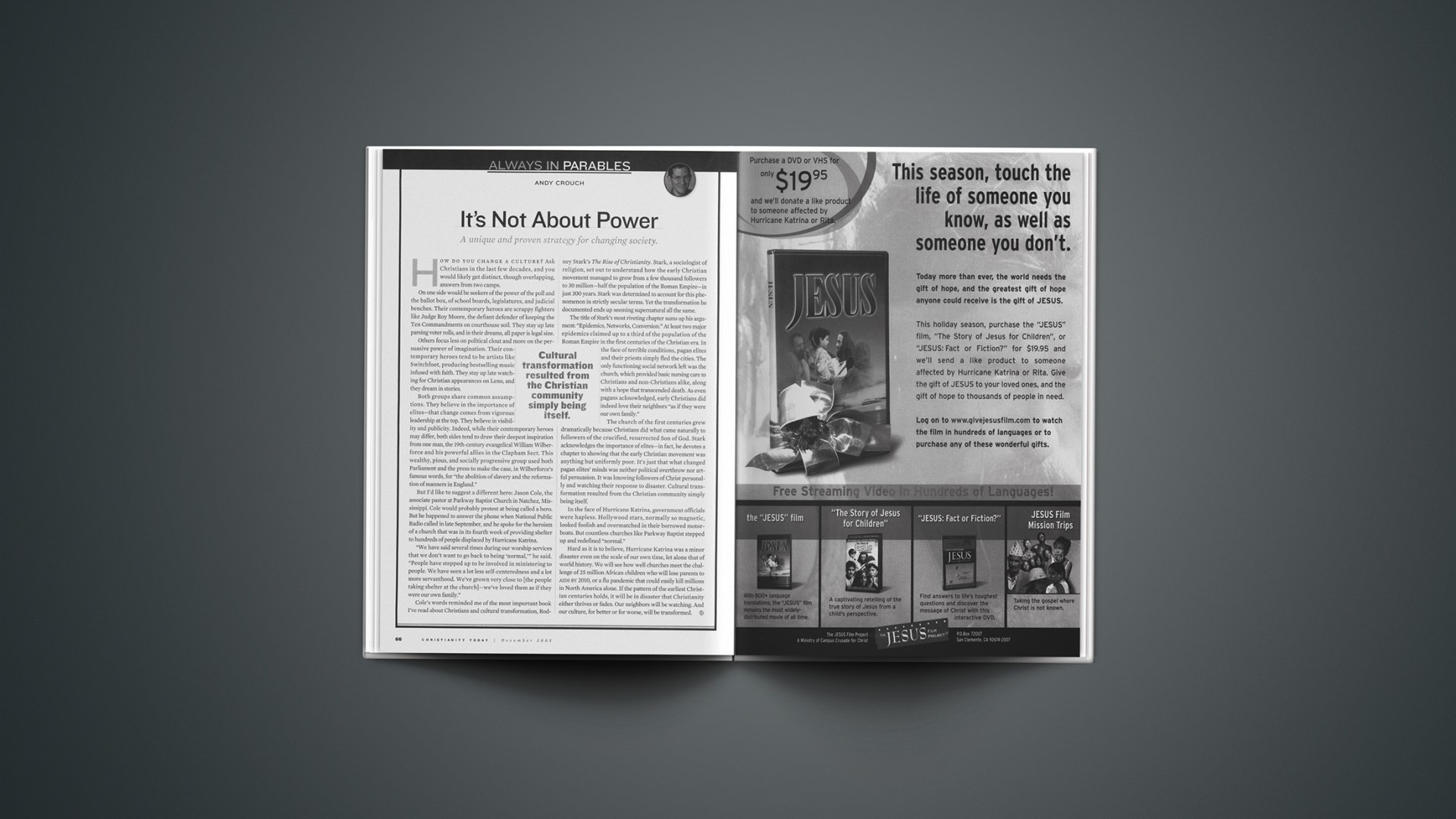

How do you change a culture? Ask Christians in the last few decades, and you would likely get distinct, though overlapping, answers from two camps.
On one side would be seekers of the power of the poll and the ballot box, of school boards, legislatures, and judicial benches. Their contemporary heroes are scrappy fighters like Judge Roy Moore, the defiant defender of keeping the Ten Commandments on courthouse soil. They stay up late parsing voter rolls, and in their dreams, all paper is legal size.
Others focus less on political clout and more on the persuasive power of imagination. Their contemporary heroes tend to be artists like Switchfoot, producing bestselling music infused with faith. They stay up late watching for Christian appearances on Leno, and they dream in stories.
Both groups share common assumptions. They believe in the importance of elites—that change comes from vigorous leadership at the top. They believe in visibility and publicity. Indeed, while their contemporary heroes may differ, both sides tend to draw their deepest inspiration from one man, the 19th-century evangelical William Wilberforce and his powerful allies in the Clapham Sect. This wealthy, pious, and socially progressive group used both Parliament and the press to make the case, in Wilberforce’s famous words, for “the abolition of slavery and the reformation of manners in England.”
But I’d like to suggest a different hero: Jason Cole, the associate pastor at Parkway Baptist Church in Natchez, Mississippi. Cole would probably protest at being called a hero. But he happened to answer the phone when National Public Radio called in late September, and he spoke for the heroism of a church that was in its fourth week of providing shelter to hundreds of people displaced by Hurricane Katrina.
“We have said several times during our worship services that we don’t want to go back to being ‘normal,'” he said. “People have stepped up to be involved in ministering to people. We have seen a lot less self-centeredness and a lot more servanthood. We’ve grown very close to [the people taking shelter at the church]—we’ve loved them as if they were our own family.”
Cole’s words reminded me of the most important book I’ve read about Christians and cultural transformation, Rodney Stark’s The Rise of Christianity. Stark, a sociologist of religion, set out to understand how the early Christian movement managed to grow from a few thousand followers to 30 million—half the population of the Roman Empire—in just 300 years. Stark was determined to account for this phenomenon in strictly secular terms. Yet the transformation he documented ends up seeming supernatural all the same.
The title of Stark’s most riveting chapter sums up his argument: “Epidemics, Networks, Conversion.” At least two major epidemics claimed up to a third of the population of the Roman Empire in the first centuries of the Christian era. In the face of terrible conditions, pagan elites and their priests simply fled the cities. The only functioning social network left was the church, which provided basic nursing care to Christians and non-Christians alike, along with a hope that transcended death. As even pagans acknowledged, early Christians did indeed love their neighbors “as if they were our own family.”
The church of the first centuries grew dramatically because Christians did what came naturally to followers of the crucified, resurrected Son of God. Stark acknowledges the importance of elites—in fact, he devotes a chapter to showing that the early Christian movement was anything but uniformly poor. It’s just that what changed pagan elites’ minds was neither political overthrow nor artful persuasion. It was knowing followers of Christ personally and watching their response to disaster. Cultural transformation resulted from the Christian community simply being itself.
In the face of Hurricane Katrina, government officials were hapless. Hollywood stars, normally so magnetic, looked foolish and overmatched in their borrowed motorboats. But countless churches like Parkway Baptist stepped up and redefined “normal.”
Hard as it is to believe, Hurricane Katrina was a minor disaster even on the scale of our own time, let alone that of world history. We will see how well churches meet the challenge of 25 million African children who will lose parents to AIDS by 2010, or a flu pandemic that could easily kill millions in North America alone. If the pattern of the earliest Christian centuries holds, it will be in disaster that Christianity either thrives or fades. Our neighbors will be watching. And our culture, for better or for worse, will be transformed.
Copyright © 2005 Christianity Today. Click for reprint information.
Related Elsewhere:
Earlier Andy Crouch columns for Christianity Today include:
Of Wardrobes and Potters | A story about faith and fairy tales. (Sept. 20, 2005)
Environmental Wager | Why evangelicals are—but shouldn’t be—cool toward global warming. (Aug. 8, 2005)
Visualcy | Literacy is not the only necessity in a visual culture. (May 31, 2005)
Compliant but Confused | Unpacking some myths about today’s teens. (April 12, 2005)
Stonewashed Worship | Churches are striving to appear ‘authentic’—like the rest of consumer culture. (Jan. 28, 2005)
When Backward Is Forward | Christmas may be the best argument against genetic enhancement. (Dec. 23, 2004)
Salt-and-Pepper Politics | Choosing between candidates whose consciences are too clean. (Oct. 04, 2004)
‘Live More Musically’ | The difference between Christian practice and a Starbucks purchase. (July 29, 2004)
The Cruel Edges of the World | There are some places that bring the distant biblical text closer to our lives. (June 07, 2004)
Pilgrims to Nowhere | Freedom isn’t much good if you don’t have a sense of direction. (March 30, 2004)
Glittering Images | A profound Christian rethinking of power is overdue (Feb. 17, 2004)
Before the Deluge | All of us have a sexual orientation that bends toward the self. (Dec. 03, 2003)
Two Weddings and a Baptism | It’s still impossible to predict what will advance the gospel in Hollywood. (Oct. 15, 2003)
Wrinkles in Time | Botox injections as a spiritual discipline. (Aug. 11, 2003)
Rites of Passage | Self-improvement is our culture’s most durable religion. (June 6, 2003)
Christian Esperanto | We must learn other cultural tongues. (June 4, 2003)
We’re Rich | But why is it so hard to admit? (Feb. 20, 2003)