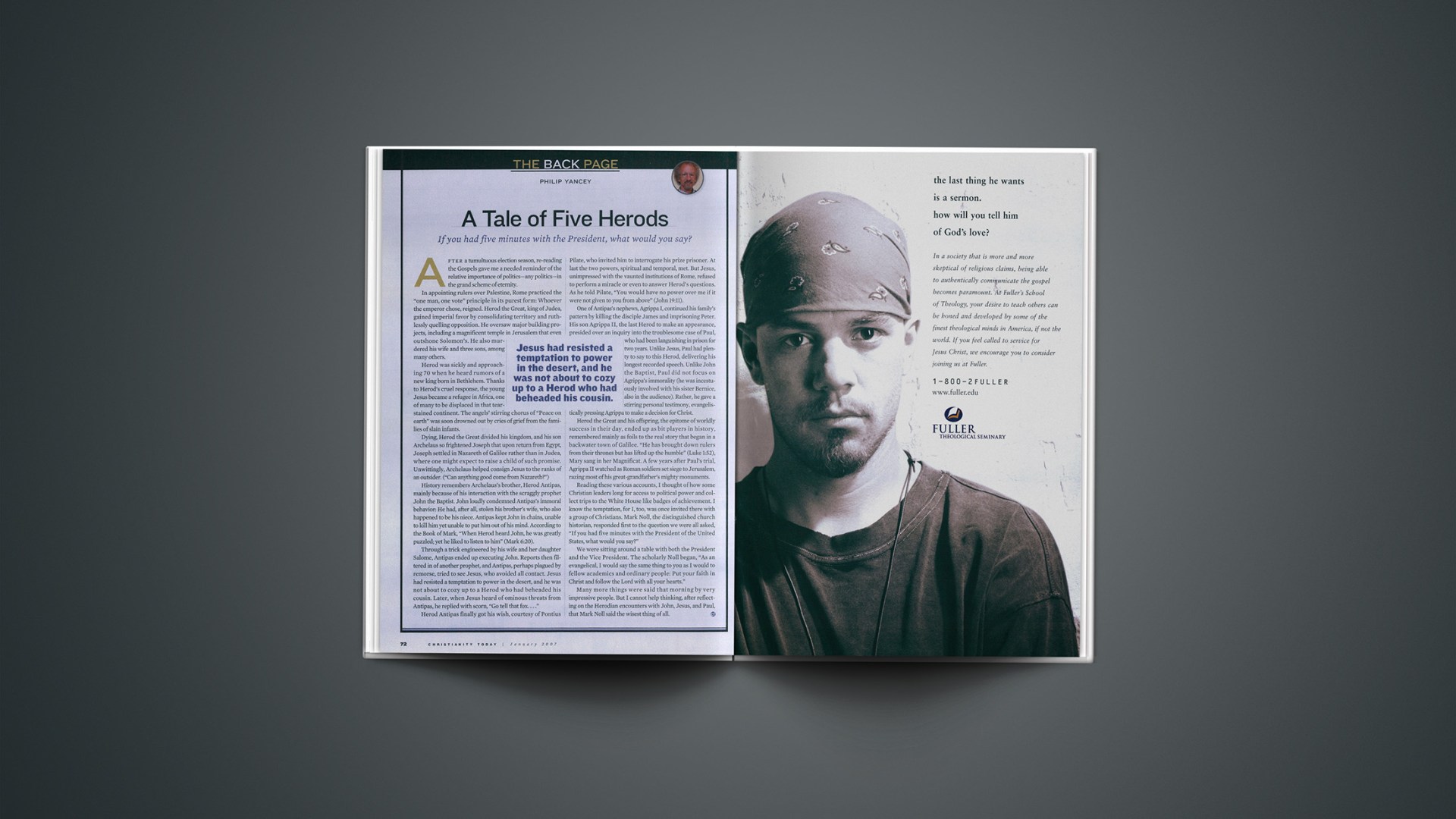

After a tumultuous election season, re-reading the Gospels gave me a needed reminder of the relative importance of politics—any politics—in the grand scheme of eternity.
In appointing rulers over Palestine, Rome practiced the “one man, one vote” principle in its purest form: Whoever the emperor chose, reigned. Herod the Great, king of Judea, gained imperial favor by consolidating territory and ruthlessly quelling opposition. He oversaw major building projects, including a magnificent temple in Jerusalem that even outshone Solomon’s. He also murdered his wife and three sons, among many others.
Herod was sickly and approaching 70 when he heard rumors of a new king born in Bethlehem. Thanks to Herod’s cruel response, the young Jesus became a refugee in Africa, one of many to be displaced in that tear-stained continent. The angels’ stirring chorus of “Peace on earth” was soon drowned out by cries of grief from the families of slain infants.
Dying, Herod the Great divided his kingdom, and his son Archelaus so frightened Joseph that upon return from Egypt, Joseph settled in Nazareth of Galilee rather than in Judea, where one might expect to raise a child of such promise. Unwittingly, Archelaus helped consign Jesus to the ranks of an outsider. (“Can anything good come from Nazareth?”)
History remembers Archelaus’s brother, Herod Antipas, mainly because of his interaction with the scraggly prophet John the Baptist. John loudly condemned Antipas’s immoral behavior: He had, after all, stolen his brother’s wife, who also happened to be his niece. Antipas kept John in chains, unable to kill him yet unable to put him out of his mind. According to the Book of Mark, “When Herod heard John, he was greatly puzzled; yet he liked to listen to him” (Mark 6:20).
Through a trick engineered by his wife and her daughter Salome, Antipas ended up executing John. Reports then filtered in of another prophet, and Antipas, perhaps plagued by remorse, tried to see Jesus, who avoided all contact. Jesus had resisted a temptation to power in the desert, and he was not about to cozy up to a Herod who had beheaded his cousin. Later, when Jesus heard of ominous threats from Antipas, he replied with scorn, “Go tell that fox. …”
Herod Antipas finally got his wish, courtesy of Pontius Pilate, who invited him to interrogate his prize prisoner. At last the two powers, spiritual and temporal, met. But Jesus, unimpressed with the vaunted institutions of Rome, refused to perform a miracle or even to answer Herod’s questions. As he told Pilate, “You would have no power over me if it were not given to you from above” (John 19:11).
One of Antipas’s nephews, Agrippa I, continued his family’s pattern by killing the disciple James and imprisoning Peter. His son Agrippa II, the last Herod to make an appearance, presided over an inquiry into the troublesome case of Paul, who had been languishing in prison for two years. Unlike Jesus, Paul had plenty to say to this Herod, delivering his longest recorded speech. Unlike John the Baptist, Paul did not focus on Agrippa’s immorality (he was incestuously involved with his sister Bernice, also in the audience). Rather, he gave a stirring personal testimony, evangelistically pressing Agrippa to make a decision for Christ.
Herod the Great and his offspring, the epitome of worldly success in their day, ended up as bit players in history, remembered mainly as foils to the real story that began in a backwater town of Galilee. “He has brought down rulers from their thrones but has lifted up the humble” (Luke 1:52), Mary sang in her Magnificat. A few years after Paul’s trial, Agrippa II watched as Roman soldiers set siege to Jerusalem, razing most of his great-grandfather’s mighty monuments.
Reading these various accounts, I thought of how some Christian leaders long for access to political power and collect trips to the White House like badges of achievement. I know the temptation, for I, too, was once invited there with a group of Christians. Mark Noll, the distinguished church historian, responded first to the question we were all asked, “If you had five minutes with the President of the United States, what would you say?”
We were sitting around a table with both the President and the Vice President. The scholarly Noll began, “As an evangelical, I would say the same thing to you as I would to fellow academics and ordinary people: Put your faith in Christ and follow the Lord with all your hearts.”
Many more things were said that morning by very impressive people. But I cannot help thinking, after reflecting on the Herodian encounters with John, Jesus, and Paul, that Mark Noll said the wisest thing of all.
Copyright © 2007 Christianity Today. Click for reprint information.
Related Elsewhere:
Philip Yancey’s columns are available on our site.
‘Welcoming the Uninvited Savior‘ is another Christianity Today article about the Herods’ Palestine.