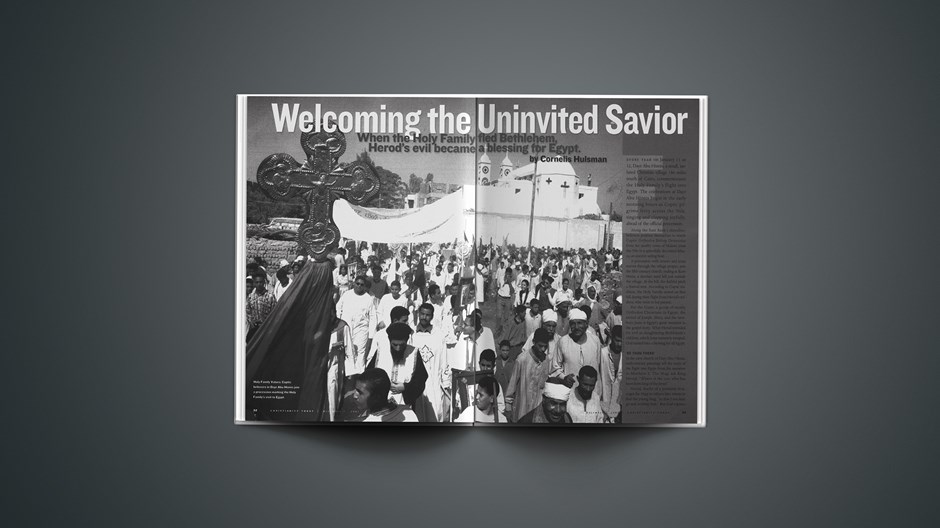
Every year on January 11 or 12, Dayr Abu Hinnis, a small, isolated Christian village 186 miles south of Cairo, commemorates the Holy Family's flight into Egypt. The celebrations at Dayr Abu Hinnis begin in the early morning hours as Coptic pilgrims ferry across the Nile, singing and clapping joyfully, ahead of the official procession.
Along the East Bank's shoreline, believers position themselves to watch Coptic Orthodox Bishop Demetrius from the nearby town of Malawi cross the Nile in a splendidly decorated felucca, an ancient sailing boat.
A procession with crosses and icons moves through the village proper, past the fifth-century church, ending at Kom Maria, a desolate sand hill just outside the village. At the hill, the faithful pitch a festival tent. According to Coptic tradition, the Holy Family rested on that hill during their flight from Herod's soldiers, who were in hot pursuit.
For the Copts, a group of mostly Orthodox Christians in Egypt, the arrival of Joseph, Mary, and the newborn Jesus is Egypt's great moment in the gospel story. What Herod intended for evil in slaughtering Bethlehem's children, which Jesus narrowly escaped, God turned into a blessing for all Egypt.
'Be Thou There'
In the cave church of Dayr Abu Hinnis, sixth-century paintings tell the story of the flight into Egypt from the narrative in Matthew 2: The Magi ask King Herod, "Where is the one who has been born king of the Jews?"
Herod, fearful of a potential rival, urges the Magi to inform him where to find the young king, "so that I too may go and worship him." But God exposes Herod's evil plans. The Magi, warned in a dream, return to their own country without informing him.
An angel in a dream warns Joseph of Herod's malicious intent. "Arise!" the angel declares. "Take the young child and his mother and flee into Egypt, and be thou there until I bring thee word" (Matt. 2:13, KJV). Herod realizes the Magi have outwitted him. Furious, he gives orders to kill all the children age 2 and younger in the region around Bethlehem.
Many villages in Egypt boast that the Holy Family paid them a visit. For centuries, perhaps for 1,600 years, Coptic congregations have organized pilgrimage festivals, called mulids, to honor the Holy Family's visit to their area. The celebration in Dayr Abu Hinnis is just one of those mulids.
Oral Traditions
The mulids are a traditional time of corporate prayer for Coptic believers. Pilgrims pray for their families, or for healing. During the mulid, the participants celebrate with a feast in which local Muslim friends and family may be invited.
Matthew's Gospel provides no details about the Holy Family's travels in Egypt, so the early Coptic Church developed oral traditions to flesh out their visit. The contemporary Coptic church still values oral tradition greatly. The lack of historical or archaeological evidence has had no influence on oral tradition.
"The church in the first centuries was persecuted by the Romans," says Bishop Demetrius, author of a widely distributed booklet about the Holy Family. "Naturally, putting oral traditions on paper wouldn't be people's first concern. But you never know; perhaps we will later find documents of this period."
The first Holy Family site is mentioned in A History of the Monks in Egypt, an ancient text describing the journey of seven pilgrims to Egypt in the late fourth century. People in Hermopolis (known today as al-Ashmunayn, 174 miles south of Cairo) told these pilgrims about a pagan temple, where the idols had fallen down after Jesus had entered the city, a story that would have encouraged believers in a time when paganism was still strong.
But Copts believe the Vision of Pope Theofilus, Coptic patriarch from A.D. 385 to 412, is their most important description of the Holy Family's time in Egypt. In that vision, the mother of Jesus describes in detail the many miracles that occurred during the family's travels from Bethlehem to al-Ashmunayn and then the southern Egyptian mountains of Qusqam. According to the vision, the infant Jesus performed many miracles, including creating springs of water.
About 450, the Coptic historian Sozomon also wrote in his History of the Church about an oral tradition of the visit of the Holy Family in al-Ashmunayn. Yet Sozomon does not mention the Vision of Theofilus, or any of the other locations mentioned in that vision.
The Homily of Zacharias, an eighth-century bishop, added Holy Family visitation sites in the Nile Delta. Also, the villages of al-Bahnassa, Dayr al-Garnus, and Ishnin al-Nasara are other sites mentioned in a manuscript attributed to medieval Bishop Cyriacus. He wrote that Father Antonius witnessed a miraculous light on a hill and was told in a vision that this area, which includes those three villages 120 miles south of Cairo, was the place the Son of God had visited.
Father Shenouda of Dayr al-Garnus says Bishop Cyriacus also referred to a now-lost manuscript of Joseph the Carpenter, who wrote about a Holy Family visit at that same hillside location.
Article continues below
Western scholars believe these traditions were almost certainly attributed to church leaders to lend credibility to the tradition. But most Coptic clergy and believers do not accept such assumptions. Many Copts attach great significance to the statements and revelations of church leaders. They believe their leaders would never fabricate stories. They are not skeptical, as are Westerners, of ancient traditions that have not been corroborated by archaeology and reliable manuscripts.
For Copts, God continues to speak through dreams, visions, and revelations. Father Matta from Tammua says that Pope Cyril VI (1959-70) had a dream revealing the visit of the Holy Family to his church in Giza, just west of Cairo, in the vicinity of the pyramids.
People in the church of Zaytun in Cairo believe the Holy Family must have visited that location because the mother of Jesus appeared there in 1968. Why would she appear at a site that had not been blessed before?
Metropolitan Bishoi argues that the Holy Family, according to an oral tradition only revealed in modern times, visited Dimyana. Medieval manuscripts mention that the Holy Family visited al-Burullus, near the Mediterranean Sea. Thus, they also must have visited nearby Dimyana. The official itinerary of the church today accepts Dimyana, but not Tammua or Zaytun.
Tradition also developed through new findings. In 1984, a stone was found in front of the church of Sakha (84 miles north of Cairo) during work on the sewage system. On one side of the stone was a small dark spot; on the other side was the word Allah in Arabic. Christian workers immediately believed this dark spot had to be the footprint of Jesus. The stone was mentioned in medieval documents but had disappeared in the 13th century. The newly discovered stone was brought to Pope Shenouda, head of the Coptic Orthodox Church. He prayed over it, and decided this was indeed the lost stone with the footprint of Jesus. But Coptic scholar Otto Meinardus, a former professor at the American University in Cairo, does not believe this stone is the one detailed in medieval texts.
Return to Israel
Western scholars may doubt the historicity of the tradition. But the place of tradition remains an unshakable feature of Coptic Orthodoxy.
The Holy Family's return journey forms another important route through Egypt. Copts pay close attention to another verse in Matthew in which an angel again appears to Joseph in a dream.
The angel said, "Arise. Take the young child and his mother and go to the land of Israel, for they are dead which sought the young child's life" (Matt. 2:20, KJV).
Article continues below
According to tradition, the Holy Family was near the site now occupied by the Monastery of al-Muharraq, one of the oldest Coptic sites. Copts believe the family stayed in this locale for more than six months, and believers consider this monastery to be their Jerusalem.
But in recent years more pilgrims have visited the monastery of Durunka, which is not mentioned as the site of a Holy Family visit in any medieval document.
As recently as the 1940s, Durunka was not on the itinerary of official pilgrimages. Bishop Michael of Assiut has actively promoted Durunka since the 1950s. He says the Holy Family first went 35 miles south before sailing north on their return to Israel. Durunka was near Lycopolis (modern-day Assiut), which in those days had the best local port—a likely spot for the Holy Family to rest.
In recent years, Bishop Michael has greatly improved the facilities to accommodate large groups of pilgrims at the monastery, which sits on a cliff face a few miles from Assiut. Durunka has also been the scene of reported appearances of Mary in 1980, 1988, 1990, and August 2001. "Is that not proof the Holy Family indeed visited Durunka?" asks Brother Luke of the monastery.
But the monks in the monastery of al-Muharraq disagree and refer to Pope Theofilus, whose vision mentions al-Ashmunayn, 40 miles north of their monastery, not Durunka, which lies in the opposite direction, as the site of a Holy Family visit.
The tradition of the village of al-Qusayr, four miles east of al-Muharraq, on the West Bank of the Nile, seems to agree with that of the monastery of al-Muharraq. Villagers say the Holy Family appeared in the 19th century in their cave church, indicating the Holy Family must have been there before. They believe the Holy Family took a smaller vessel from al-Qusayr north to al-Ashmunayn, from which they took a larger boat and returned to Israel.
Many of the traditional locations related to the Holy Family were once large cities during the age of the Pharaohs. According to other tradition, the infant Jesus revealed his divinity to the Egyptians. He raised from death the son of a widow in Bilbeis. That story is remarkably similar to that of the widow of Nain (Luke 7:11-17). Wells and caves were created, and trees were blessed. Pharaonic priests and towns that rejected him were cursed. Those who received him well were forever blessed.
Article continues below
Receiving an Unexpected Blessing
Early Copts were not afraid to testify about their faith and face the consequences of martyrdom. They knew from the prophecies of Isaiah 19, Jeremiah 43, and Ezekiel 29 and 30 that false religion would wither away.
Copts are uncertain if the Holy Family tradition in the medieval era played a role in strengthening the faith of believers in times of suffering. But they see it as a pattern of how to face persecution.
"Evil should never be answered with evil," writes Pope Shenouda in the Christian magazine Watani. "The Holy Family did not resist Herod's effort to kill them, but they escaped. Jesus did not resist the evil through fighting it, but he conquered it through his sacrifice on the cross. In the same way, martyrs did not resist the evil, but conquered it through the perseverance in their faith, as Jesus commanded: 'Do not resist an evil person'" (Matt. 5:39).
Copts are more confident about the connection between the Holy Family's journey and the founding of their church. "The church in Egypt is the only church in the world which has been prophesied in the Old Testament," says Father Philoxenos of the Monastery of al-Muharraq. He explains that the tradition of the flight to Egypt is rooted in the prophecy of Isaiah 19:1. This verse speaks about the idols of Egypt trembling before the Lord. "That was fulfilled when our Lord came to Egypt.
"Important too is verse 19: 'In that day, there will be an altar to the Lord in the heart of Egypt.' This verse refers to the altar in the Monastery of al-Muharraq that lies in the middle of Egypt," Father Philoxenos says. "The flight of the Holy Family to Egypt was the beginning of the church in Egypt and made Isaiah say, 'Blessed be Egypt my people'" (Isa. 19:25, KJV).
Coptic church leaders make the story contemporary by encouraging individuals and families to receive Jesus into their homes and lives.
Pope Shenouda, writing in Watani, explained that the people of Egypt did not pray for the Holy Family's visit. They did not ask for his grace, yet this grace was offered to them. Pope Shenouda says as Egypt opened its heart to the Holy Family, so we should open our hearts to God. "What is the benefit if God comes for all Egypt, but does not come into your house?"
Cornelis Hulsman, based in Cairo, Egypt, is editor of Religion News Service of the Arab World and coauthor of Be Thou There: The Holy Family's Journey in Egypt
(AUC Press 2001).
A ready-to-download Bible Study on this article is available at ChristianBibleStudies.com. These unique Bible studies use articles from current issues of Christianity Today to prompt thought-provoking discussions in adult Sunday school classes or small groups.
For more information about the Coptic church, see Coptic.net
Last year, the Detroit News covered local Coptic celebrations of the second millennium anniversary of Jesus' visit to Egypt.
In 1997, Cornelis Hulsman and Timothy C. Morgan reported on Egypt's Coptic church thriving in the face of bloody carnage, legal restraint, and discrimination.
For more Christianity Today coverage of Egypt, see our world report.
Have something to add about this? See something we missed? Share your feedback here.
Our digital archives are a work in progress. Let us know if corrections need to be made.















 While we pray for peace, we need moral clarity about this war.
 A Christian reconciliation group in Israel and Palestine warned that war would come. Now the war threatens their relevance.españolالعربيةFrançaisрусскийУкраїнська
 The plan would organize UMC churches in four global regions, with each given more leeway around same-sex marriage and other theological issues.






