MSNBC just ran down the evangelical vote in the Republican contest today. A third of Republican voters surveyed today said they were evangelical. Two-thirds said no.
Of these, 33 percent voted for Huckabee, 31 percent for Romney, 30 percent for McCain, and 4 percent for Ron Paul.
When asked why they voted for their candidate, 53 percent said it was because their candidate “shares my values,” 21 percent cited experience, 18 percent said the candidate “says what he believes,” and 8 percent said “he has the vest chance to win in November.” (The breakdown here wasn’t all that different from above. For example, of evangelicals who said they voted for their candidate because he “shares my values,” 33 percent were Huckabee voters.)
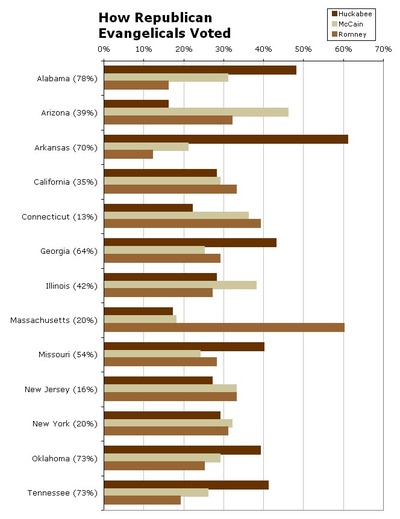
Here’s what the evangelical breakdown looks like so far. (Click for a larger version.)
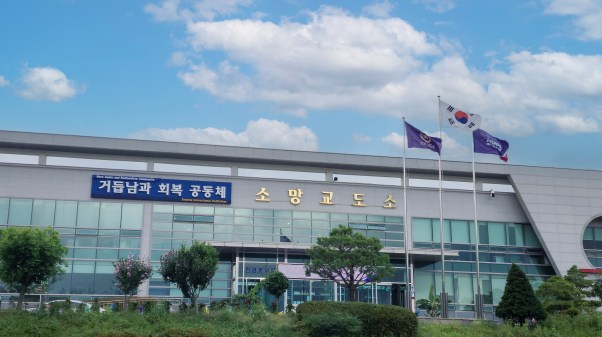
 A week after a prominent pastor in China released his viral letter on faithful disobedience amid a government raid on his church, Communist authorities once again shut down worshipers from Chengdu’s Early Rain Covenant Church—one of the most prominent unregistered churches in the country—as well as Guangzhou’s Rongguili Church, one of its first underground Christian communities.
On Sunday, 60 police and religious affairs officials interrupted weekly gatherings at Rongguili, ultimately closing the church, seizing materials, and taking cell phones from attendees, Asia News reported.
“Halfway through the children’s Bible class, we heard the footsteps of dozens of police and officials stomping up the stairs,” one member said, according to the South China Morning Post.
“They read out law enforcement notices declaring our venue was an illegal gathering [that had engaged in] illegal publishing and illegal fundraising and confiscated all Bibles.”
The Protestant congregation, which now draws more than 5,000 people to worship each week, was founded in the 1970s by the late pastor Samuel Lamb; it represents one of the few churches in China dating back to before the Cultural Revolution.
Ahead of Christmas, Chinese authorities have continued their ongoing crackdown on underground Protestant churches, which do not belong to the government-sanctioned Three-Self Patriotic Movement and are illegal under Communist rule. The activity has spurred further concern by US officials and American Christians.
The previous Sunday, December 9, officials shut down Early Rain Covenant Church, arresting more than a dozen Christians, including pastor Wang Yi. After he was detained, the church released Yi’s statement explaining and defending his nonviolent resistance to China’s “evil” and “wicked” rulers.
“I firmly believe that Christ has called me to carry out this faithful disobedience through a life of service, under this regime that opposes the gospel and persecutes the church,” he concluded. “This is the means by which I preach the gospel, and it is the mystery of the gospel which I preach.”
Prior to his arrest, he insisted that, in the event of government interference, the church continue to gather. With their church locked and guarded by police, 50 to 60 people gathered for worship outside this week, only to once again be halted and arrested by officials. World magazine reported from China:
A group of about 50 or 60 Early Rain members held a service in a nearby riverside park, singing hymns, praying, and reciting the first question and answer of the Heidelberg Catechism: “What is your only comfort in life and death? That I am not my own but belong with body and soul, both in life and in death, to my faithful Savior, Jesus Christ.”
Three of Early Rain’s church plants have also suffered persecution over the past week, World wrote. One lost access to their building, one preacher was detained, and another was put under house arrest.
At least 10 Early Rain leaders remain in custody, according to news updates. Those that have been released relayed accounts of being shackled, starved, and tortured while in detention.
“Lord, look at the injustice done against your children,” read a prayer request from Early Rain, shared by the ministry China Aid. “This country is trampling on the dignity of your children, but these children are the apple of your eye. You will heal these wounds with your loving hands and teach us, in the midst of this suffering, the love of God and the endurance of Christ. Lord, come quickly!”
Beijing’s largest unregistered “house church,” 1,500-member Zion Church, was closed in September after refusing a government directive to install security cameras in the sanctuary. This month, another congregation in the Chinese capital, Cathedral of the Immaculate, has been shut down indefinitely for repairs.
Some Catholics consider the repairs to be “a veiled attempt to hamper Christmas celebrations, which attract thousands of people, even non-Christians,” Asia News reported. Others see the repairs as necessary but question the timing during the holiday season.
As CT has reported, government activity against the growing, decades-old underground church movement in China has risen under the current administration, led by President Xi Jingping.
“China isn't backing away from the religious persecution; it seems to be expanding,” said Sam Brownback, the US ambassador-at-large for international religious freedom, last week, when China once again appeared on the State Department’s Countries of Particular Concern list of the world’s worst religious freedom violators.
In February, the Communist Party of China (CPC) officially implemented a wave of tighter regulations designed to preserve Chinese culture and party authority against ideological threats.
“The Chinese government is working furiously to recreate the church in its image,” wrote CT editor-in-chief Mark Galli in an op-ed last month.
“Regulations announced last year formalized policy that has, in practice, been in effect for some years now: Religious leaders are required to ‘conduct religious activities in the Chinese context, practice core socialist values, carry forward the fine traditions of the Chinese nation, and actively explore religious thought which conforms to the reality in China.’”
In certain provinces, the CPC has campaigned to remove Christian symbols from Christians’ homes and replace them with pictures of the president; restricted Christian education for children; and disrupted worship by removing crosses from church buildings, barring access, or destroying them altogether.
It’s in this context that pastor Yi issued his 2,000-word declaration against the government’s attempt to restrict his ministry and the work of Christians across China.
“Regardless of what crime the government charges me with, whatever filth they fling at me, as long as this charge is related to my faith, my writings, my comments, and my teachings, it is merely a lie and temptation of demons,” he wrote in the letter, posted by China Partnership. “I categorically deny it. I will serve my sentence, but I will not serve the law. I will be executed, but I will not plead guilty.
“Moreover, I must point out that persecution against the Lord’s church and against all Chinese people who believe in Jesus Christ is the most wicked and the most horrendous evil of Chinese society,” he continued. “This is not only a sin against Christians. It is also a sin against all non-Christians. For the government is brutally and ruthlessly threatening them and hindering them from coming to Jesus. There is no greater wickedness in the world than this.”