News

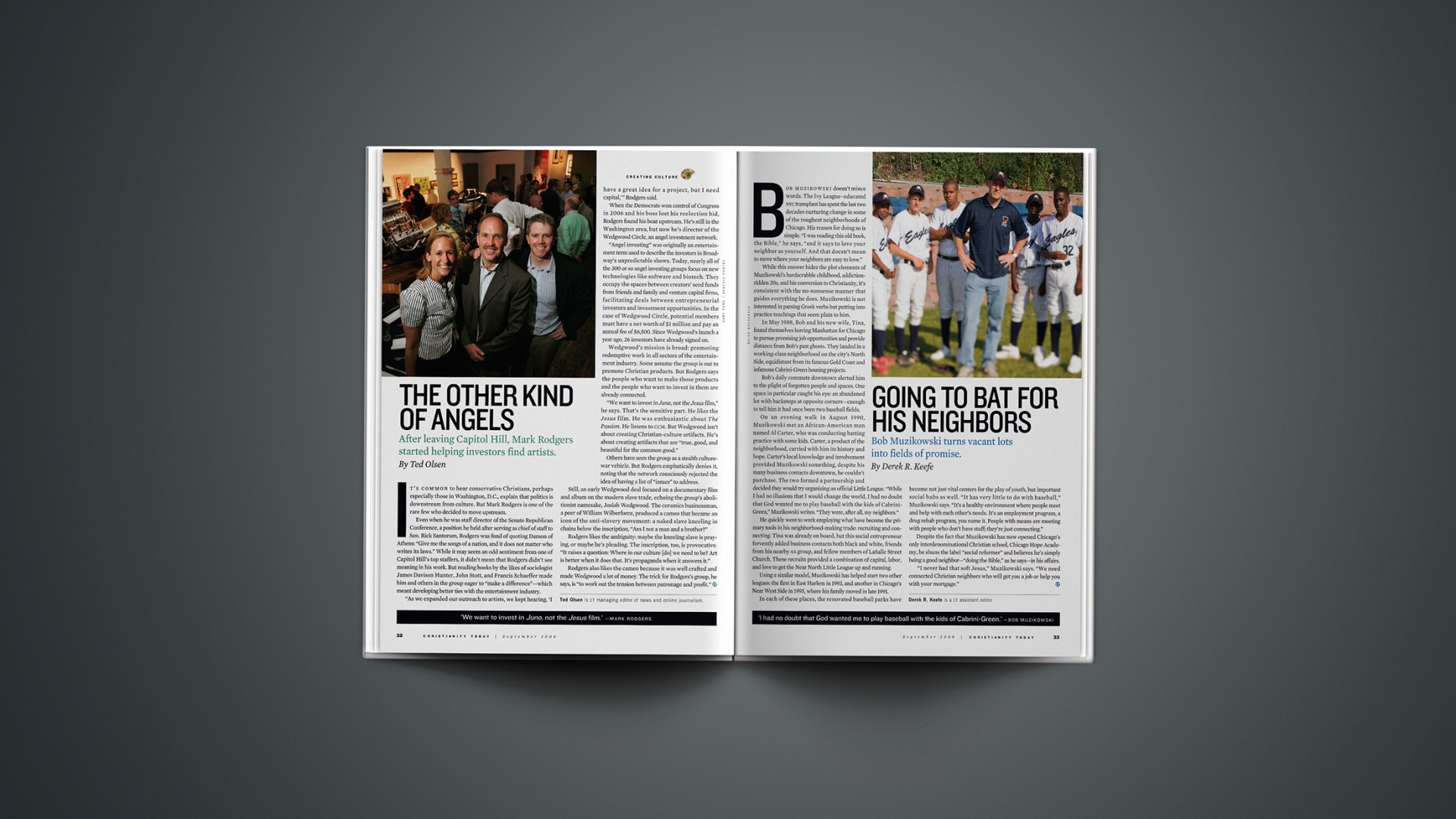
The Other Kind of Angels

After leaving Capitol Hill, Mark Rodgers started helping investors find artists.

It’s common to hear conservative Christians, perhaps especially those in Washington, D.C., explain that politics is downstream from culture. But Mark Rodgers is one of the rare few who decided to move upstream.

Even when he was staff director of the Senate Republican Conference, a position he held after serving as chief of staff to Sen. Rick Santorum, Rodgers was fond of quoting Damon of Athens: “Give me the songs of a nation, and it does not matter who writes its laws.” While it may seem an odd sentiment from one of Capitol Hill’s top staffers, it didn’t mean that Rodgers didn’t see meaning in his work. But reading books by the likes of sociologist James Davison Hunter, John Stott, and Francis Schaeffer made him and others in the group eager to “make a difference”—which meant developing better ties with the entertainment industry.

“As we expanded our outreach to artists, we kept hearing, ‘I have a great idea for a project, but I need capital,’ ” Rodgers said.

When the Democrats won control of Congress in 2006 and his boss lost his reelection bid, Rodgers found his boat upstream. He’s still in the Washington area, but now he’s director of the Wedgwood Circle, an angel investment network.

“Angel investing” was originally an entertainment term used to describe the investors in Broadway’s unpredictable shows. Today, nearly all of the 300 or so angel investing groups focus on new technologies like software and biotech. They occupy the spaces between creators’ seed funds from friends and family and venture capital firms, facilitating deals between entrepreneurial investors and investment opportunities. In the case of Wedgwood Circle, potential members must have a net worth of $1 million and pay an annual fee of $6,500. Since Wedgwood’s launch a year ago, 26 investors have already signed on.

Wedgwood’s mission is broad: promoting redemptive work in all sectors of the entertainment industry. Some assume the group is out to promote Christian products. But Rodgers says the people who want to make those products and the people who want to invest in them are already connected.

“We want to invest in Juno, not the Jesus film,” he says. That’s the sensitive part. He likes the Jesus film. He was enthusiastic about The Passion. He listens to CCM. But Wedgwood isn’t about creating Christian-culture artifacts. He’s about creating artifacts that are “true, good, and beautiful for the common good.”

Others have seen the group as a stealth culture-war vehicle. But Rodgers emphatically denies it, noting that the network consciously rejected the idea of having a list of “issues” to address.

Still, an early Wedgwood deal focused on a documentary film and album on the modern slave trade, echoing the group’s abolitionist namesake, Josiah Wedgwood. The ceramics businessman, a peer of William Wilberforce, produced a cameo that became an icon of the anti-slavery movement: a naked slave kneeling in chains below the inscription, “Am I not a man and a brother?”

Rodgers likes the ambiguity: maybe the kneeling slave is praying, or maybe he’s pleading. The inscription, too, is provocative. “It raises a question: Where in our culture [do] we need to be? Art is better when it does that. It’s propaganda when it answers it.”

Rodgers also likes the cameo because it was well crafted and made Wedgwood a lot of money. The trick for Rodgers’s group, he says, is “to work out the tension between patronage and profit.”

Ted Olsen is CT managing editor of news and online journalism.

Copyright © 2008 Christianity Today. Click for reprint information.

Related Elsewhere:

Wedgwood’s website has more information.

This article is the third of five profiles in Christianity Today‘s cover package on “The New Culture Makers.”

Christianity Today also wrote about artist Makoto Fujimura and the Prison Entrepreneurship Program.

Crouch spoke with CT about culture making on a local scale.

Also in this issue

The CT archives are a rich treasure of biblical wisdom and insight from our past. Some things we would say differently today, and some stances we've changed. But overall, we're amazed at how relevant so much of this content is. We trust that you'll find it a helpful resource.

Cover Story

Creating Culture

Hope for Troubled Times

Compiled by Richard A. Kauffman

When a Professor of Aramaic Meets Hollywood

Ariel Sabar

The Ironic Faith of Emergents

Scot McKnight

McLaren Emerging

Scot McKnight

My Top 5 Books on Food

Stephen H. Webb, author of 'Good Eating'

Bookmarks

John Wilson, editor of 'Books & Culture'

On the Grand Canyon Bus

News

It's Primetime in Iran

Christopher Lewis

News

Looking for Home

Christopher Lewis

Review

Girls on Display

Todd C. Ream and Sara C. Ream

Missionary Myths

Theology in Aisle 7

News

The Father of Faith-Based Diplomacy

Rob Moll

Should I Fish or Lay Low?

Carolyn Nystrom

News

Richard Foster on Leadership

By Richard Foster

A Life Formed in the Spirit

Review

Debauchery and Crucifixes

Andy Whitman

News

Quotation Marks

News

Prayer at the Pump

A Christianity Today Editorial

News

Go Figure

News

Going to Bat for His Neighbors

Derek R. Keefe

Choosing Celibacy

Marcy Hintz

Wire Story

Sunday Drivers

Ashly McGlone, Religion News Service

News

For the Love of Lit

News

No More Shortcuts

Brad A. Greenberg

News

Re-Imagining Reality

Tim Stafford

Crouch and Culture

Cultivating Where We're Planted

Interview by Derek R. Keefe

News

Caesar's Sectarians

A Christianity Today Editorial

News

Healing ORU

John W. Kennedy in Tulsa

Missional Misstep

David Fitch

News

'Dead Sea Scrolls on Stone'

Gordon Govier

News

Translation Tiff

Jocelyn Green

News

Leaving Lakeland

Cary McMullen, 'The Ledger of Lakeland'

News

Undue Attention in Algeria

Compass Direct News

News

The Party of Faith

Sarah Pulliam

News

Salvation through Buddhism?

Sarah Eekhoff Zylstra

View issue

Our Latest

The Russell Moore Show

A Reading of Luke 2

Voices across Christianity Today join together to read the Christmas story found in Luke 2.

How Pro-life Groups Help When a Baby’s Life Is Short

Adam McGinnis

Christian groups offer comfort and practical support for expectant families grappling with life-limiting illness.

Hark! The Boisterous Carolers Sing

Ann Harikeerthan

I grew up singing traditional English Christmas hymns. Then I went caroling with my church in India.

“Christian First, and Santa Next”

Even while wearing the red suit, pastors point people to Jesus.

The Bulletin

The Christmas Story

The CT Media voices you know and love present a special reading of the Christmas story.

My Top 5 Books on Christianity in East Asia

Insights on navigating shame-honor cultural dynamics and persecution in the region.

A Rhythm of Silence and Solitude

Our culture rewards the sharpest take, but two spiritual practices can help Christians show up better in the public sphere.

What Rosalia’s ‘LUX’ Reveals About Religion Today

Christina Gonzalez Ho and Joshua Bocanegra

Young women score higher in “spirituality” than young men, but they’re leaving the church in droves. That comes through in recent releases like this one. 

Apple PodcastsDown ArrowDown ArrowDown Arrowarrow_left_altLeft ArrowLeft ArrowRight ArrowRight ArrowRight Arrowarrow_up_altUp ArrowUp ArrowAvailable at Amazoncaret-downCloseCloseEmailEmailExpandExpandExternalExternalFacebookfacebook-squareGiftGiftGooglegoogleGoogle KeephamburgerInstagraminstagram-squareLinkLinklinkedin-squareListenListenListenChristianity TodayCT Creative Studio Logologo_orgMegaphoneMenuMenupausePinterestPlayPlayPocketPodcastRSSRSSSaveSaveSaveSearchSearchsearchSpotifyStitcherTelegramTable of ContentsTable of Contentstwitter-squareWhatsAppXYouTubeYouTube