I’ve never had much of a desire to travel through time. Let’s just let the past, with all its mistakes and bad haircuts, stay in the past, I’ve always thought. Until now. As the ending credits of The Time Traveler’s Wife were rolling, I had a sudden urge to slip back a year or so to tell the film’s screenwriter and director that the fruit of their labor was going to frustrate audiences nationwide if they didn’t add a few more scenes early on.
But, sadly, no.
Instead The Time Traveler’s Wife starts with a car driving through a snowy, sleepy little town. There’s a mom in the front seat and what appears to be a girl in the backseat, until the mom calls the child Henry (see what I mean about those haircuts?). They’re singing Christmas songs together until their sedan looks like it’s going to smash head-on into a semi. But before it does, the boy slowly disappears.
We next see him a few yards and a few moments away, shaken and a bit scratched up, but fine. The car wreckage, which presumably still contains his mom, is smoking in the background. He’s talking to a man who tells him he’s a future version of himself and that everything’s going to be okay.
Then the grown-up Henry (Eric Bana) dissolves and reappears—naked—in the back stacks of a large Chicago library. There’s a pile of clothing nearby, which he quickly puts on before going back to his post at the desk to deliver a book to a patron.
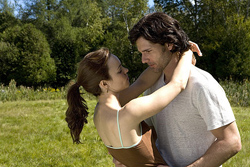
His next customer is a young woman, Clare (Rachel McAdams), who recognizes him instantly, even though she’s a stranger to him. Clare convinces Henry to have dinner with her that night, where she tells him, “Your future is my past. For you, none of it has happened yet. But for me … I’ve known you since I was six.”
Um, what? you’re likely thinking.
Precisely.
In retrospect (and after reading the production notes), I realize the writers and directors were trying to give us, the audience, the disjointed feeling of time travel in the opening scenes of the film. But unfortunately, the effect is simply disjointed. And, I would tell the year-or-so-ago versions of the writer and director, we don’t show up to a movie like The Time Traveler’s Wife to experience time travel, we show up to experience a story. To meet compelling characters. To watch the magical process of them falling in love. And to see how they handle the requisite challenges they’ll face in our hour and a half journey with them.
Without the proper introductions, we aren’t invested in Henry and Clare. We don’t care about them or what happens to them. So the movie starts to feel like being thrust into the middle of a game without being told any of the rules or objectives. Or, perhaps even more fitting, it’s like an arranged marriage. Details first, emotion later.
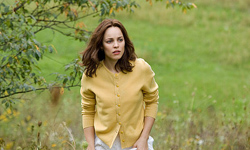
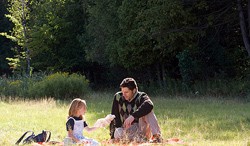
So we don’t quite understand why Clare keeps staring all moony-eyed at Henry (other than the fact that he’s, you know, Eric Bana) throughout the film because we never really see them fall in love. Oh sure, we flash back to the meadow where six-year-old Clare is settling into a solo picnic only to be interrupted by a rustling in a nearby bush. Turns out it’s a naked man. She hands him her blanket, he says he’s from the future and that he’ll be back next Tuesday, then he disintegrates. It’s more odd than magical. We bounce back and forth throughout time and throughout their relationship for the rest of the film.
But we’re left with questions: Why does Henry travel through time? Why does everyone seem to just accept this? Why must he always arrive naked? How does he keep conveniently finding clothes exactly his size upon arrival? And, most importantly, why do Henry and Clare love each other?
What’s so frustrating about not having this last question explained (which, if done well, would have made us overlook all the other questions) is that this could have been a truly lovely film. It’s based on the 2003 bestselling and beloved book by Audrey Niffenegger. It stars the radiant Rachel McAdams, who positively shimmers through most of the movie. And Eric Bana, who, though somewhat lackluster here, does an apt job. These likeable stars are set in sumptuous scenes, creating almost picture-postcard-like images.
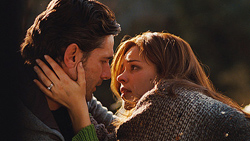
And there are intriguing themes to explore here. What would you say to a previous version of yourself? Would you play those winning lotto numbers? Do you really have free will if you’ve seen the future and know you can’t change it?
Most intriguing is watching a couple slip in and out of different time periods in their relationship. Henry disappears momentarily on his honeymoon night only to find himself on his second meeting with young Clare in that meadow. Years later, after a big fight, Clare is visited by a younger Henry, who hasn’t yet experienced the events that spurred their argument. It’s one thing to remember a first date decades into a marriage, it’s quite another to go back and experience it again. What an intriguing way to illustrate that all those experiences—good and bad, young and old, naïve and wise—are there, intermingled, in a life-long love.
By the end I was finally invested in Henry and Clare. I did care. But soon after, the credits started rolling and I was left wishing the good people behind The Time Traveler’s Wife had pulled me in about an hour and a half sooner. All the elements are there, just a bit too jumbled in time.
Talk About It
Discussion starters- If you could go back ten years in time and visit yourself, what would you say? If you could go back and relive one event in your life, what would it be? Would you do it differently, if you could?
- How does the time travel impact Henry and Clare—individually and as a couple? What emotions does it stir in each of them? What sacrifices and concessions does it require? How do these emotions and sacrifices impact their relationship—both positively and negatively?
- Discuss the role of free will in the film. Does it exist?
- There are characters in The Time Traveler’s Wife who know about events in the future and those who don’t. How does the knowing or not knowing impact each character? Who’s better off?
The Family Corner
For parents to considerThe Time Traveler’s Wife is rated PG-13 for thematic elements, brief disturbing images, nudity and sexuality. We see both Eric Bana and Rachel McAdams fully naked from behind. They sleep together after he’s known her about a day—and she’s kind of known him about 15 years. One character is seen naked and bleeding—from a gunshot wound—in a couple scenes. Two different childhood characters experience the death of a parent. Henry’s father has a drinking problem. And Henry keeps dissolving, which could be a disturbing image for younger viewers.
Photos © New Line Cinema
Copyright © 2009 Christianity Today. Click for reprint information.