





Say you’re a hotshot investigative journalist, a rising star in a Shreveport, Louisiana television newsroom, but due to budgetary restraints you’ve been relegated to covering soft stories—dog obstacle course races and coffee taste tests. But you’ve been watching, and you have a hunch that the District Attorney, who is running for governor, is dirty. Something just doesn’t check out about the guy. He’s too smooth. His history seems implausible. Every one of his cases seems to be won with DNA evidence. But you’re dating one of his underlings.
So you and your buddy concoct a plan to plant circumstantial evidence that will lead to wrongful indictment in a murder—and you plan to indict yourself. Then you can catch him in the act and prove his guilt. And maybe you’ll win a Pulitzer for your daring work.

But these things never go quite according to plan.
Sometimes I see a film that isn’t very good—maybe the acting is a bit stilted, or the writing is overly ambitious and twisty, or the story never quite clicks into place—but it’s clear that the director had an ambitious vision that simply exceeded his budget or slipped out of his grasp. It’s not quite a good movie, but I can tell that there’s something special about it, and so I can enjoy it.
Beyond a Reasonable Doubt is not that movie.
It’s a remake of the last American film by Fritz Lang (Metropolis, M, The Big Heat), who helped to kick-start the film noir genre by establishing such conventions as a moral ambiguity, moody lighting, and psychological conflict. Lang purportedly made the film to prove a point about the insufficiency of circumstantial evidence in court cases.

That goal is certainly accomplished by this remake, but it’s trying way too hard to be a noir film from the ’50s, while still using some thoroughly modern action movie techniques. The quippy exchanges and snappy flirtations, which might have worked if they had been pushed a bit further (see Rian Johnson’s excellent Brick for a successful modern noir), sound strange rolling off these characters’ tongues. There are altogether too many fast-paced montages to swelling music. You feel jerked around by the story too much, and without much charm to compensate. It just doesn’t work.
Michael Douglas, as you might expect, is the best thing in this movie—eerily, in fact, as if he’s floated in from the original. Amber Tamblyn is completely adequate, but you know she’s better than the movie lets her be. Surprisingly, Jesse Metcalfe fits the role fairly well, but this kind of leading-man role is beyond his league. Neither Tamblyn nor Metcalfe seem to comfortably fit into their scripted conversations, and at times their impassioned pleas to one another are hopelessly melodramatic.
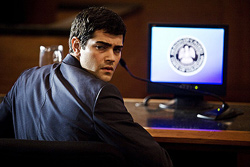
Beyond a Reasonable Doubt is not a total miss. The story has all the elements of a fun action-suspense flick: courtroom drama, cops, politicians, prisons, newsrooms, explosions, car chases, comedy, violence, romance, and a cast of amusing secondary characters. Its plot twists are twisty indeed. The story unfolds fast. You won’t be bored.
And it does, in fact, show the shaky ground on which our legal system can stand—especially in today’s digitally dependent world. All it takes is a couple of crooked, power-hungry people to play the system to their own advantage, leaving the most vulnerable members of society to deal with the consequences. Lang would probably be pleased that his goal is accomplished.
But while Beyond a Reasonable Doubt could have been a staggeringly good film, with a brilliantly parallel narrative and some gut-wrenching twists, it is gimmicky, weak, and not convincing enough as a film to be believable as a story. What a shame.
Talk About It
Discussion starters- Several characters in this story are trying to hide their sins and take advantage of others for their own advancement. Read Genesis 4 and Joshua 7. What happens to people who try to hide what they have done?
- What do you think of C.J.’s plan? Was it right? Were his aims pure?
- How do characters in the film treat some of society’s rejects—the homeless, the poor, the prostitutes? Do you ever find yourself regarding people as props for your own advancement, rather than just as people?
The Family Corner
For parents to considerBeyond a Reasonable Doubt is rated PG-13 for a sex scene, violence and brief strong language. There’s one f-bomb in the movie, uttered at a key moment, but there are many other lesser profanities sprinkled liberally throughout. You don’t see anything in the sex scene, but it’s clear what’s going on. The film’s violence is more scary than graphic.
Photos © Anchor Bay
Copyright © 2009 Christianity Today. Click for reprint information.









