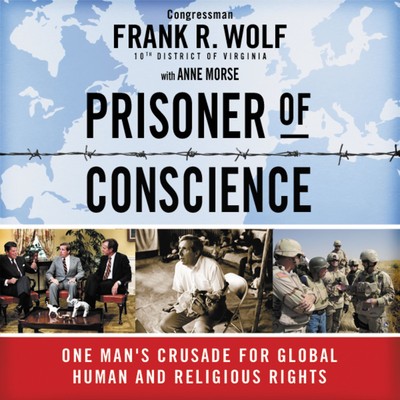
Congressman Frank Wolf, a Virginia Republican, has been an outspoken advocate for international human rights for the past 30 years. In July, the House of Representatives passed his bill, cosponsored by Rep. Anna Eshoo (D-CA), to appoint a special religious freedom envoy to the Middle East and Central Asia. In his new book, Prisoner of Conscience: One Man's Crusade for Global Human and Religious Rights (Zondervan), Wolf discusses human rights issues from the 1980s onward, and recounts his many visits to hotspots around the world. Wolf spoke with ct contributing editor Susan Wunderink about the role churches and the U.S. government can play in improving international human rights.

Why do you say, "America—and especially our churches—is failing the oppressed peoples of the world"?
I meet many people who are baffled and concerned that the West doesn't seem to be that interested in their plight. Three nuns from Iraq just came to my office. They said they feel abandoned. Half the Christian community in Iraq is now living in ghettos in Damascus, Lebanon, and Jordan.
I was in Egypt last month. The United States has given the Egyptian government over $50 billion [since the late 1970s]. And yet the Coptic Christians have been persecuted during that time. If you're a Coptic Christian in Egypt, you can't get a government job, and you can't be in the military. They wonder why the church in the West hasn't spoken out.
The church in Sudan has suffered persecution. In southern Sudan, 2.1 million people have died—mainly Christians, but also some Muslims and some animists. I had one woman tell me, "The West seems more interested in the whales than in us."
In China, you have roughly 30 Catholic bishops who have been arrested. You have hundreds of Protestant pastors and house church leaders being imprisoned and persecuted. And nobody in the West advocates for China's Uighur Muslim minority.
Should we be publicizing these issues and bringing them up with our legislators?
Not only should churches in the West be advocating and praying for persecuted believers, but everyone should be advocating for religious freedom. During the 1980s, when Secretary [of State George] Shultz would go to China, he would meet with the dissidents or with their families. The American embassy was an island of freedom. We don't see that same passion today, either within or outside the church.
Some argue that China, for instance, needed to prioritize economic rights—pulling people out of extreme poverty—before it could make progress on political rights, like assembly or free speech.
I would not agree with that. There have been economic gains in China, clearly. But people in the rural areas are living in tremendous poverty. So there has been some improvement, but in terms of human rights and religious freedom, things are actually worse in China over the past 10 to 15 years. Leaders of the house churches wonder why we are not advocating more for them.
How is the United States' influence different now than it was during the cold war?
I think the United States has lost a lot of influence, because Western leaders have not advocated the way Jimmy Carter, Senator Henry "Scoop" Jackson, and Ronald Reagan once advocated for human rights.
Reagan, in 1983 [at the annual convention of the National Association of Evangelicals], called the Soviet Union the "Evil Empire." I've been to a gulag camp where the prisoners learned about Reagan's statement.
Today, there is not the passion or the commitment on the part of elected officials or business leaders to speak out on behalf of the persecuted. I think America has lost much of its influence partially because our leaders aren't articulating human rights as a driving issue.
Your book also addresses reducing the U.S. debt and improving our country's economic competitiveness. How do those issues tie into human rights?
As America becomes weak, our largest creditor is China. Our second-largest creditor is Saudi Arabia, whose leaders fund the messages and institutions of radical Wahhabi Islam.
Our Declaration of Independence and Constitution should stand as a covenant not only between American citizens, but also between America and a Chinese dissident in Beijing, a Coptic Christian in the upper Nile, or a Chaldean who's being gunned down in Iraq. By maintaining economic ability to deal with issues of persecution, America can still be the dominant power to defend human rights and religious freedom.
Copyright © 2011 Christianity Today. Click for reprint information.
Related Elsewhere:
Prisoner of Conscience is available from ChristianBook.com and other book retailers.
Recent Christianity Today articles on persecution include:
Persecution Prompts Missions Agency to Transform | Operation Mobilization India transforms itself into a local witness. (October 21, 2011)
Reports: Iran Pastor's Case Sent to Khamenei | Courts avoid decision in apostasy case, may hear further appeal. (October 12, 2011)
Christians Killed, Injured in Arab Spring Fallout | The bloodiest day since Egypt's uprising was caused by a peaceful Christian protest. (October 10, 2011)
Zimbabwean Churches Told to Support Ruling Party—or Else | Mugabe regime violently targeting wide spectrum of congregations. (August 10, 2011)
CT also has more music, movies, books, and other media reviews.