First things first: Derek Webb is one of my favorite artists, one of the most creative folks I know. I've long been a fan of his music, his honesty, his commitment to justice, and his willingness to challenge the rest of us in sometimes unexpected ways. He and I have had some good conversations over the years, and he always makes me think – often about things I'd never considered before, or at least in ways I'd never done before.
When Derek released his Feedback album last spring – an instrumental meditation on the Lord's Prayer – I really liked it. Still do. It's terrific music, and while I can't cleanly "connect" every note to a corresponding phrase in the prayer, I was fine with that. It's good music to contemplate, as are Christ's words.
Webb wanted the work of art to extend beyond the music, so he first commissioned painter Scott Erickson for a series of paintings as a companion to the project. I've seen the art, and it's very good.
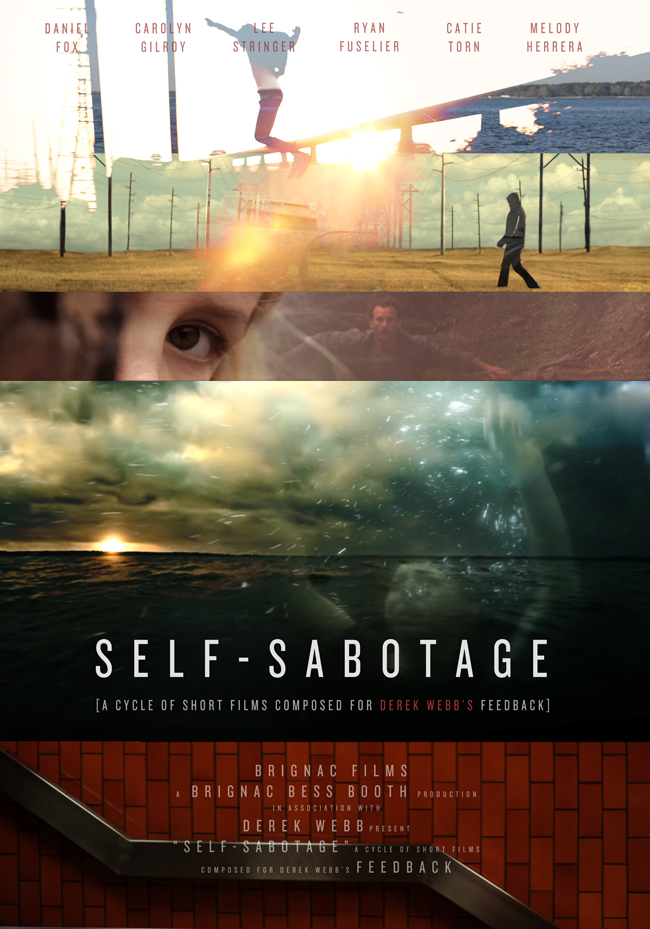
Then Webb wanted to extend the project to the medium of film, and worked with director Scott Brignac to come up with a "cycle of short films" called Self-Sabotage, described as "an exploration of the Lord's Prayer based on and inspired by Derek Webb's Feedback. It follows six characters in a narrative with no words, only the music to parallel the stories. Their lives, like moving icons, open windows into the great mystery of communion through self-dethroning sabotage."
OK, I mostly get that. But frankly, the film itself lost me. I enjoyed the images, and the way they're wedded to the soundtrack. I thought I picked up something about a Father's relentless love for his child, but I might've been wrong about that. I also thought a lot of it was about some nut-job stalking a young woman.
Apparently I'm not alone in my head-scratching. When the film premiered in Houston, Andrew Causey, who moderated a panel discussion afterward, said he had these questions: "Why was that girl dancing in the streets? Who was that guy in the woods? Did one guy just punch himself in the face? Does the girl jump? What does this have to do with the Lord's Prayer? Did the running guy commit a crime? If so, what was it? Why does the creepy guy keep following the sad girl? Why doesn't she spray him with mace?"
Causey was apparently more haunted by the film than I was, because he kept thinking about it, determined to find more meaning behind the abstraction. And, Lord bless him, he has come up with some pretty good insights and ideas here. Perhaps if I gave it repeated viewings, I would come up with some of the same observations – or completely different ones.
I'm no literalist, and I generally don't mind abstractions and ambiguity in art. But Self-Sabotage, though interesting to look at, was just a bit too abstract for me. I just didn't get it.
Check it out below (and/or buy it here). What about you? Do you "get" it?
SELF-SABOTAGE from Scott Brignac on Vimeo.