News

Church and State (Dept.): John Kerry Gets Religion

New adviser will (hopefully) make faith less foreign in foreign affairs.

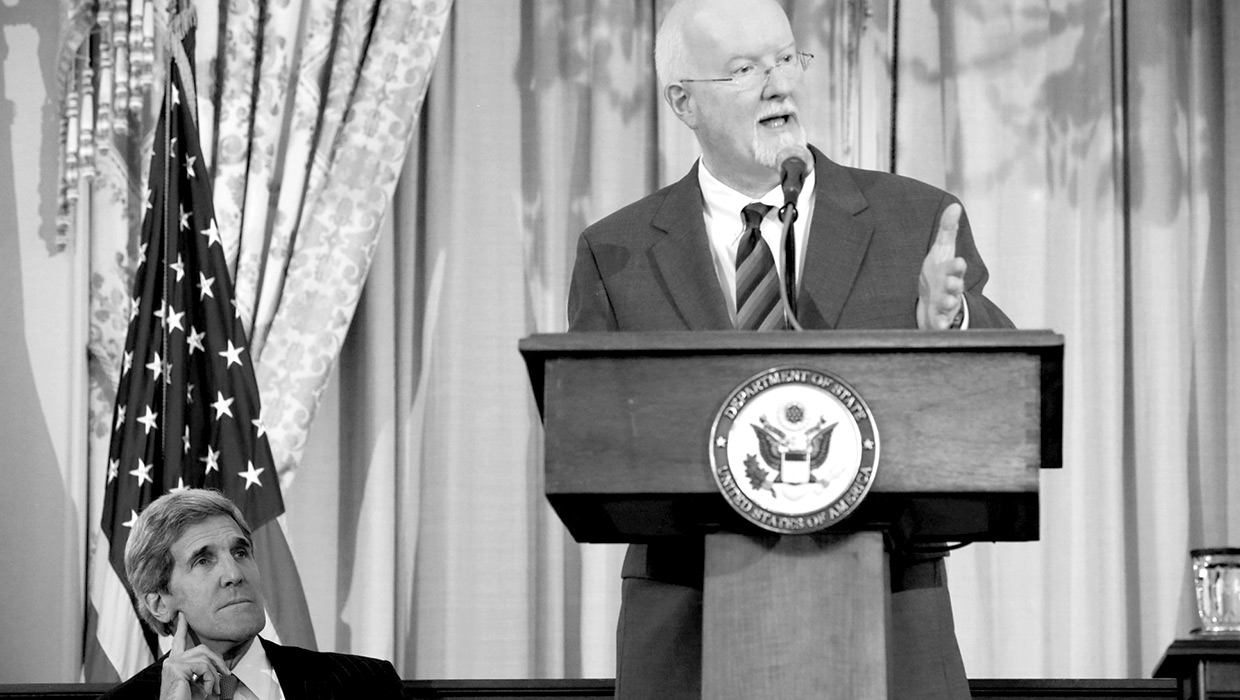
Chip Somodovilla / Getty

If Secretary of State John Kerry were heading to college today, he'd study comparative religion. "That's how integrated it is [into] everything," he remarked in August.

Redoing college isn't an option for Kerry, who studied political science at Yale. But he's serious about religion. Kerry didn't waste any time launching the State Department's faith-based initiatives office just months into his appointment. To lead the office, Kerry selected his friend Shaun Casey, a professor of Christian ethics at Wesley Theological Seminary.

"My understanding is, in that first meeting, Kerry leaned over to a staff member and said, 'Let's get Shaun in here,' " said Casey, who grew up in the Church of Christ and previously coordinated evangelical outreach for President Obama.

Appointed through the end of Obama's term, Casey will be the first adviser to the secretary of state on the religious dimension of foreign affairs. He told ct that his new office will advise the secretary, help diplomats engage people of various religions, and teach faith-based groups to bring their views to bear on U.S. foreign policy.

Diverse groups from the Chicago Council on Global Affairs to the International Religious Freedom Roundtable have been suggesting such an office for years. In 2012, a white paper from the Interagency Working Group on Religion and Global Affairs made recommendations that appear to have been used as a blueprint for the office.

Before this summer, the State Department had its own Office of International Religious Freedom and worked with the U.S. Commission on International Religious Freedom (USCIRF), an independent advisory body. It also had an ambassador-at-large for international religious freedom until the presidential appointee, Suzan Johnson Cook, resigned in October.

Yet none of these offices examined issues beyond religious freedom. Nor did they report directly to the secretary of state, says Institute for Global Engagement president Chris Seiple. He said the fact that Casey directly advises Kerry on a wide range of religious topics is a good sign that the State Department is taking religion seriously.

The new office is a clear conduit for religious communities to speak into broader issues—such as peace and development—that fall outside the issue of religious freedom, says Knox Thames, director of policy and research at USCIRF.

But not everyone is optimistic about Casey's appointment. Thomas Farr, who teaches religion and international affairs at Georgetown University, says the new office perpetuates an existing problem: American foreign policy—characterized by "the appearance of motion" on religious issues—is still not promoting religious freedom.

"There is ample reason to wonder why the goal [of engaging religion] cannot be achieved by a vigorous, effective IRF policy," said Farr, who directs the Berkley Center's Religious Freedom Project.

But Judd Birdsall, a former U.S. diplomat and current PhD candidate at Cambridge University, says religious freedom policy doesn't encompass the whole picture. He says religious freedom and religious engagement are like overlapping circles: distinct but complementary, and mutually reinforcing if executed properly.

"If engagement is done well," he said, "it can foster greater respect between religions and governments."

Other critics say the office blurs the line between church and state. Casey says there's no conflict because faith-based groups don't seek funding from his office.

Still, he understands the nervousness. He says leaders are being scrupulous about the First Amendment and not discriminating against any groups—200 have visited the office in the first 12 weeks.

"No one has been angry that we opened up shop," he said. "They now feel like they have access, and they understand how we might partner to advance diplomacy."
Also in this issue

The CT archives are a rich treasure of biblical wisdom and insight from our past. Some things we would say differently today, and some stances we've changed. But overall, we're amazed at how relevant so much of this content is. We trust that you'll find it a helpful resource.

Cover Story

New Life After the Fall of Ted Haggard

Patton Dodd

Cover Story

Letting Pastors Be Real

Reply All

Testimony

How I Escaped the Mormon Temple

Lynn Wilder

The Gift of Being Evangelical

Laura Turner

Peace and Goodwill? 'Bah, Humbug,' Says the Holy Spirit

Biblical Adoption Is Not What You Think It Is

Three Views: Why Confess Sins in Worship When It Seems So Rote?

Kathleen Norris, John D. Witvliet, Enuma Okoro

Editorial

Four Powerful Ways to Solve the Crisis in Orphan Care

Timothy C. Morgan

Miracle of Science: 65 Diseases Treated With Adult Stem Cells

Bob Smietana

Perfecting 'The Ask'

Harold Smith, President and CEO

Trauma Counseling for Christian Journalists

Christ In Color

Timothy L. Hall

Meet the Christian Reporter Climbing the Ladder at The New York Times

Interview by Paul Glader

The Scary Truth About Christian Giving

Interview by Rob Moll

Review

Stop Blaming 'The Culture' for Our Distorted View of God

James K. A. Smith

Review

What Birmingham Means Today

Review by Michael O. Emerson

Eric Metaxas: My Top 5 Books for Nonbelievers

Eric Metaxas

New & Noteworthy Books

Trading Tracts for Trafficking

Photo by Kyle Van Etten / InterVarsity Christian Fellowship / USA

News

YouTube's Blocked Testimony

Ken Walker

News

Help the Persecuted Stay? Or Help Them Move?

Kate Tracy

News

Gleanings: December 2013

News

Should Christian Colleges Encourage Students to Marry Each Other?

News

Why So Many Christians Are Relaxing Over Drinks

Kevin P. Emmert

View issue

Our Latest

Public Theology Project

Christians, Let’s Stop Abusing Romans 13

Believers often use the passage to wave away state violence, but that’s the opposite of what Paul intended.

News

The 50 Countries Where It’s Most Dangerous for Christians in 2026

From Syria to Sudan, believers around the world face increasing oppression and persecution.

Christian Writer Daniel Nayeri Dreams from Home

Jonathon Crump

Lying on the floor of his mauve-walled writing shed, the celebrated YA author writes himself around the world.

The Russell Moore Show

Martin Shaw on the Liturgy of Myth

What do myth, wilderness, and ancient story have to teach a culture drowning in information but starving for meaning?

Review

It’s Not Just What We Teach, but How

A new book on public schools—and the public square—looks beyond culture-war battles to deeper questions of pedagogy.

How to Do Your Own Research About Vaccines

A doctor shows how to inoculate yourself against foolishness with a shot of wisdom.

News

As Iran Cracks Down on Protests, Christians Speak Up

This time, believers in the Iranian diaspora are praying more explicitly for the fall of the country’s rulers.

News

The 94-Year-Old Hong Kong Cardinal Fighting for Chinese Freedom

For decades, Cardinal Joseph Zen has stood resolutely against China’s Communist government.

Apple PodcastsDown ArrowDown ArrowDown Arrowarrow_left_altLeft ArrowLeft ArrowRight ArrowRight ArrowRight Arrowarrow_up_altUp ArrowUp ArrowAvailable at Amazoncaret-downCloseCloseEmailEmailExpandExpandExternalExternalFacebookfacebook-squareGiftGiftGooglegoogleGoogle KeephamburgerInstagraminstagram-squareLinkLinklinkedin-squareListenListenListenChristianity TodayCT Creative Studio Logologo_orgMegaphoneMenuMenupausePinterestPlayPlayPocketPodcastRSSRSSSaveSaveSaveSearchSearchsearchSpotifyStitcherTelegramTable of ContentsTable of Contentstwitter-squareWhatsAppXYouTubeYouTube