Episode 10: 'Brothers in Arms'
 NBC
NBCA.D. The Bible Continues says goodbye to Saul, and thus to one of its most fascinating and even endearing characters, in its tenth episode. It also introduces two new characters in ways that might surprise viewers who are familiar with their Bibles.
First, Saul: Ever since he became a believer two episodes ago, Saul has been a surprisingly engaging character, and the series has brought a not-unwelcome touch of humour to his interactions with the apostles, who can't believe that one of their former enemies is now acting like he knows more about the faith than they do.
Saul's take-charge attitude, and the friction between him and the apostles after they accept him as a fellow brother in Christ, aren't exactly spelled out in the passage from Acts on which this episode is based, but you can certainly find these elements in Paul's epistles, all of which were written over a decade after the events of this episode.
Acts 9 tells us that the apostles ultimately sent Saul back to his home in Tarsus because his life was threatened by some Hellenistic Jews, and Paul himself says in Acts 22 that he left Jerusalem because Jesus appeared to him in a vision and told him to do so. But in A.D., the reasons for sending Saul away are somewhat different.
Here, Saul's life is threatened by the Zealots, who are getting ready to confront the Romans over Caligula's intended desecration of the Temple, and the last thing they want is a Jew like Saul running around and telling people that the Temple is irrelevant now because Jesus fulfilled the Law. The Christians in this episode have struck a truce with the high priest Caiaphas and have promised to respect the Temple, and Saul, in this context, is just too much of a wild card; thus, the apostles decide Saul has to go, for everyone's safety.
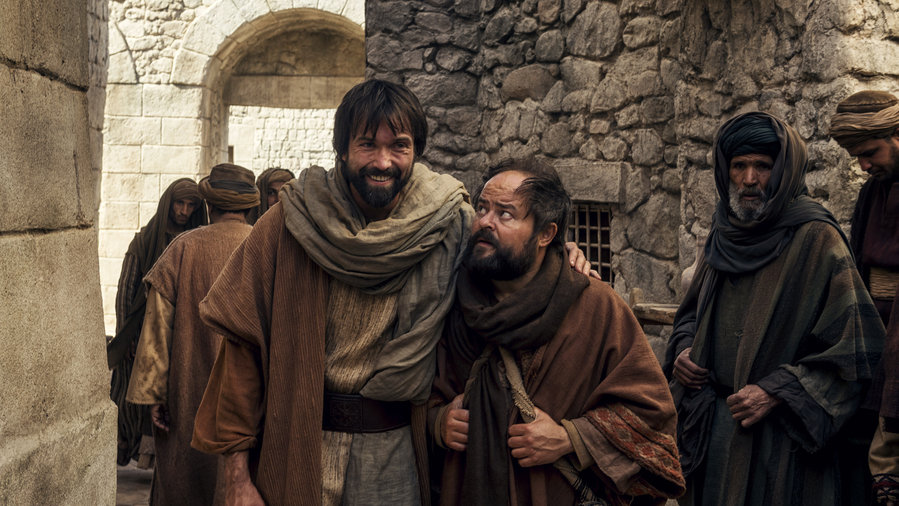
Whatever the reason for Saul's departure, the scene in which he bids farewell to the other apostles is genuinely touching. As played by Emmett J. Scanlan, Saul goes through a range of subtle emotions as he seems to feel alternately rejected and accepted by the apostles; he gives Peter one last hug, and he takes one last little dig at Simon the Zealot. It's a perfect send-off, and it makes me hope that we will get to see these characters meet again some day.
Now, the two new characters.
First of all, there is the Ethiopian eunuch.
 NBC
NBCIf A.D. was telling these stories in the order that they appear in Acts, the eunuch's story would have been told two episodes ago. But instead, he appears here, and he exchanges diplomatic gifts with Caiaphas—and while the eunuch doesn't get around to meeting Philip (yet), he does receive from Caiaphas a copy of the book of Isaiah, which is what the biblical eunuch was reading when Philip met him in Acts 8.
And then the episode does something unexpected, and reveals that the eunuch—who is also the chief treasurer for the Ethiopian queen—has come to Jerusalem to make a rather large financial contribution to the Zealots. Is the Ethiopian kingdom, which lies outside of the Roman Empire, plotting to help kick the Romans out of Judea? Has the eunuch come to Jerusalem to support a mission of violence?
Then there is James, who is identified in the Bible as "the brother of the Lord" but is never quite identified as such in this episode.
The James of this series is clearly some sort of kinsman of Jesus—he grew up with Jesus and says it was he, rather than Mary or Joseph, who found Jesus in the temple when Jesus was 12—but he calls himself a "follower" of Jesus and he calls the apostles his "brothers", which subtly underscores the flexibility of these terms and allows the series to avoid specifying whether James was a half-brother, step-brother or cousin of Jesus.
(Different churches have different beliefs on this subject because of its implications for beliefs about Mary's virginity—and incidentally, have you noticed that we haven't seen Mary for several episodes now? If she were still around, the series might have to take a stand and specify, for example, whether she was James's mother or not.)
 NBC
NBCWhen we meet him, James seems to be an old friend of the apostles, and perhaps one who hasn't seen them since before the crucifixion of Jesus.
The biblical chronology is somewhat different: the brothers of Jesus—presumably including James—did not believe in Jesus during his ministry (John 7:1-5) and actively tried to block it at one point (Mark 3:20-35), but then Jesus appeared to James after the Resurrection (I Corinthians 15:7), and the brothers of Jesus were part of the Christian community by the time Pentecost happened just a few weeks later (Acts 1:14).
Lined up like that, these passages seem to indicate that James underwent a Saul-like conversion: he did not believe in Jesus at first, but then Jesus appeared to him, and then James went on to become a major leader in the Church (not immediately, perhaps, but certainly by Acts 15). But there is no sense of that conversion in A.D., no sense that James has ever been anything but a friend of the gang.
The episode does, however, hint that James will succeed Peter as leader of the Church in Jerusalem at some point in the future. And the episode does depict James as one who thinks Saul is too "radical" for the Church in Jerusalem.
So, from Saul's departure to the introduction of James, A.D. is clearly using its last episodes this season to lay the groundwork for future seasons, when James and Paul will butt heads over the future direction of the Church. Could be interesting. And as mixed as my feelings about this series are, I do hope it is renewed for another season so that we can see that.
 NBC
NBCOne last note: In this episode, the Christian women who work for Pilate and Herodias are exposed and punished. Mary Magdalene gets off relatively easy, and is told to disappear, but Joanna is imprisoned, and Tabitha is flogged by Cornelius as per Pilate's orders.
Acts 9:37—which will be covered in one of the two remaining episodes—says Tabitha simply "became sick and died," but it seems A.D. couldn't just leave it at that, and had to suggest that her future death will be the result of violent persecution. And so the series continues to insert gratuitous violence into the story where it didn't exist before.
But I'm also concerned about the series' depiction of Cornelius. I mentioned this a couple months ago, in my recap of the first episode, but it bears repeating: Acts 10 describes Cornelius (and all his family!) as people who gave money to the poor and prayed to God constantly before they became Christian, and after ten episodes of A.D. we still haven't seen any sign of that. Instead, Cornelius (who does not appear to have a family in this series) has been just another agent of Roman brutality—occasionally a somewhat conflicted one, to be sure, but still.
There are only two episodes left this season, and Cornelius's conversion will supposedly happen in one of them. It will be interesting to see how they try to pull that off.
Peter T. Chattaway writes about films in general, and Bible films in particular, at FilmChat.