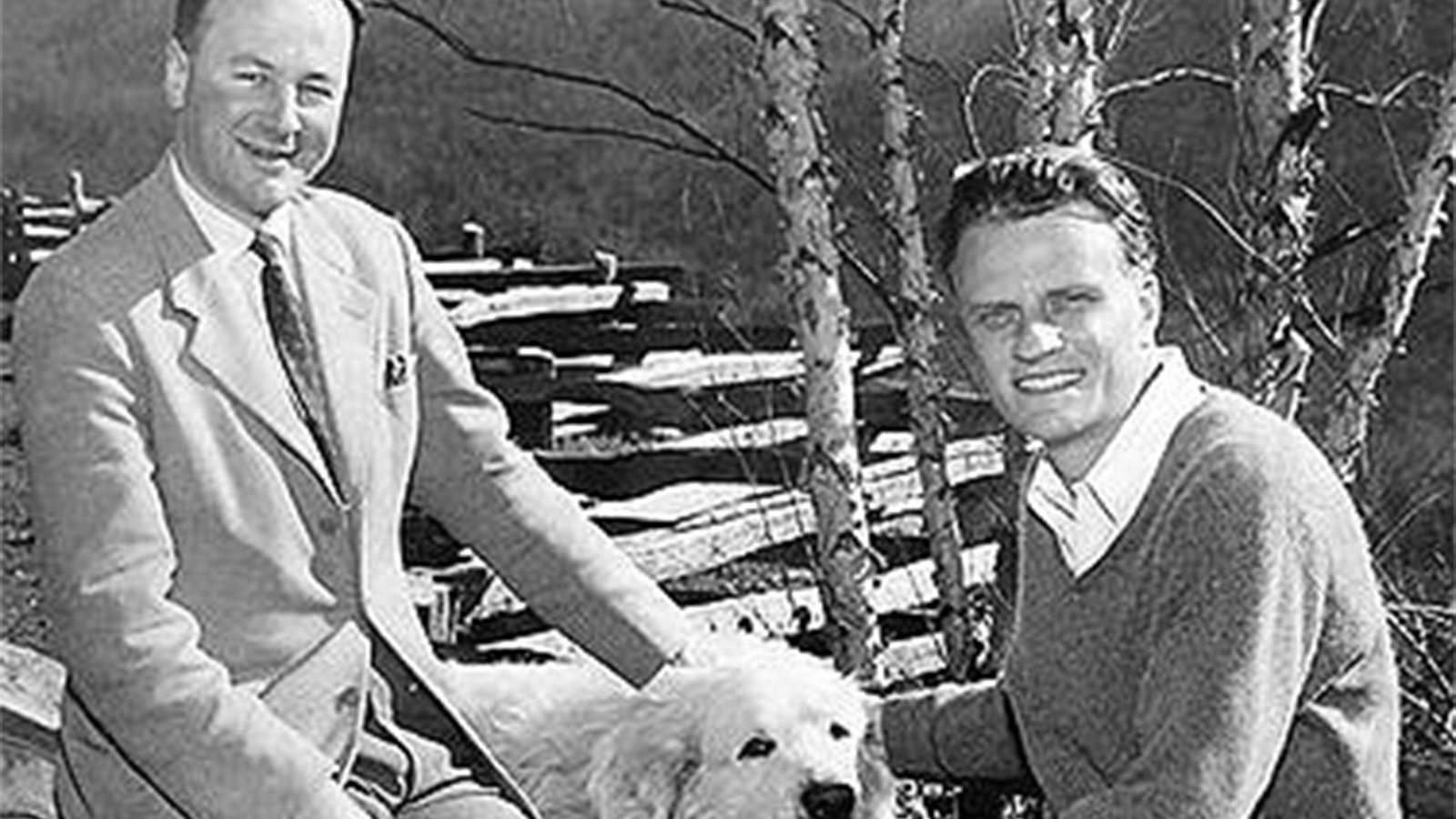

John R. W. Stott first met Billy Graham in the 1940s, while sharing an open-air meeting at Speakers' Corner in London's Hyde Park. Their shared concern for evangelism led to a close association during Graham's 1954 Harringay crusade, which captivated London nightly for nearly three months. Over the next 50 years, the two men's lives would frequently intertwine, through shared leadership in significant ventures like the Lausanne International Congress on World Evangelization and in personal friendship. In 2007, Stott offered these unpublished reminiscences:
Integrity. If I had to choose one word with which to characterize Billy Graham, it would be integrity. He was all of a piece. There was no dichotomy between what he said and what he was. He practiced what he preached.
Finance. When Graham first came to London, a considerable group of church leaders was wondering whether to invite him to preach there. They were critical, but he had anticipated their questions. He was able to say that he received a fixed salary, less than most salaries paid to the senior pastors of large churches, and he received no "love offerings" (unaccounted extras). As for crusade finances, they were published in the press during each crusade.
Sex. Graham was exemplary in his private life. Sometimes he said publicly that he had slept with one woman only, his wife, Ruth. He had no skeletons in any closet.
Harringay. After postponing the close of the Harringay crusade, it went on to last 12 weeks, becoming a remarkable phenomenon. Our church (All Souls, Langham Place) was fully involved, and I went almost every night. Twelve thousand people assembled, night after night, and listened attentively to the message. Each night, I asked myself what brought the crowds, since many of our churches were half-empty. The answer, I thought, was that Graham was the first transparently sincere preacher they had ever heard. There was something authentic about that man. As many media people confessed, "We don't agree with him, but we know he is sincere."
Courage. Few Christian leaders have been granted an audience with successive American presidents, with Queen Elizabeth II, and with many other national leaders. Lesser mortals might well have used such opportunities to boost their own ego, but Graham used them as opportunities for the gospel. He was not afraid of human beings, however exalted in popular opinion.
Study. Graham was always conscious of lacking a formal theological education. But he had a substantial personal library and kept up some regular reading. Speaking to about 600 clergy in London in 1979, Graham startled his audience with two suggestions for how he would change his ministry if he were to start over. First, he would study three times as often and take on fewer engagements. Second, he would give more time to prayer. In making these statements, he must have had in mind the two apostolic priorities of Acts 6:4 ("attention to prayer and the ministry of the word").
Christmas. In November 1955, I had the privilege of serving as Graham's "chief assistant missioner" during his Cambridge University mission. During those ten days our friendship strengthened, and I was touched to be invited to spend Christmas with the family at Montreat. I cherish two vivid memories of that visit. The first was family prayers each day. I saw the world-famous evangelist reading the Scriptures and praying with Ruth and their children. Secondly, we all carried Christmas parcels to a settlement of poor "hillbilly" families on the mountain nearby. In both cases, Graham the mass evangelist was sharing the gospel with small groups.
Message. One important aspect of Graham's preaching was his continuous return to the good news of Christ crucified. Though this habit garnered constant criticism, he refused to be dislodged from gospel essentials. For preparation, he also read several newspapers and had aides scouring them, so he could comment on current events.
Social conscience. Graham accepted the statements of the Lausanne Covenant, which commended both social action and evangelism. Although he knew that his personal vocation was to evangelize, he had the courage to refuse involvement in a South African crusade governed by apartheid strictures. He also had a personally tender social conscience and supported many good social causes.
Influence. He did much (especially through the Amsterdam conference) to encourage younger evangelists. He put evangelism on the ecclesiastical map, making it respectable in a new way. But his influence is perhaps best seen in a new worldwide evangelical unity, manifest in such initiatives as the launching of Christianity Today and the gathering of several global evangelical congresses.
Team. A notable feature of the Billy Graham Evangelistic Association is that it has never been a one-man show. True, Graham was always the main preacher. But the trio of Graham, Cliff Barrows, and Bev Shea always appreciated and supported one another. No traces of jealousy spoiled this cooperation.
John R. W. Stott (1921–2011) was rector of All Souls Church in London, founder of Langham Partnership International, and author of many books, including Basic Christianity and The Cross of Christ.