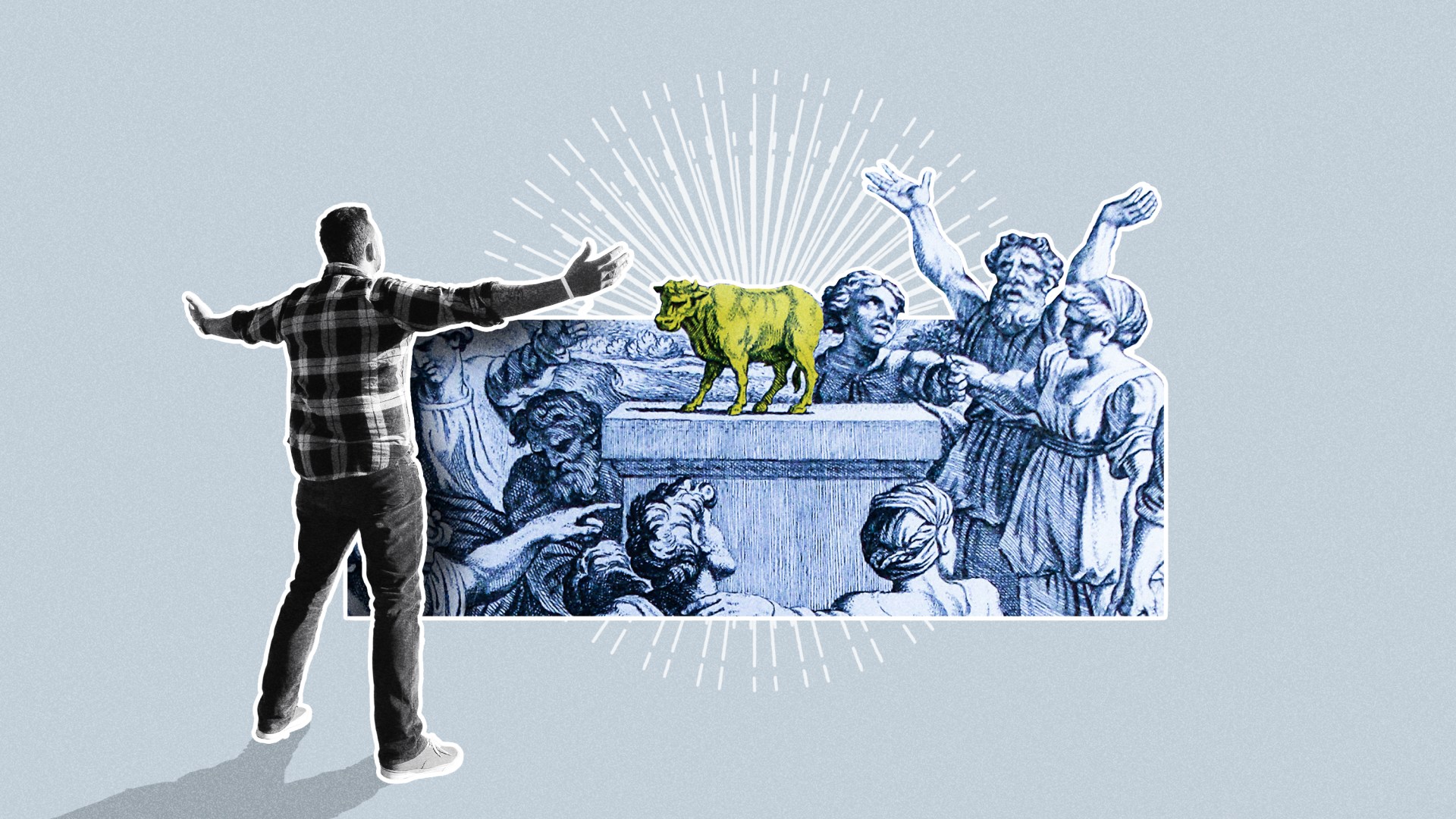

John Calvin famously said the heart is a veritable factory of idols. I used to think this was just typically dark, hyperbolic, Calvinist misanthropy. The older I get, though, the more I concede it to be a sober statement of fact. Idols are our specialty. We churn them out at a furious rate, an extravagant assortment of false gods, deities, and spirits that we’ve cooked up over the centuries. Zeus, Odin, Marduk—some real classics. Our capacity to lie to ourselves about divinity is impressive and extends as wide as creation itself.
More impressive, though, is our pantheon of false images of the living and true God. It’s not for nothing the Ten Commandments quickly move from ruling out the worship of false gods to censuring the false worship of the true God. While the first command is the most basic for a reason, the second is the more insidious and tempting for Christians to break. Satan’s been a liar and murderer from the beginning (John 8:44), and his first trick was to deceive Eve into thinking God is a miser (Gen. 3:4–5).
Our hearts still fall into that same satanic groove, quickly moving from confessing “I believe in God” to talking about “the God I believe in,” to making the most dire and pretentious utterance of all: “I could never believe in a God who…”
Of course, the sad joke is this “God” usually ends up being no more than our own shadows blown up to God-sized proportions. In that sense, Ludwig Feuerbach, a 19th-century philosopher and insightful unbeliever, was on to something when he said all theology is really projection—a roundabout way of describing our own best thoughts of ourselves.
Feuerbach can’t claim all the credit, though. The apostle John tackles this tendency by ending his first letter with the curiously abrupt command, “Dear children, keep yourself from idols” (1 John 5:21). This seems an afterthought until you recognize it’s what the whole letter has been about. “God is light; in him there is no darkness at all” (1:5). John knows that the light that is God the Son “has come into the world, but people loved darkness instead of light because their deeds were evil” (John 3:19). And so we lie to ourselves—and in such diverse and sundry ways!
John recognizes that some of us want to take sin lightly and so make up a God in our own image who minimizes sin, rarely judges, and never punishes. John tells us to stop hoodwinking ourselves. There’s no such God: “No one who continues to sin has either seen him or known him” (1 John 3:6). God is light—pure light, brilliant, fiery, holy light that will not abide darkness in his children.
Sometimes we conjure up a hateful, stony-hearted God, an unyielding prosecutor, a Javert-like jailer who longs to lock us up and throw away the key. And if God is going to be like that, why not settle in the shadows with our sins? But John knows this too, so he reminds us “if we confess our sins, he is faithful and just and will forgive us our sins and purify us from all unrighteousness” (1 John 1:9). Come clean and you’ll be cleansed by Jesus’ blood. Why? Because God is merciful. He is faithful. He is just.
A crowd-favorite way to twist God to our liking is convincing ourselves that he’s on our side when we self-righteously judge our fellow believers, revile them, and break communion with them for being wrong about this tiny doctrinal nuance or that social cause. But again, John reminds us to love one another—even the worst of us—for “whoever does not love does not know God, because God is love” (1 John 4:8). And he made that plain in the Son, whom he sent to be a propitiation for our deepest, blackest, foulest sins on the cross (v. 10).
Over and over again, John corrects the myriad ways we are tempted to turn from the true and living God to the dead idols we’ve made of him. He points us to the Son of God, who came to destroy the deceptive works of the devil (1 John 3:8) and give us understanding, that in Jesus we might know him who “is true God and eternal life” (5:20).
The apostle instructs us still: Keep yourself from idols. Don’t fool yourself about your bent to fabricate a God out of falsehoods. If you say you’re without sin, you make God a liar (1:10). Instead, ask yourself, “What idol am I tempted to make of God?” Humbly confess that sin and look to the cleansing of the Son. Let the light of him who is the truth shine upon you and dispel the darkness.
Derek Rishmawy is the Reformed University Fellowship campus minister at the University of California, Irvine and a doctoral candidate at Trinity Evangelical Divinity School.